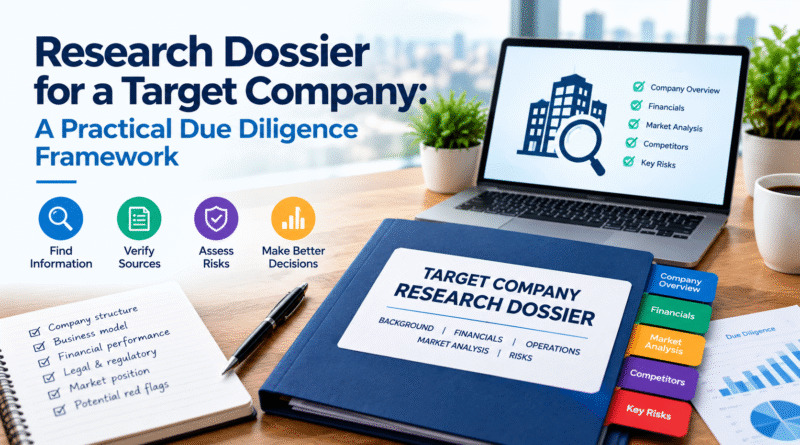
Research Dossier for a Target Company: A Practical Due Diligence Framework
Quick answer: A research dossier on a target company is a structured report that pulls together financial, operational, market, legal, and leadership information about a business you’re evaluating, for investment, acquisition, partnership, or competitive analysis. Its purpose is to replace assumptions with verified evidence before money or a signature is on the line.
The single most common mistake in building one isn’t missing a section. It’s treating a first-pass dossier as if it were completed due diligence, when the two are meaningfully different in depth and legal weight.
Table of Contents
- What a Research Dossier Actually Is
- Research Dossier vs. Due Diligence: The Real Difference
- The Nine Core Sections
- Step-by-Step Build Process
- Where to Source Reliable Information
- Common Mistakes That Undermine a Dossier
- How Different Teams Use the Same Dossier
- Best Practices for Quality Control
- A Simple Dossier Template
- FAQs
1. What a Research Dossier Actually Is
A research dossier is a business intelligence document, not a marketing summary. It’s built to answer specific, often uncomfortable questions: Who actually owns this company? Is it financially stable? What risks could derail its growth? How does it really compare to competitors, not just on paper?
Common triggers for building one include acquisition evaluation, investment decisions, partnership assessment, market expansion research, and structured competitor analysis.
2. Research Dossier vs. Due Diligence: The Real Difference
These terms get used interchangeably, but they’re not the same thing, and conflating them can create a false sense of security before a major transaction.
| Research Dossier | Due Diligence |
|---|---|
| General business investigation | Formal, detailed verification process |
| Supports analysis and early-stage planning | Required before major transactions close |
| Can rely primarily on public information | Often requires confidential, disclosed documents |
| Lower legal and financial stakes | High stakes, frequently involves legal counsel |
A well-built research dossier is often the first stage before deeper due diligence, not a replacement for it. If you’re heading toward an acquisition or significant investment, treat the dossier as your screening tool, and bring in legal and financial professionals for the formal verification that follows.
3. The Nine Core Sections
Company Overview and Background
Founding year, headquarters, ownership structure, products and services, and major milestones. This is the foundation everything else builds on.
Business Model Analysis
Revenue sources, pricing strategy, customer segments, sales channels, and cost structure. A company with fast growth but thin margins needs a very different evaluation lens than one with slow, steady profitability.
Financial Analysis
| Financial Area | What It Reveals |
|---|---|
| Revenue growth | How quickly sales are increasing |
| Profit margin | Operational efficiency |
| Cash flow | Ability to fund day-to-day operations |
| Debt levels | Financial obligations and exposure |
| Valuation | Estimated business worth |
Pull from annual reports, income statements, balance sheets, and investor presentations where available.
Market Research and Industry Position
Industry size, growth rate, customer behavior trends, and macroeconomic factors. A company can look strong in isolation while sitting in a shrinking or rapidly commoditizing market.
Competitor Analysis
Market share, pricing position, product differentiation, brand strength, and demonstrated innovation, typically assembled through SWOT analysis, pricing comparisons, and customer review analysis.
Leadership and Management Analysis
| Leadership Area | Research Focus |
|---|---|
| Founder background | Prior experience and track record |
| Executive team | Roles, skills, tenure |
| Board composition | Strategic guidance and governance |
| Recent leadership changes | Possible signal of transformation or instability |
Frequent executive turnover is a pattern worth flagging, not necessarily a dealbreaker, but a prompt for deeper questions.
Legal and Regulatory Due Diligence
| Category | What to Review |
|---|---|
| Company registration | Legal status and incorporation |
| Trademarks and patents | IP ownership and protection |
| Lawsuits | Current or past legal disputes |
| Regulatory compliance | Industry-specific requirements |
| Contracts | Key business agreements |
Customer and Reputation Analysis
Look for repeated patterns rather than isolated reviews. A handful of one-star reviews rarely tells the whole story; recurring complaints about a specific issue (support response time, product defects) usually does.
Technology and Innovation Assessment
Software platforms, R&D activity, patent filings, automation maturity, and cybersecurity posture, particularly important when evaluating software, fintech, healthcare, or manufacturing businesses where technology is a competitive moat.
4. Step-by-Step Build Process
Step 1: Define the research goal. Investment evaluation, competitor research, partnership assessment, and acquisition analysis each demand a different depth and focus. Decide this before you start collecting, not after.
Step 2: Collect basic company information. Name, industry, headquarters, website, founding year, and core products. This forms your baseline profile.
Step 3: Gather from reliable sources. Prioritize official company sources, government registries, and financial filings over aggregator sites (see the sourcing table below).
Step 4: Analyze, don’t just accumulate. Run a SWOT pass once you have enough material:
| SWOT Category | Example |
|---|---|
| Strengths | Strong brand, loyal customer base |
| Weaknesses | High costs, limited market reach |
| Opportunities | New markets, emerging technology |
| Threats | Increasing competition, regulatory shifts |
Step 5: Structure the final report. Executive summary, company profile, market analysis, financial review, risk assessment, and final evaluation, in that order, so a reader can get the headline in 30 seconds and the depth on demand.
5. Where to Source Reliable Information
| Source Type | Examples |
|---|---|
| Official sources | Company website, investor relations pages |
| Government records | Business registrations, regulatory filings |
| Financial sources | Annual reports, earnings statements |
| Industry sources | Market research reports, trade publications |
| News sources | Established business news outlets |
| Customer sources | Review platforms, verified testimonials |
Record the source name, publication date, and verification status for every data point you pull. This single habit is what separates a defensible dossier from a collection of unattributed claims.
6. Common Mistakes That Undermine a Dossier
Using unverified information. Cross-check figures across at least two independent sources before treating them as fact.
Collecting too much irrelevant data. More pages don’t equal better research. Stay tied to your stated research goal from Step 1.
Ignoring risk signals. A dossier that only highlights positives isn’t research, it’s marketing. Weaknesses and threats belong in every version.
Letting the dossier go stale. Leadership changes, new funding rounds, and legal developments can invalidate a dossier within months. Note the “as of” date clearly and set a review cadence.
7. How Different Teams Use the Same Dossier
- Investors use it to evaluate growth potential and measure downside risk before committing capital.
- Sales teams use it to understand a prospect’s structure, decision-makers, and likely pain points.
- Consultants use it as the evidence base for strategic recommendations to clients.
- Entrepreneurs use it to study competitors and identify gaps in the market.
The same underlying research, structured differently, ends up powering very different decisions.
8. Best Practices for Quality Control
- Define a clear objective before collecting anything
- Use primary, official sources wherever possible
- Date-stamp every financial figure
- Separate verified facts from interpretation and opinion
- Include risks and weaknesses, not just strengths
- Set a re-verification schedule tied to how fast-moving the company or industry is
9. A Simple Dossier Template
- Executive Summary: company background, key findings, top risks, top opportunities
- Company Profile: history, products, locations, ownership
- Market Analysis: industry overview, trends, competitors, customer segments
- Financial Review: revenue, profitability, funding history, financial risks
- Risk Assessment: legal, market, operational, and financial risks
- Final Evaluation: overall potential, key challenges, recommended next steps
A dossier built to this structure should let someone unfamiliar with the company understand its position without repeating your entire research process from scratch.
10. FAQs
What is a research dossier on a target company? A structured report collecting and analyzing key information (financial, operational, market, legal, and leadership) about a specific business under evaluation.
Who typically uses a company research dossier? Investors, business owners, sales teams, consultants, and analysts preparing for partnerships, acquisitions, or competitive positioning.
Can AI help build one? Yes, for organizing information, summarizing long documents, and flagging patterns. Important figures and claims should still be verified against primary sources before being trusted.
How often should a dossier be updated? It depends on the industry’s pace of change. Fast-moving sectors may need monthly or quarterly refreshes; more stable industries may only need updates when a major event occurs.
Is a research dossier the same as due diligence? No. A dossier is typically broader and can rely on public information; due diligence is a formal, detailed verification process usually required before a transaction closes.
What’s the biggest mistake people make when building one? Treating a first-pass research dossier as if it carries the same legal and financial weight as completed due diligence.
