Modern Nightstand: How to Choose the Right Size, Style and Material for Your Bedroom
Direct Answer
A modern nightstand should sit level with the top of your mattress, or within about 2 inches above or below it. Most standard nightstands are 23 to 28 inches tall, 20 to 30 inches wide depending on your bed size, and 14 to 18 inches deep. Choose the height first, then the width, then the style and material — get the size wrong and even the best-looking modern nightstand will feel awkward every night.
Key Takeaways
- Height rule: the top of a modern nightstand should be level with your mattress top, within about 2 inches either way. Measure from the floor to the top of the mattress, including any topper.
- Width by bed: twin beds suit 20–24 inch nightstands, queen beds 20–30 inches, and king beds 24–36 inches when space allows.
- Depth: 14–18 inches is enough for a lamp, phone, book and glass of water without crowding the room.
- Leave a gap: keep 2–6 inches between the bed and the nightstand so you can make the bed and open drawers.
- Style: mid-century modern, Scandinavian, Japandi and minimalist are the most popular modern nightstand styles — and they do not have to match the bed.
- Storage: one drawer plus an open shelf is the most useful everyday layout; drawers hide clutter, shelves keep books in reach.
- Styling: keep about half the surface empty. A lamp, one book and a glass of water is enough.
What Is a Modern Nightstand?
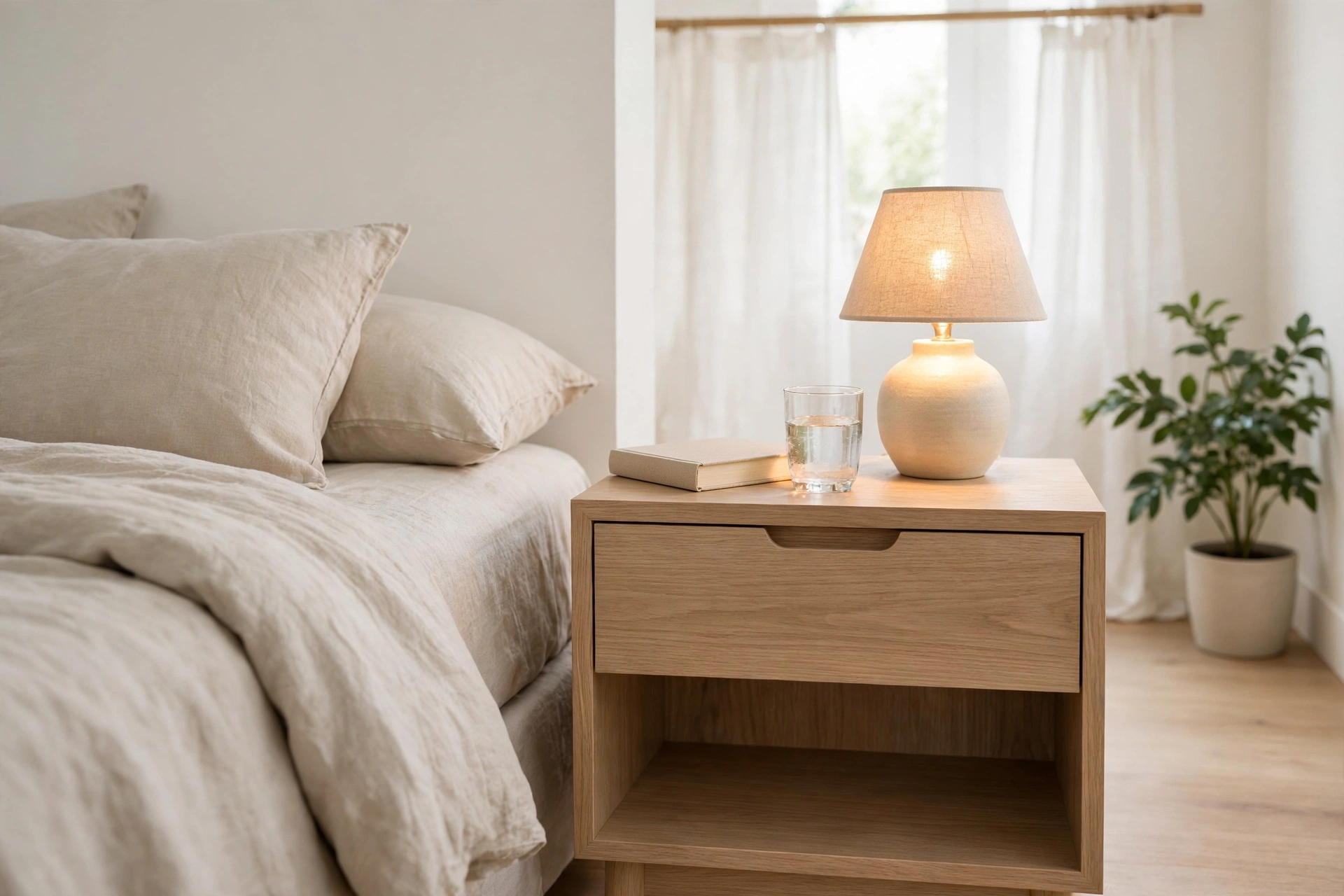
A modern nightstand is a small bedside table designed around clean lines, simple shapes and practical storage. Unlike a traditional nightstand, which often has ornate carving, turned legs or a heavy dark finish, a modern nightstand keeps the silhouette simple: flat fronts, slim legs or a floating mount, and a finish that lets the material speak — light oak, walnut, matte black metal, white lacquer or rattan.
The word “nightstand” and “bedside table” mean the same thing in most shops, so do not worry about the label. What matters is that the piece does three jobs at once: it holds what you reach for in the dark, it stores what you do not want to see, and it finishes the look of the bed wall. A good modern nightstand does all three without drawing attention to itself.
How Tall Should a Nightstand Be?
Height is the single most important measurement, and it is the one people get wrong most often. The rule designers repeat is simple: measure from the floor to the top of your mattress, including any topper, and choose a nightstand whose surface lands level with that point, or within about 2 inches above or below it.
If the nightstand is too low, you have to reach down every time you grab your phone or switch off the lamp, and you are more likely to knock things off in the dark. If it is too high, it towers over the bed and makes the room feel out of proportion. A slightly taller piece usually looks better than a shorter one, but the comfortable range is narrow, so measure before you buy rather than guessing from a photo.
Most standard nightstands fall between 23 and 28 inches tall, which fits the average bed height of about 25 inches from floor to mattress top. Low platform beds are the exception: with a mattress sitting almost on the floor, a nightstand of 12 to 18 inches can be the right fit. Beds with thick mattresses, pillow tops or tall foundations need the taller end of the range. For a detailed breakdown of heights by bed type, the dimensions guide at Living Cozy (https://www.livingcozy.com/blog/nightstand-dimensions) walks through low, standard and tall categories with designer recommendations.
| Bed type | Mattress top (approx.) | Nightstand height to aim for |
|---|---|---|
| Low platform bed | 12–18 in | 12–20 in |
| Standard bed, average mattress | About 25 in | 23–28 in |
| Tall bed / thick mattress or topper | 28–32 in | 26–32 in |
What Size Nightstand Do You Need?
Once the height is right, size the width to the bed. A nightstand that is too narrow beside a king bed looks like a toy; one that is too wide beside a twin crowds the wall. These are starting ranges from designers, not strict rules — your wall space decides the final number.
| Bed size | Nightstand width (starting range) | Notes |
|---|---|---|
| Twin | 20–24 in | One narrow piece is usually enough |
| Full / Queen | 20–30 in | 20–24 in is the safe middle; 30 in if the room allows |
| King / California King | 24–36 in | Two wider pieces balance a large bed |
Depth is the third measurement. Most modern nightstands are 14 to 18 inches deep, which leaves room for a lamp base, a phone, a book and a glass of water. Deeper than 18 inches and the piece starts to jut into the walking space; shallower than 14 inches and a standard lamp base will dominate the surface.
Finally, leave a gap of 2 to 6 inches between the bed and the nightstand. That gap lets you tuck in bedding, make the bed without scraping the furniture, and open drawers and doors freely. If a drawer needs clearance, allow at least 3 inches in front of it, and 5 inches is safer.
Modern Nightstand Styles: Which One Fits Your Bedroom?
“Modern” is a broad label, so it helps to know the styles inside it. The most common modern nightstand styles are mid-century modern, Scandinavian, Japandi, minimalist, contemporary and organic modern. Each one suits a different bedroom, and mixing them with the rest of the room is easier than most people think.
| Style | What to look for | Best with |
|---|---|---|
| Mid-century modern | Tapered legs, warm walnut, clean horizontal lines | Retro or warm-toned bedrooms |
| Scandinavian | Pale wood, white finishes, simple shapes, light feel | Bright, airy bedrooms; small rooms |
| Japandi | Low profile, natural wood, matte finishes, minimal hardware | Calm, uncluttered bedrooms |
| Minimalist | Flat fronts, no visible handles, one material throughout | Bedrooms where the bed is the statement piece — see our guide to minimalist furniture (https://updatemag.com/minimalist-furniture/) |
| Contemporary | Mixed materials, metal accents, lacquer or glass | Bedrooms with a bolder, current look |
| Organic modern | Curved edges, rattan or cane, natural textures | Bedrooms with plants and soft textiles |
One mistake to avoid is the matching-set trap: buying the bed, dresser and nightstands from the same collection makes a bedroom look like a furniture showroom rather than a room someone lives in. A modern nightstand can be a different wood tone or even a different material from the bed — if you mix wood tones, keep them in the same family (warm with warm, cool with cool) with enough contrast to look deliberate.
The same sizing logic applies across the room. If you are also choosing living-room furniture, our guide to the round coffee table (https://updatemag.com/round-coffee-table/) uses the same measure-first approach for height, clearance and proportion.
Which Material Lasts Longest?
Material decides how a modern nightstand ages, how much it costs and how it handles daily knocks, water rings and dust. There is no single best material — the right one depends on your budget and how hard the piece will be used.
| Material | Pros | Cons | Best for |
|---|---|---|---|
| Solid wood (oak, walnut) | Durable, repairable, ages well | Heaviest and most expensive | A nightstand you plan to keep for years |
| Wood veneer | Real-wood look at a lower price | Thin surface can chip; hard to refinish | Style on a budget |
| MDF / laminate | Cheapest, many finishes, light | Chips and swells with water; shortest life | Guest rooms and first apartments |
| Metal (steel, brass accents) | Strong, slim frames, modern look | Can feel cold; shows fingerprints | Industrial or contemporary bedrooms |
| Glass top | Light, airy, easy to wipe | Shows dust; can chip at edges | Small bedrooms that need visual lightness |
| Rattan / cane | Warm texture, breathable look | Harder to clean; less sturdy | Boho or organic modern bedrooms |
For everyday use, solid wood or a good-quality veneer over a sturdy core is the safest bet. Use a coaster under the water glass whatever the material — water rings are the most common damage on a nightstand, and they show on every finish.
Nightstand With Drawers, Shelves or Both?
Storage is where a modern nightstand earns its keep, and the layout you choose should match what you actually keep beside the bed.
- One drawer plus an open shelf is the most useful everyday layout. The drawer hides chargers, medication and clutter; the shelf keeps a book or two in reach.
- Two or three drawers suit people who want everything hidden. It costs more and the piece looks heavier, so it works best beside larger beds.
- Open shelves only look light and modern, but everything is on display. They suit tidy sleepers and guest rooms.
- A floating nightstand mounts to the wall with no legs. It frees floor space, makes cleaning easy and suits small bedrooms, but it holds less weight and cannot be moved without patching the wall.
- A nightstand with a charging drawer or built-in USB ports is worth considering if you charge a phone and watch overnight — just check that the ports are a standard type and that the drawer still closes with cables inside.
Whatever layout you choose, test the drawer before buying: it should open smoothly with one hand, close without slamming, and clear the bed frame and wall by a few inches.
One or Two Nightstands?
Two matching nightstands, one on each side of the bed, is the classic look — it frames the bed, balances the wall and gives each sleeper their own space. But it is not a rule.
- Two nightstands suit shared bedrooms, king and queen beds, and rooms with enough wall space on both sides.
- One nightstand is the right call in a small bedroom, a single sleeper’s room, or a room where a door or window leaves space on only one side. A single well-chosen piece looks intentional; a second one squeezed in looks like an afterthought.
- Mismatched nightstands can work when they share a height and a material family. Keep the heights equal — different heights on either side of the bed look like a mistake even when the styles differ.
If you sleep alone and only use one side of the bed, put the nightstand on the side you actually use. Symmetry matters less than reach.
How to Style a Modern Nightstand
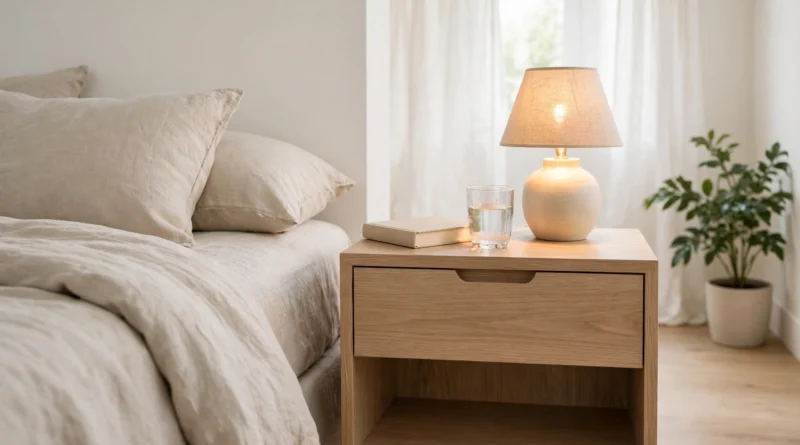
Styling a nightstand is mostly about restraint. Designers advise leaving about half of the surface empty, so the piece looks calm rather than crowded. A good starting formula is a lamp, one book and a glass of water — and nothing else.
- Lamp: the lamp base should fit the surface without dominating it. On a narrow nightstand (under 18 inches wide), choose a slim-base lamp or a wall-mounted light instead.
- Height of the lamp: the bottom of the shade should sit roughly at shoulder height when you are sitting up in bed, so the light falls on the page and not in your eyes.
- Books: one or two books, stacked flat, add warmth. A tall pile looks like storage, not styling.
- Personal items: one framed photo or a small plant is enough. More than that and the nightstand becomes a display shelf.
- Cables: run the charging cable through the drawer or behind the piece. A tangle of cables ruins the clean look a modern nightstand is meant to give.
How to Decorate Your Bedroom Around a Modern Nightstand
A nightstand does not stand alone — it is part of the bedroom, and the bank questions behind this guide ask exactly how to decorate the room around it. The short answer is that the nightstand should echo the room, not lead it: pick the bed and bedding first, then choose a nightstand that fits their height, colour family and mood.
How to decorate your bedroom: start with the bed wall. The headboard, the nightstands and the lamp form one visual group, so keep their heights and tones in conversation. A tall upholstered headboard pairs well with a solid, slightly taller nightstand; a low platform bed pairs with a low, leggy one. Add texture with bedding and a rug before adding more furniture.
How to decorate a large bedroom: a big room can swallow small furniture, so scale up. Wider nightstands (30 inches or more beside a king bed), a larger lamp and a bench or chair at the foot of the bed stop the room feeling empty. Fill the extra wall space with art or a dresser rather than a third nightstand.
How to create a cosy bedroom: warmth comes from layers, not from more furniture. A wooden nightstand with a warm-toned lamp, linen bedding, a soft rug underfoot and one plant will make a room feel cosy at any size. Keep the palette to two or three warm neutrals and let the wood do the work. The choosing guide at Maisonly (https://maisonlyinteriordesign.com/how-to-choose-nightstands-matching-style-and-functionality/) covers the same height and proportion rules with room-by-room examples, and is a useful second opinion before you buy.
Modern Nightstand Buying Checklist
Use this checklist before you pay, and you will avoid the most common regrets.
- Measured floor to top of mattress, including the topper
- Nightstand height within 2 inches of the mattress top
- Width fits the bed size and the wall space, with 2–6 inches of gap beside the bed
- Depth 14–18 inches, with room for a lamp and a book
- Drawer opens fully without hitting the bed or wall (3–5 inches of clearance)
- Storage layout matches what you keep beside the bed
- Material suits your budget and the room’s other furniture
- Lamp base fits with about half the surface left empty
- Style echoes the bedroom rather than matching the bed exactly
- Weight limit checked if you plan to use a floating nightstand
Frequently Asked Questions
What is the standard height for a nightstand?
Most standard nightstands are 23 to 28 inches tall, which matches the average bed height of about 25 inches from the floor to the top of the mattress. Low platform beds need shorter pieces, sometimes 12 to 18 inches, and tall beds with thick mattresses need the taller end of the range. The mattress top is the measurement that matters, not the bed frame.
Can a nightstand be taller than the bed?
Yes, slightly. A nightstand up to 2 inches above the mattress top still looks balanced and is easy to reach from. More than that and it starts to tower over the bed. A nightstand that is lower than the mattress is worse — reaching down for a lamp or phone in the dark is awkward and easy to knock over.
Do nightstands have to match each other?
No. Two nightstands on either side of a bed look best when they are the same height, but they do not need to be identical. Matching height with different styles or finishes can look more interesting than a matching pair, as long as the heights are equal and the materials sit in the same colour family.
What is the difference between a nightstand and a bedside table?
There is no practical difference. “Nightstand” is the more common term in the United States, while “bedside table” is used more in the UK. Shops use them interchangeably, so search both terms when you are comparing prices.
Is a floating nightstand a good idea?
A floating nightstand is a good idea in a small bedroom because it frees floor space and makes cleaning easier. It is a poor idea if you need heavy storage — wall-mounted pieces hold less weight than standing ones — and it cannot be moved without patching the wall. Check the weight rating and fix it into a stud, not just plasterboard.
How far should a nightstand be from the bed?
Leave 2 to 6 inches between the bed and the nightstand. That gap is enough to tuck in bedding and open drawers, and small enough that you can still reach the lamp and phone without stretching.
Conclusion
Choosing a modern nightstand comes down to three measurements and one style decision. Measure the mattress height and pick a piece level with it, within about 2 inches. Size the width to the bed — 20–24 inches for a twin, 20–30 for a queen, 24–36 for a king — and keep the depth around 14–18 inches. Then choose a style and material that echo the bedroom without copying the bed exactly, with enough storage for what you actually keep beside you at night. Get those right and the nightstand disappears into the room in the best way: everything within reach, nothing in the way.