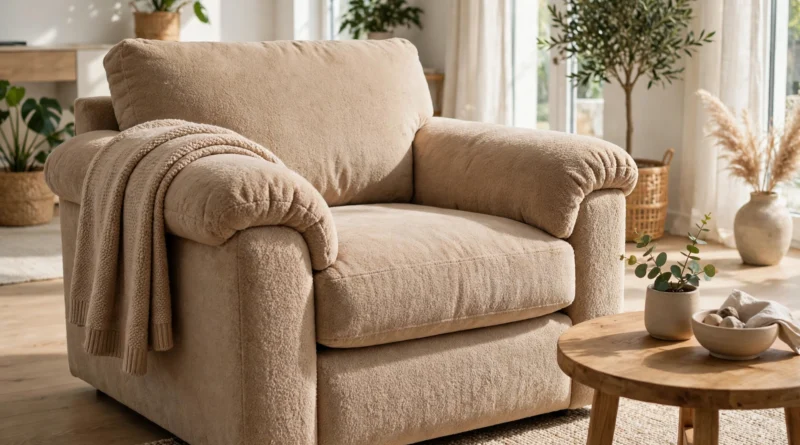
Oversized Chair: How to Choose the Right Size, Style and Material for Your Living Room
Direct Answer
An oversized chair is a wide, deep upholstered seat that sits between a standard armchair and a loveseat. Most oversized chairs are 38 to 48 inches wide overall, with a seat width of about 30 to 40 inches, a seat depth of 22 to 28 inches, and a back height of 40 to 46 inches. That is roughly 4 to 6 inches more seat depth and width than a regular accent chair, which is why an oversized chair feels roomy enough to curl up in with a book, a blanket and a cup of tea. Before you buy one, measure your room, your doorways and the chair itself: leave at least 18 inches of walking space around it, check that the weight capacity (usually 300 to 500 lbs on quality models) suits everyone who will use it, and choose a kiln-dried hardwood or steel frame with high-density foam cushions if you want it to last.
Key Takeaways
- Size: expect 38-48 inches wide overall, a 30-40 inch seat, 22-28 inch seat depth and a 40-46 inch back. Standard armchairs are typically 30-36 inches wide.
- Seat height: 17-19 inches from the floor suits most adults, letting feet rest flat with knees at about 90 degrees.
- Weight capacity: quality oversized chairs support 300-500 lbs. Always check the manufacturer specification rather than guessing.
- Frame first: kiln-dried hardwood or steel frames last; thin particleboard frames often degrade within a couple of years.
- Cushions: high-resilience (HR) foam holds its shape far longer than standard polyurethane foam.
- Price: entry-level models start around $300, good mid-range chairs run $600-$1,400, and premium pieces go beyond $1,500.
- Small rooms can work: choose slim arms, visible legs and a lighter colour, and keep at least 18 inches of clearance around the chair.
- Measure the doorway: many oversized chairs need in-home assembly or a wide delivery path, so measure every door and hallway before ordering.
What Is an Oversized Chair?
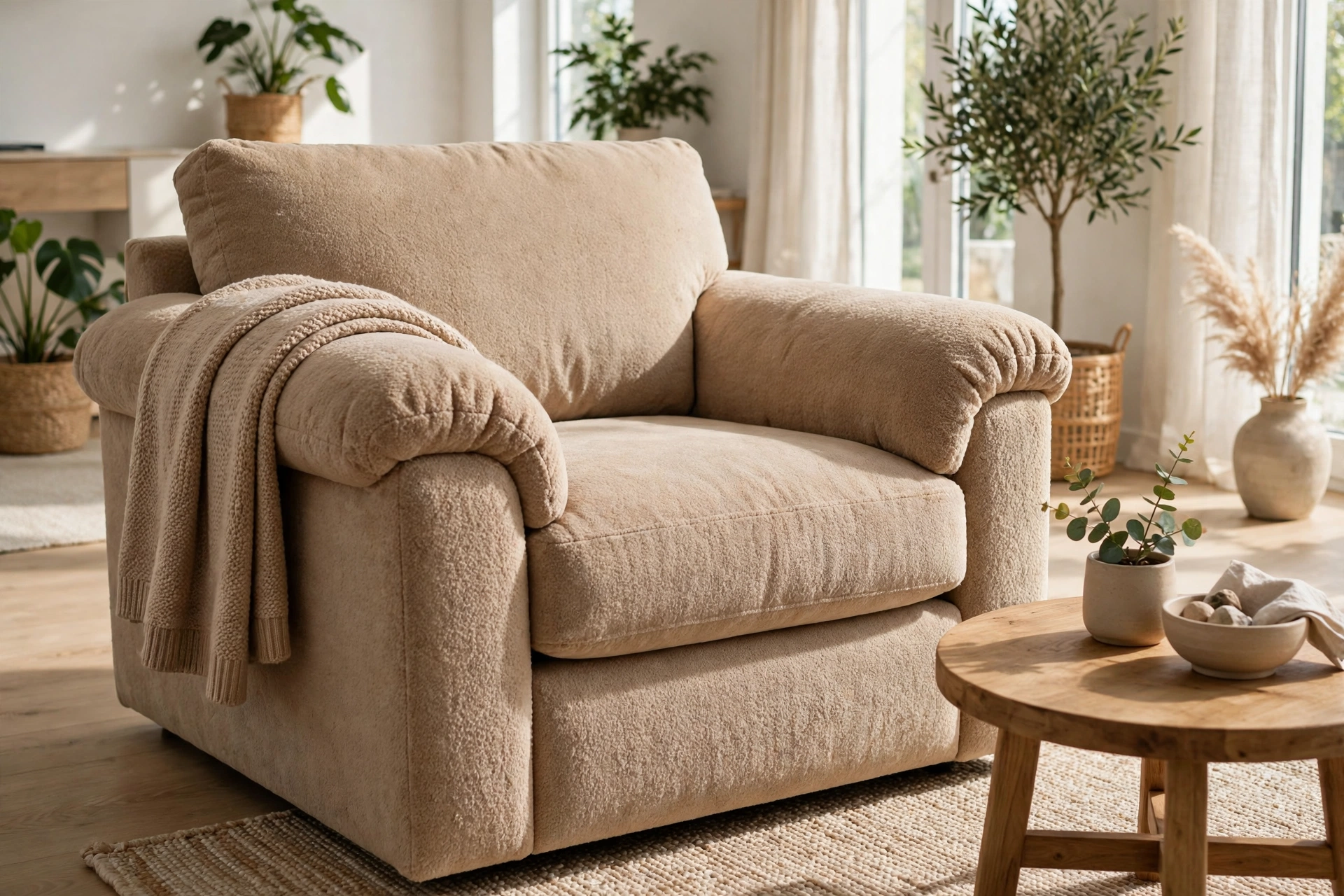
An oversized chair is an upholstered, padded seat that is noticeably larger than a standard armchair but smaller than a loveseat or sofa. It is built for comfort first: a deeper seat, a taller back and broader armrests than a regular chair, with thick, plush cushioning that invites you to sink in rather than sit upright. Many models come with a matching footrest, and some are sold as chair and a half designs, which is the trade name for exactly this in-between size.
The name is a little misleading, because oversized is a marketing term rather than a technical specification. A chair can be 42 inches wide and still feel unsupportive if the seat is too shallow or the back is too straight. True comfort comes from three things working together: seat depth, backrest shape and arm height. For most adults, a seat depth of 20 to 22 inches supports the full thigh without pressing behind the knee, a seat-to-back angle of about 105 to 110 degrees cradles the lower back, and arms that sit at a natural resting height stop the shoulders from hunching.
What Is an Accent Chair?
An accent chair is a standalone chair chosen as much for how it looks as for how it sits. It adds colour, texture or shape to a room and often becomes the visual focal point, whether that is a bold colour, an interesting leg shape or an unusual silhouette. Accent chairs come in many styles — armchairs, side chairs, slipper chairs, wingbacks and oversized chairs are all accent-chair styles — so an oversized chair can also be an accent chair when it is picked to stand out. The full range of styles is well illustrated in this guide to the 25 types of accent chairs, which shows how oversized designs sit alongside slimmer occasional chairs.
Oversized Chair vs Armchair vs Loveseat
The difference is mostly purpose and scale. An armchair is any chair with armrests, built for comfortable sitting; an accent chair is defined by its decorative role, with or without arms; and one chair can be both. A loveseat seats two people side by side and is usually 48 to 72 inches wide. An oversized chair sits in the middle: wider and deeper than an armchair, narrower than a loveseat, and roomy enough for one person to curl up or for a child to squeeze in beside you. If you want a seat that anchors a reading corner, an oversized chair is the right scale. If you need a genuine two-person seat every day, buy the loveseat instead.
| Chair type | Typical overall width | Seat depth | Best for |
|---|---|---|---|
| Standard armchair / accent chair | 30-36 in | 18-21 in | Small corners, occasional seating |
| Oversized chair | 38-48 in | 22-28 in | Reading nooks, curling up, one generous seat |
| Chair and a half | 40-52 in | 22-26 in | One person stretched out, or one adult plus a child |
| Loveseat | 48-72 in | 21-24 in | Two people sitting side by side |
Oversized Chair Dimensions: What Size Should You Expect?
Dimensions vary by brand, so always check the exact measurements of the model you like rather than trusting the label. As a guide, the figures below are the ranges most buying guides quote for a true oversized chair, and they match the typical measurements listed in the oversized chair FAQ on Top5Best.
| Measurement | Standard armchair | Oversized chair |
|---|---|---|
| Overall width | 30-36 in | 38-48 in |
| Seat width | 24-30 in | 30-40 in |
| Seat depth | 18-21 in | 22-28 in |
| Seat height | 17-19 in | 17-19 in |
| Back height | 34-40 in | 40-46 in |
| Weight capacity | 250-350 lbs | 300-500 lbs |
Seat height deserves a second look, because it decides whether the chair is comfortable for daily sitting. At 17 to 19 inches from floor to seat surface, most adults can rest their feet flat with knees at roughly 90 degrees. Some guides quote 16 to 18 inches, which suits shorter sitters. If you are tall, favour the higher end of the range and a deeper seat; if you are shorter, a shallower seat and a footrest will stop your legs dangling. The practical test is simple: sit for at least five minutes in the shop, check that two or three fingers fit between the front edge and the back of your calf, and make sure your lower back feels supported without you having to slouch.
How to Measure Your Room for an Oversized Chair
An oversized chair only works if it fits the room, the doorway and the traffic around it. Measure twice, then mark the footprint on the floor with painter tape before you buy — it is the cheapest way to see whether the chair will dominate the room.
- Measure the footprint plus clearance. Mark the chair width and depth on the floor, then add at least 18 inches of walking space on every side that people pass, and 36 inches for main walkways. If the chair is a recliner or rocker, add the full reclined or rocking footprint too — a rocking chair needs about 3 feet of clear space behind it.
- Measure every doorway and hallway. Oversized chairs are bulky, and many need in-home assembly or a wide delivery path. Measure the narrowest door, hallway turn and stairwell on the route in, and compare with the chair packaged dimensions, not just its assembled size.
- Check the sightlines. Stand at the sofa, the doorway and the TV and look at the taped outline. A chair that blocks a window, a walkway or the view of the television will annoy you daily, however comfortable it is.
- Mind the scale of the room. In a room under about 150 square feet, an oversized chair can overwhelm the space. Look for an oversized-lite design instead: generous proportions but slim arms, exposed legs and a vertical back stitching that keep the piece feeling light. Low-profile designs with open arms or visible legs reduce visual bulk in any room.
- Pair it with the right table. A chair this deep needs a side table within easy reach and a surface for a book or a drink. A small round table works well beside a wide chair because it softens the blocky outline — our guide to choosing a round coffee table covers the sizing rules that apply here too, including the 14 to 18 inch gap between seat and table edge.
Types of Oversized Chairs
Not every oversized chair is the same shape, and the type decides how it feels to sit in and where it belongs.
- Oversized recliner. The most comfortable option for long sitting, TV and naps. Expect a steel-and-hardwood frame, a 350 to 500 lb weight limit and a price of roughly $600 to $1,400. Needs extra floor space behind it for the reclining mechanism.
- Club chair. A classic deep armchair with low arms and a relaxed, slightly reclined back. The most versatile oversized style — it suits a living room, a study or a bedroom corner.
- Chair and a half. The widest indoor option, built for stretching out or sharing with a child. Works best in larger rooms or as a standalone reading seat.
- Swivel glider or swivel recliner. Adds a gentle gliding or turning motion, popular for nurseries and for anyone who likes to shift position while reading. Check the base is stable and the mechanism is covered by at least a one-year warranty.
- Tub or barrel chair. A curved, enveloping back that wraps around the sitter. Stylish and cosy, but the curved back gives less lumbar support for long sessions, so test it before committing.
- Oversized outdoor and camp chairs. A different category: wide folding chairs for patios and camping, usually rated at 400 to 500 lbs with 600D fabric and steel frames. Do not confuse them with indoor oversized chairs — the sizing, materials and comfort are not comparable.
Frame, Cushions and Upholstery: What Lasts
The frame is the skeleton of the chair and the single best predictor of how long it will last. Kiln-dried hardwood (oak or maple) and reinforced steel frames hold up for years; engineered wood, MDF and thin particleboard warp and loosen, and chairs built on them often degrade within two years. Ask the seller what the frame is made of — if they cannot say, treat that as your answer.
Cushions matter almost as much. High-resilience (HR) foam keeps its shape far longer than standard polyurethane foam, and a dual-layer cushion (foam over a feather wrap) gives softness with structure. Sinuous springs or eight-way hand-tied springs under the seat spread weight evenly; a chair with no spring system at all will sag in the middle within a year or two. Removable, reversible cushions are a practical bonus: flip them regularly and they wear evenly.
Upholstery is a trade-off between look, feel and maintenance:
| Material | Best for | Watch out for | Typical lifespan (daily use) |
|---|---|---|---|
| Performance fabric | Family rooms, pets, kids | Check the rub count and cleaning code | 7-10 years |
| Boucle / textured fabric | Cosy reading corners | Snags on pet claws and jewellery | 5-8 years |
| Top-grain leather | Living rooms, high-traffic zones | Fades in direct sun; needs conditioning | 12-15 years |
| Velvet | Statement chairs, low-traffic rooms | Marks easily; shows pressure marks | 5-8 years |
| Faux leather | Budget buys, easy wipe-downs | Peels and cracks with heat and sun | 3-5 years |
For a household with children or pets, performance fabric is usually the smartest choice: it resists stains, cleans with water-based cleaners and does not show every mark. Leather ages beautifully and wipes clean, but it is cold in winter, sticky in summer and scratches visibly. Whatever you choose, check the cleaning code on the tag before you buy, and keep the chair out of direct sunlight if you want the colour to last.
How Much Does an Oversized Chair Cost?
Prices vary widely by brand, frame and fabric, so treat these as typical ranges rather than quotes for any single model. Pay for the frame and the cushions first — that is where the money shows over time.
| Type | Typical price range | What the money buys |
|---|---|---|
| Entry-level oversized chair | Around $300-$500 | Basic frame, standard foam, simple fabric |
| Mid-range oversized chair | $500-$900 | Hardwood frame, HR foam, better fabric choices |
| Oversized recliner | $600-$1,400 | Steel-and-hardwood frame, reclining mechanism, 350-500 lb capacity |
| Premium / designer oversized chair | $1,500 and up | Top-grain leather or premium fabric, hand-tied springs, longer warranty |
Before you pay, check the return policy and the warranty. Look for at least one year of coverage on the mechanism and the frame, and confirm the return window and any restocking fee — returning an oversized chair is expensive, and some sellers charge for the privilege. If a deal looks too good, check the frame material and the weight capacity first: a chair rated under 250 lbs with a particleboard frame is not a bargain at any price.
Will an Oversized Chair Work in a Small Living Room?
Yes, with the right choices — but an oversized chair is the wrong buy for a genuinely tiny room, and it is better to know that before delivery than after. The chair itself is only part of the footprint: you also need the clearance around it, a side table and a lamp, and a path past it that nobody has to squeeze through.
- Choose slim arms and visible legs. Wide rolled arms add 6 to 8 inches of visual bulk without adding seat space. Slim track arms and tapered wooden legs make the same seat look lighter.
- Pick a lighter colour or a low-contrast fabric. A chair close in tone to your walls and rug recedes; a dark, high-contrast chair in a small room becomes the whole room.
- Keep the back low. A tall back divides a small room in half. A lower back, or a chair placed against a wall rather than floating in the middle, keeps sightlines open.
- Skip the matching footrest. An ottoman that doubles as extra seating or a side table earns its floor space; a dedicated footrest often does not.
- Use the tape trick. Outline the chair on the floor and live with the outline for a day. Walk past it, open nearby doors and drawers, and check you are not shuffling sideways. If you are, the chair is too big for the room.
- Consider a chair and a half instead of a full oversized recliner. It gives the generous seat without the extra depth a reclining mechanism demands.
How to Decorate with Accent Chairs
An oversized chair is a natural focal point, so style it deliberately rather than letting it sit bare in a corner. The goal is to make it look inviting and to tie it into the rest of the room.
Start with a throw and one cushion, not five: a folded throw over one arm softens the blocky outline, and a single lumbar cushion adds colour without clutter. Add a side table and a lamp at arm reach — a reading chair without light is a chair nobody uses after dark. A rug underneath anchors the chair and the table together; the front legs of the chair should sit on the rug, not beside it.
Balance the scale of the chair with the rest of the room. A big chair next to a small, delicate sofa looks like a mistake; pair it with substantial pieces — a solid coffee table, a floor lamp, a large plant — so the proportions feel intentional. If your room leans minimalist, a single oversized chair in a neutral fabric can be the one soft, generous piece in the space; our guide to minimalist furniture explains how to choose simple, well-made pieces that keep a room calm rather than crowded. And remember that an oversized chair works in more than the living room: a bedroom reading corner, a home office or a nursery all suit one, as long as the scale and the clearance work.
Oversized Chair Buying Checklist
- Measured the room, the doorways and the delivery route
- Taped the footprint on the floor and checked the walking space (18 inches minimum)
- Confirmed seat width, seat depth, seat height and back height against your body
- Sat in it for at least five minutes, or confirmed the return policy if buying online
- Checked the frame material (kiln-dried hardwood or steel preferred)
- Checked the cushion fill (HR foam or foam-over-feather preferred)
- Confirmed the weight capacity suits everyone who will use it
- Chose upholstery that fits your household (performance fabric for kids and pets)
- Checked the warranty (at least one year on frame and mechanism) and the return terms
- Planned the side table, lamp and rug so the chair is usable from day one
Frequently Asked Questions
What is the difference between an oversized chair and a loveseat?
An oversized chair is a single generous seat, 38 to 48 inches wide, designed for one person to curl up in. A loveseat is 48 to 72 inches wide and seats two people side by side. If you need a genuine two-person seat, buy the loveseat; if you want the roomiest possible single seat, buy the oversized chair.
How wide is an oversized chair?
Most oversized chairs are 38 to 48 inches wide overall, with a seat width of 30 to 40 inches. Some chair-and-a-half designs reach 52 inches. Always check the exact dimensions of the model you are buying, because oversized is not a regulated size.
Can two people sit in an oversized chair?
One adult can sit very comfortably, and an adult plus a small child fits easily. Two adults will feel cramped — the seat is wide, but it is still one seat with one backrest. For regular two-person sitting, a loveseat is the better buy.
Do oversized chairs come apart for delivery?
Many do, at least partly: legs unscrew, backs detach, and some models ship in two boxes for narrow doorways. Check the product details for assembly required and measure your narrowest doorway against the packaged dimensions before ordering.
How do I clean an oversized chair?
Check the cleaning code on the tag first. Most fabric chairs can be vacuumed weekly with an upholstery attachment and spot-cleaned with a water-based cleaner; performance fabrics tolerate more. Leather needs a damp cloth and occasional conditioner, and should be kept out of direct sun. Always test any cleaner on a hidden spot first.
Is an oversized chair good for back pain?
It can be, if the seat depth, seat height and lumbar support suit your body. Look for a seat-to-back angle of about 105 to 110 degrees, firm HR foam rather than soft sagging cushions, and a backrest that follows the natural curve of your spine. A chair that is too deep forces you to slouch, which makes back pain worse — so sit in it before you buy, or buy from a seller with a free return.
Conclusion
An oversized chair is one of the most satisfying pieces of furniture you can buy — provided you buy the right size. Start with the measurements: 38 to 48 inches wide, a 22 to 28 inch seat depth and a seat height of 17 to 19 inches are the ranges to aim for, with at least 18 inches of clearance around the chair and a doorway wide enough to get it in. Then spend your money where it lasts: a kiln-dried hardwood or steel frame, high-resilience foam cushions and upholstery that suits your household. Get those choices right and the chair becomes the seat everyone in the house argues over — the reading corner, the nap spot and the best seat in the living room, all in one piece of furniture.