Compound Lifts: A Beginner’s Guide to Squats, Deadlifts, Bench Press and Rows
Compound lifts are exercises that move more than one joint and work several muscle groups at the same time. A squat, for example, moves your hips, knees and ankles while working your quads, glutes, hamstrings and core together. Because one movement trains so much muscle at once, compound lifts are the most time-efficient way for a beginner to build overall strength — most starter programmes are built around just a handful of them.
Key Takeaways: A compound lift moves multiple joints and muscles; an isolation exercise moves one joint and targets one muscle. The classic compound lifts are the squat, deadlift, bench press, overhead press, row and pull-up. Beginners do best starting with light weights (or bodyweight), learning form first, and training each lift 1–3 times per week. A simple starter week needs only 3–5 compound lifts per session, done for 2–4 sets of 5–10 reps. Compound lifts do not replace isolation work entirely — isolation moves are useful for weak points and muscles the big lifts miss.
What Is a Compound Lift?
A compound lift is any exercise in which two or more joints move together, so several muscle groups share the work. When you squat, your hips, knees and ankles all bend and straighten, and your quads, glutes, hamstrings, calves and core all contribute. When you do a bicep curl, only your elbow moves and mainly your biceps work — that is an isolation exercise. The distinction matters because it decides how much you get from each set. One set of squats trains your whole lower body; matching that with isolation moves would take a leg extension, a leg curl and a hip thrust. That is why coaches and trainers build programmes around compound lifts first and add isolation exercises afterwards, not the other way round. This is general educational information, not personal training or medical advice. If you have an injury, pain, or a health condition, talk to a qualified coach or clinician before starting a new lifting programme.
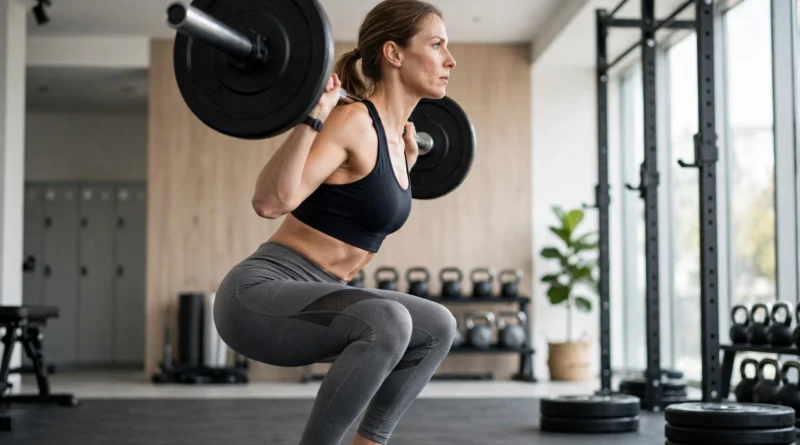
What Muscle Do Squats Work?
Squats mainly work the quadriceps (the front of the thighs) and the glutes, with the hamstrings, calves, lower back and core helping to stabilise and drive the movement. That is why the squat is the default lower-body compound lift: no single isolation exercise covers the same ground. Form basics for a beginner squat:
- Stand with feet about shoulder-width apart, toes turned slightly out.
- Brace your core as if someone were about to poke your stomach.
- Sit your hips back and down, keeping your chest up and your knees tracking over your toes.
- Lower until your thighs are roughly parallel to the floor, or as far as you can with a flat back.
- Drive through the whole foot to stand back up.
Start with bodyweight squats or a goblet squat (holding one dumbbell or kettlebell at your chest) before you put a barbell on your back. The pattern matters more than the weight in your first weeks.
The Big Compound Lifts and the Muscles They Work
Most beginner programmes use five or six lifts. Together they cover the whole body: a squat pattern, a hinge pattern, a horizontal push, a vertical push, a horizontal pull and a vertical pull.
| Lift | Muscles Worked | Pattern |
|---|---|---|
| Squat | Quads, glutes, hamstrings, core | Squat pattern |
| Deadlift | Glutes, hamstrings, lower back, forearms, upper back | Hinge |
| Bench press | Chest, shoulders, triceps | Horizontal push |
| Overhead press | Shoulders, triceps, upper chest, core | Vertical push |
| Barbell or dumbbell row | Lats, traps, rear deltoids, biceps | Horizontal pull |
| Pull-up or lat pulldown | Lats, biceps, forearms, core | Vertical pull |
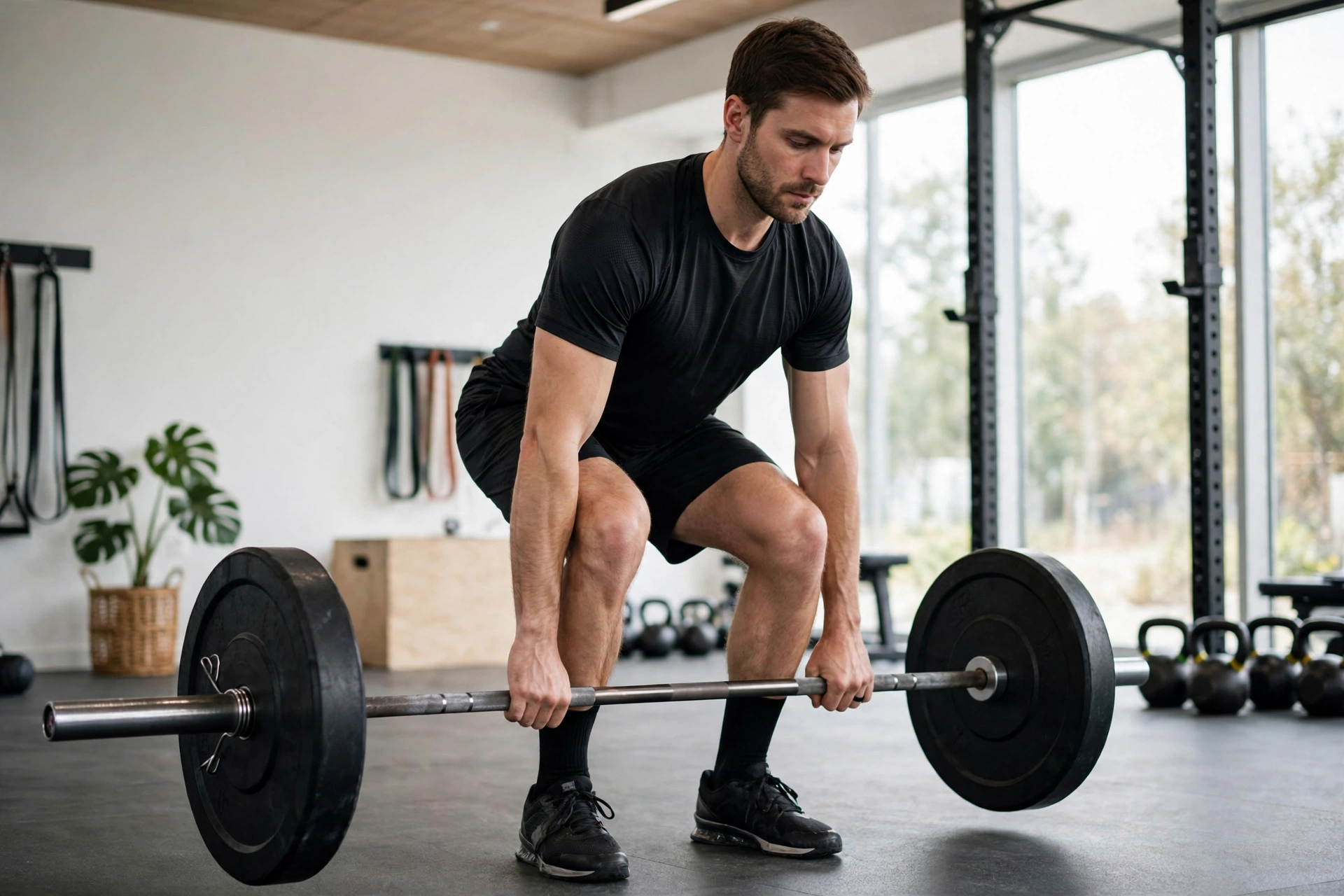
Deadlift
The deadlift is a hip hinge: you pick a weight up from the floor by driving your hips forward, not by rounding your back to yank it up. It trains the whole posterior chain — glutes, hamstrings and back — plus grip and upper-back strength. Beginners often start with a Romanian deadlift (lowering the weight to just below the knees and standing back up) or a dumbbell deadlift, which teaches the hinge with a lighter, more forgiving load.
Bench press
The bench press is the main upper-body pushing lift. Lying on a bench, you lower a barbell or dumbbells to your chest and press them back up, working your chest, shoulders and triceps. Keep your shoulder blades squeezed together, your feet flat on the floor, and your elbows at roughly 45 degrees to your body rather than flared straight out to the sides.
Overhead press
The overhead press (pressing a barbell or dumbbells from your shoulders to overhead) builds shoulder and triceps strength and demands serious core stability, because there is no bench behind you. It is usually the slowest lift to progress, and that is normal — small increases count.
Row and pull-up
Pushing lifts need pulling lifts to balance them, or your shoulders and posture pay for it. A barbell or dumbbell row trains the lats, traps, rear deltoids and biceps, while a pull-up or lat pulldown trains the same pulling muscles from above. If you cannot do a full pull-up yet, a lat pulldown or band-assisted pull-up is the honest starting point, not a half-rep struggle.
Compound vs Isolation Exercises: Which Should You Do?
Both have a place, and the argument is about order and share of your time, not about one being “bad”. Compound exercises give you more strength per set and per minute, teach muscles to work together the way they do in real life — lifting, carrying, pushing, pulling — and let you lift heavier weights, which is a stronger growth stimulus (see the ACE Fitness guides linked here: the 5 Benefits of Compound Exercises and Essential Exercises for an Optimal Strength-training Workout). Isolation exercises let you target one muscle precisely, which is useful for a lagging muscle, for rehab-style work, or for muscles the big lifts under-train (calves and side deltoids are common examples). A practical rule many coaches use is roughly three compound exercises to one isolation exercise in a session. Beginners, though, often need no isolation work at all for the first few months: the big lifts alone provide more than enough stimulus while technique is still being learned.
Do Compound Lifts Build Muscle Faster?
For a beginner, compound lifts usually build overall strength and muscle faster than an isolation-only routine, for a simple reason: they let you train more muscle with heavier loads in fewer sets. Early progress also comes heavily from your nervous system learning the movements — your body gets better at firing the right muscles together — which is exactly what multi-joint lifts train. That is also why beginners sometimes get stronger very quickly without looking much different at first: coordination improves before muscle size catches up. That said, compound lifts are not magic. Muscle still grows from progressive overload (gradually doing more weight or reps over time), enough protein and sleep, and consistency across months. No single exercise choice replaces those basics.
How Many Compound Lifts Per Workout?
For a beginner, 3–5 compound lifts per session is plenty. A typical full-body session might be: squat, bench press, row, plus one hinge or overhead movement. Doing eight big lifts in one session usually means the later ones are done tired and sloppy, which is where form breaks down. On sets and reps, a useful beginner range is 2–4 sets of 5–10 reps per lift, with the heavier lifts (squat, deadlift) at the lower end of the rep range and the upper-body lifts anywhere in it. Rest 2–3 minutes between sets of the big lifts; you are training strength, not racing the clock. Major health guidelines recommend muscle-strengthening activity on at least two days per week, and a 3-day full-body routine built on compound lifts covers that comfortably.
How Often Should You Do Compound Lifts?
Most beginners do well training 2–3 days per week, with at least one rest day between sessions. You can repeat the same core lifts each session (a squat, a push and a pull every time) and simply add a little weight or a rep when the previous session felt solid. Training the same lift more often is actually an advantage early on: more practice means faster technique gains. Soreness in the first week or two is normal when a movement is new. Sharp joint pain is not — stop, check your form, lighten the load, and get advice if it persists.
A Simple Beginner Compound Lift Week
This fits neatly alongside a 3-day full-body routine like our beginner workout plan, and it pairs with the at-home strength exercises in our strength-at-home guide if you train without a gym.
Day 1 — Lower body + push: Goblet squat 3 sets of 8–10; Bench press (or dumbbell chest press) 3 sets of 8–10; Dumbbell row 3 sets of 10 each side.
Day 2 — Hinge + pull: Romanian deadlift 3 sets of 8–10; Overhead press 3 sets of 8–10; Lat pulldown or assisted pull-up 3 sets of 8–10.
Day 3 — Repeat Day 1, slightly heavier: Squat 3 sets of 6–8; Bench press 3 sets of 6–8; Row 3 sets of 8–10.
Add the smallest available weight increase when you can finish all sets with good form and one or two reps still in reserve. If form breaks down, stay at the same weight for another week — that is progress too.
Compound Lifts at Home Without a Barbell
You do not need a barbell to train compound patterns. Dumbbells, kettlebells or resistance bands cover every pattern: goblet squats and split squats for legs, dumbbell Romanian deadlifts for the hinge, floor press or push-ups for pushing, single-arm rows and pull-ups (or a band pulldown) for pulling. The pattern is the programme; the equipment is just the loading tool. Bodyweight versions — squats, push-ups, pull-ups, lunges — are legitimate compound lifts in their own right, and they are where most beginners should start anyway.
Common Beginner Mistakes With Compound Lifts
- Adding weight before learning the movement: film a set from the side, or ask a coach to watch one. Ugly reps at a light weight become injuries at a heavy one.
- Skipping the warm-up: a few minutes of easy movement plus one or two light sets of the first lift prepares joints and reminds your body of the pattern.
- Training only the lifts you like: a bench-only routine with no rows is how shoulders get cranky. Keep push and pull balanced.
- Chasing soreness: soreness is not a score. Steady progress in weight, reps and form is.
- Copying an advanced programme: high-volume powerlifting routines assume years of technique. A beginner needs fewer lifts, done well, more often.
FAQ
What is a compound lift, in one sentence? An exercise that moves more than one joint and works several muscle groups at once — squats, deadlifts, bench press, rows and overhead press are the classic examples.
Can beginners do compound lifts? Yes — they are arguably the best place for a beginner to start, because they build whole-body strength and coordination efficiently. Start with bodyweight or light dumbbell versions, learn the pattern, then add load gradually.
What are the big 3 lifts? The “big 3” are the squat, bench press and deadlift — the three lifts contested in powerlifting, and the core of most strength programmes.
Do I still need isolation exercises? Not at first. Add them later for specific goals: a lagging muscle, extra arm or calf work, or rehab-style training. Keep them as the minority of your session.
How long before compound lifts show results? Strength usually improves noticeably within the first 4–8 weeks as technique and coordination improve, with visible muscle changes typically taking a few months of consistent training. Individual results vary a lot, so judge yourself against your own logbook, not someone else’s photos.
Conclusion
Compound lifts are the foundation of strength training for a reason: a squat, a deadlift, a press and a row train nearly your whole body in a handful of movements, in less time than an isolation-only routine, and they teach your muscles to work together the way everyday life demands. Start light, learn the patterns, train 2–3 days a week, and add weight only when your form earns it. For a ready-made routine built on exactly these lifts, see our beginner workout plan, and for a version you can do without a gym, see our guide to the best exercises for strength at home.