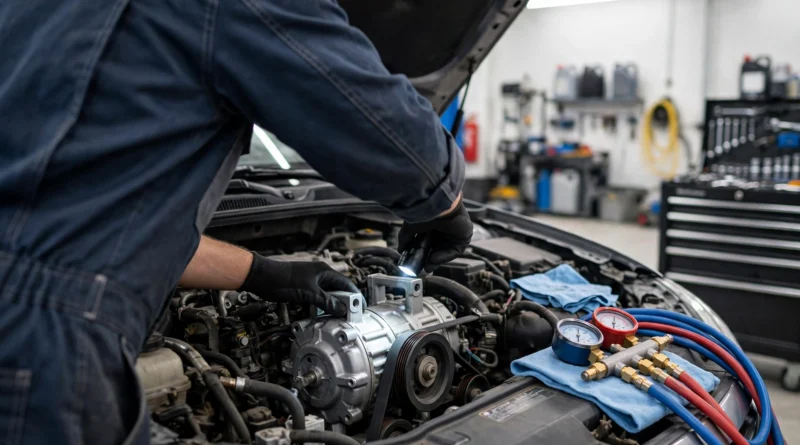
Car AC Repair: Signs, Costs and What to Check Before You Pay
Direct Answer
Car AC repair usually means finding why the system stopped blowing cold air and fixing that one cause — most often a refrigerant leak, a worn compressor, or a clogged cabin air filter. A simple recharge typically costs $150–$300, while a compressor replacement usually runs $900–$1,500. Before you pay a shop, check the cabin air filter, listen for the compressor clicking on, and ask for a leak test — a recharge without a leak check often fails again within weeks.
Key Takeaways
- Warm air, weak airflow, strange noises, bad smells and oily residue under the hood are the five signs your car AC needs attention.
- A refrigerant leak is the most common cause of warm air — and the reason a recharge alone often stops working again quickly.
- Typical US repair ranges: recharge $150–$300, leak repair $200–$800, compressor replacement $900–$1,500, evaporator replacement $700–$2,000+.
- Cars from model year 2017 onward mostly use R-1234yf refrigerant, which costs more than the older R-134a — check which one your car takes before comparing quotes.
- A clogged cabin air filter is a $15–$30 part most drivers can swap themselves, and it is the cheapest possible cause of weak airflow.
- Car insurance covers AC damage from accidents, weather or vandalism — not wear and tear.
- Run your AC for a few minutes every couple of weeks, even in winter: it keeps seals lubricated and helps clear fogged windows.
What Does Car AC Repair Actually Involve?
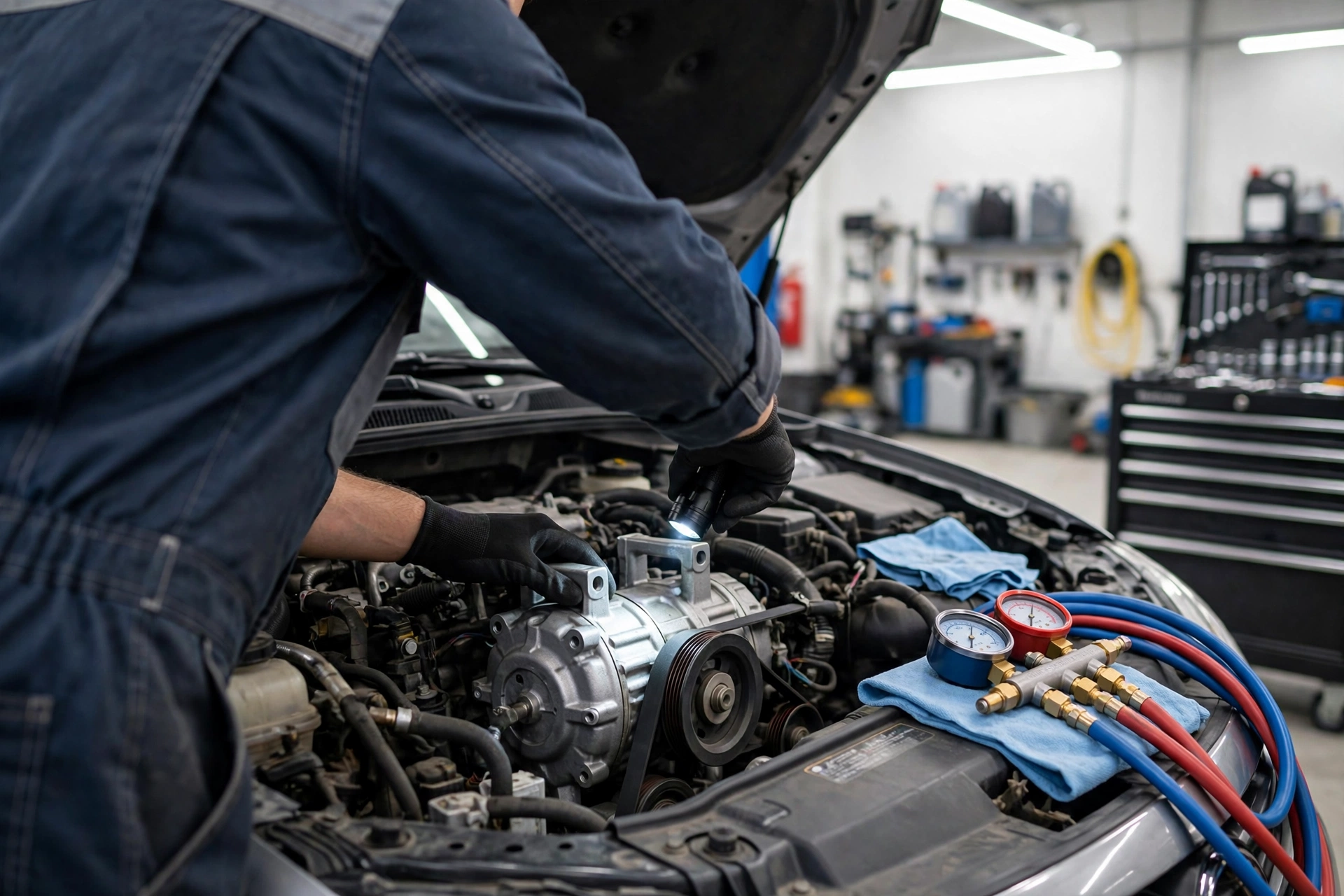
A car air conditioning system is a sealed loop. A compressor pumps refrigerant around the loop, the condenser sheds heat from it at the front of the car, an expansion valve meters it into the evaporator behind the dashboard, and the blower pushes cabin air across that cold evaporator and out of your vents. When any part of that chain fails, the air coming out of the vents stops being cold — even though the rest of the system may be fine.
That is why “car AC repair” is not one job with one price. A good shop diagnoses first, then fixes the failed part. The most common jobs are a refrigerant recharge, a leak repair, a compressor replacement, a condenser or evaporator replacement, and a blower motor or cabin air filter change. Knowing which one you are likely facing — and what each typically costs — is what stops you overpaying.
Signs Your Car AC Needs Repair
Catch the problem early and the fix is usually cheaper. A small leak left alone can starve the compressor of the oil that circulates with the refrigerant, and a cheap leak repair can turn into a compressor replacement.
| Symptom | What it usually means |
|---|---|
| Warm air from the vents on the coldest setting | Low refrigerant from a leak, or a compressor that is not engaging |
| Weak airflow even on full fan | Clogged cabin air filter, or a failing blower motor |
| Cooling that comes and goes | Low refrigerant, an electrical fault, or a compressor clutch problem |
| Grinding, squealing or clicking when the AC switches on | Worn compressor bearings or a failing compressor clutch |
| Musty or sweet smell from the vents | Musty: mould in the evaporator; sweet: refrigerant leak |
| Oily residue around AC fittings or under the car | Refrigerant leaking — oil travels with the refrigerant |
| Windows that will not clear in damp weather | The AC is not dehumidifying, which points to a system fault |
Two quick checks cost nothing. First, with the engine running, switch the AC on and listen for a click from under the hood and a small change in engine note — that is the compressor clutch engaging. No click at all often means low refrigerant has triggered the low-pressure cutout, a blown fuse, or a failed clutch. Second, check the cabin air filter: on most cars it sits behind the glovebox and takes minutes to inspect. A filter black with dust and leaves explains weak airflow on its own.
Why Is My Car AC Not Blowing Cold Air?
Low refrigerant is the most common reason, and it almost always means a leak. Air conditioning systems lose a small amount of refrigerant over time through seals and hose fittings, but a system that needs topping up every year has a leak that needs finding. A proper leak test uses UV dye or an electronic sniffer — topping the gas up again and hoping is not a repair.
If the system is fully charged and still not cold, the cause is further down the chain:
- A failing compressor. The compressor is the pump at the heart of the system. Worn internal parts move less refrigerant, so the system looks full but cannot build enough pressure to cool. Grinding or rattling noises when the AC engages are the classic warning.
- A compressor clutch that never engages. The clutch connects the compressor to the engine. A blown fuse, a failed relay, a faulty pressure switch or a bad clutch coil can all stop it engaging.
- A blocked or damaged condenser. The condenser sits in front of the radiator and sheds heat. Road debris, bent fins or internal blockage stop it doing that job, so the refrigerant never cools down properly.
- A clogged expansion valve or orifice tube. This small part meters refrigerant into the evaporator. Debris, sludge or moisture freezing inside it restricts flow and kills cooling.
- A blend door fault. The blend door mixes hot air from the heater core with cold air from the evaporator. If its actuator fails, warm air mixes in and the vents blow lukewarm no matter how well the AC itself works.
- Air or moisture contamination. When refrigerant leaks out, air and moisture get in. Moisture reacts with refrigerant and oil to form acids that corrode the system from inside, and it can freeze inside the expansion valve and block it.
One warning from working technicians is worth remembering: if your AC was recharged and stopped blowing cold again within days or weeks, do not just recharge it again. Find the leak first, or the same money will keep disappearing with the refrigerant. A detailed walkthrough of the ten most common reasons a recharge does not restore cold air is covered in this technician’s guide to AC problems after a recharge.
How Much Does Car AC Repair Cost?
Costs vary by vehicle, refrigerant type, labour rates and where you live, but repair-cost guides report broadly consistent US ranges for the common jobs. Use them as a benchmark, then get a written quote for your car before authorising anything.
| Repair | Typical cost range | How long it takes |
|---|---|---|
| Cabin air filter replacement | $15–$30 (part only) | A few minutes, DIY |
| Refrigerant recharge (R-134a) | $150–$350 | 30–60 minutes |
| Refrigerant recharge (R-1234yf) | $200–$500 | 30–60 minutes |
| Refrigerant leak repair (hose, O-ring or seal) | $200–$800 | 1–2 hours |
| AC compressor replacement | $900–$1,500 (up to $2,800 without warranty coverage on some vehicles) | 3–6 hours |
| Condenser replacement | $600–$1,000 | 2–4 hours |
| Blower motor replacement | $300–$450 | 1–2 hours |
| Evaporator core replacement | $700–$2,000+ | A full day or more |
| Complete AC system replacement | $1,500–$4,000+ | A full day or more |
The ranges above are typical US figures reported by repair-cost guides such as Lemonade’s car AC repair cost guide — your quote will depend on your car’s make and model, whether the part is original or aftermarket, and local labour rates, which commonly run $100–$200 an hour. A simple recharge is the cheapest fix; an evaporator is the most labour-intensive because it sits behind the dashboard, and removing the dashboard to reach it can take five to eight hours before the recharge even starts.
Three things move the price most:
- Refrigerant type. Older cars use R-134a, which is cheap and widely available. Most cars from model year 2017 onward use R-1234yf, which can cost several times more per pound — so the same recharge costs more on a newer car.
- Vehicle type. A compressor replacement on an economy car typically costs less than on a large SUV or a luxury car, where the part alone can cost over $1,000 and the compressor may be buried deep in the engine bay.
- What else gets replaced. A proper compressor job usually includes a new receiver-drier and expansion valve, plus a system flush, to stop debris from the old compressor damaging the new one. That adds roughly $100–$250 but protects the repair.
Car AC Recharge: When It Helps and When It Does Not
A recharge — also called a regas — refills the refrigerant. Done properly, a shop first pulls a vacuum on the system to remove old refrigerant and any moisture, checks that it holds vacuum (which confirms there is no obvious leak), then refills it with the exact type and quantity your car specifies. Dye is often added so a future leak can be traced with a UV light.
A recharge helps when the system has simply lost charge slowly over years and has no leak. It does not help when there is an active leak, a failed compressor, a blocked expansion valve or a blend door fault — in those cases the cold air returns briefly, if at all, and then fades again.
Can I recharge my car’s AC myself?
DIY recharge kits are sold at most auto parts stores and connect a can of refrigerant to the low-pressure service port. They can work for a slow-loss top-up, but there are real limits. Most kits only include a low-pressure gauge, which tells half the story — being only a few ounces over or under the specification can make cooling worse, and more refrigerant does not mean colder air. An overcharged system often cools worse than a slightly undercharged one. And refrigerant must never be vented into the air: in the US, knowingly releasing it is illegal, and a shop’s recovery machine is the right way to remove it. If your system needed a recharge within the last year and is weak again, skip the DIY kit and get a leak test — that is the repair, not another can.
How do I know if my car AC needs a recharge?
The clearest sign is air that used to be cold and is now only cool or warm, especially if it got gradually worse over a season. Other clues are the compressor cycling on and off rapidly, or the clutch not engaging at all because low pressure has triggered the cutout. A shop can confirm it in minutes with pressure gauges: low pressure on both sides of the system points to low charge, while normal pressure with warm air points to a different fault.
What refrigerant does my car use?
Check the label under the hood or in your owner’s manual. Cars built before about 2017 generally use R-134a; most cars from model year 2017 onward use R-1234yf, and by the 2021 model year virtually all new cars used it. The two are not interchangeable — using the wrong one can damage the system and is not a shortcut worth taking.
Car AC Compressor: Symptoms, Repair or Replace, and Cost
The compressor is the most expensive single part in the system, so it is worth knowing its warning signs: grinding or rattling noises when the AC switches on, warm air even though the system is charged, a clutch that will not engage, visible oil around the compressor, or a seized compressor that shreds the drive belt.
Sometimes only the clutch, its coil or a shaft seal has failed, and a shop can replace that single part instead of the whole compressor — typically $400–$800, and the cheapest compressor-related fix. Once the compressor itself has seized, lost internal pressure or come apart, the whole unit has to be replaced, usually $900–$1,500 including labour and recharge. If a failed compressor scattered metal debris through the lines and condenser, the job becomes a full system overhaul at $1,500–$3,000+, because flushing alone cannot reliably remove the debris from a modern parallel-flow condenser. A replacement compressor usually carries a one- to two-year warranty.
Can you drive with a broken AC compressor?
Yes, in most cases — a failed compressor does not stop the car running, and the heater and ventilation still work. But do not ignore it for long. If the compressor has seized, it can damage the serpentine belt that also drives other parts, and running a low-refrigerant system can spread debris through the rest of the AC system. In winter the AC also dehumidifies the air, so a dead compressor can leave your windows fogging up. Get it checked before a small problem becomes a system-wide one.
How long does car AC repair take?
A recharge or a cabin air filter takes under an hour. A compressor replacement typically takes three to six hours. An evaporator replacement can take a full day or longer because the dashboard has to come out. Add time for leak detection and for the system to be vacuum-tested and recharged after any repair that opens the sealed loop.
Why Does My Car AC Smell Bad?
A musty smell usually means mould growing in the evaporator case, fed by moisture that never dries out. It is worse in cars where the AC is rarely used or where the cabin air filter is long overdue. A sweet, chemical smell is different — that can be refrigerant leaking from the evaporator, and it needs a leak check. For mould, the practical fixes are replacing the cabin air filter, running the fan for a few minutes with the AC off before switching the car off so the evaporator dries, and having the evaporator cleaned if the smell persists. If the smell is sweet rather than musty, get the system leak-tested rather than masking it with an air freshener.
Is It Worth Fixing the AC on an Old Car?
Compare the repair quote with the car’s value and with what else the car needs. A $150–$300 recharge on a car you plan to keep for another year is almost always worth it. A $1,500 compressor replacement on a car worth $2,000 with other problems looming is a harder call. If the car is otherwise sound and you rely on it daily, fixing the AC is usually cheaper than replacing the car — and a working AC matters at resale time. If you are weighing repair against replacement, our guide to the best used cars to buy can help you judge what a replacement would actually cost. And if the car is still under warranty or a certified pre-owned plan, check the cover before paying anything yourself — AC parts are sometimes covered.
Does Car Insurance Cover AC Repair?
Generally, no — not for wear and tear. Car insurance covers AC damage caused by an accident, severe weather or vandalism, but a compressor that wore out or a seal that leaked with age is a maintenance cost, not an insurance claim. The exception is if the AC was damaged in a covered event, such as a front-end collision that damaged the condenser. Check your policy wording, and if the damage came from an accident, report it promptly — waiting can complicate the claim.
How to Keep Your Car AC Healthy
Most AC failures are slow and preventable. A little routine care goes a long way:
- Run the AC regularly, all year. Ten minutes every couple of weeks keeps the seals lubricated and the refrigerant oil circulating. It also keeps the windows clear in winter, because the AC dries the air.
- Change the cabin air filter on schedule. Check it at least once a year — more often if you drive on dusty roads. It is the cheapest fix in this whole guide.
- Do not ignore small changes. Air that is slightly less cold than last summer, a new noise, or a faint smell are all cheaper to fix now than after the compressor has been starved of oil for a season.
- Get it checked before summer. A pre-summer inspection and pressure check catches low refrigerant before the first heatwave, when every shop is booked out.
- Keep up the rest of the car’s routine checks. The AC is one system among many — a car that gets its regular checks, including checking the oil, is a car whose small problems get found while they are still small.
FAQ
Why is my car AC blowing warm air?
The most common cause is low refrigerant from a leak. Other causes include a compressor that is not engaging, a failed compressor clutch, a blocked condenser, or a blend door mixing warm heater air with the cold air. Check the cabin air filter first, then listen for the compressor clutch clicking on.
How often should car AC be serviced?
There is no fixed schedule for most cars, but a pressure and performance check every one to two years is sensible, and a cabin air filter change at least once a year. If the air gets noticeably less cold, get it checked rather than waiting for the next service.
Why is my car AC not cold after a recharge?
The most common reasons are a leak that let the new refrigerant escape, an incorrect charge (too much or too little), a failing compressor, a clogged expansion valve, or a blend door fault. A recharge that fades within days or weeks means the underlying fault was never fixed.
Does turning the AC off save fuel?
Running the AC uses a small amount of extra fuel, but at motorway speeds the drag from open windows costs more than the AC does. In stop-start traffic with the windows down, the AC is the more expensive option — but the difference is small either way, and it is not a reason to let the system sit unused for months.
Conclusion
Car AC repair is mostly diagnosis: find the one failed part, fix it, and recharge the system properly. Start with the cheap checks — the cabin air filter and whether the compressor clutch engages — and get a leak test before paying for a recharge that may not last. Know the typical costs before you walk into a shop: a recharge is a few hundred dollars, a compressor is usually $900–$1,500, and an evaporator is the job that takes a full day. With those numbers in hand and a written quote in front of you, you can tell a fair price from an inflated one — and keep your car blowing cold air for years.