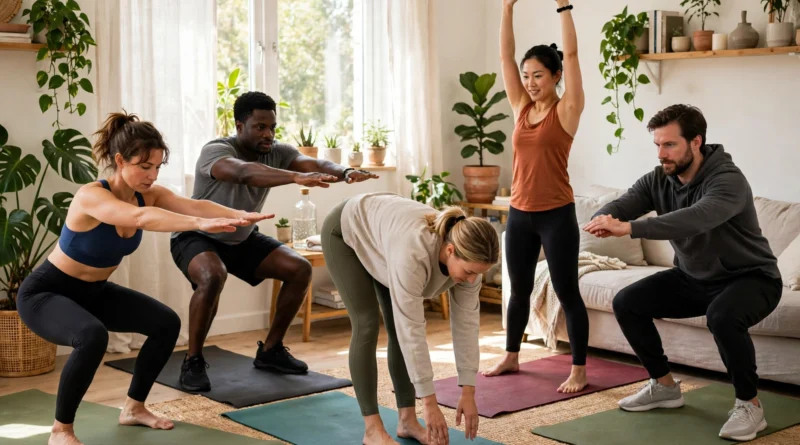
Best Group Exercises at Home: Fun Workouts for Families, Partners and Friends
Direct Answer
The best group exercises at home are simple bodyweight moves that everyone can do at the same time, at their own level: squats, lunges, glute bridges, planks, step touches and marching in place, plus a few partner moves and one team game to finish. No equipment is needed, a session of 20 to 40 minutes works for most groups, and the trick is not picking harder exercises — it is picking exercises with an easier and a harder version, so nobody is left behind or bored.
Key Takeaways
- The best group exercises at home are moves everyone does together: squats, push-ups, lunges, glute bridges, planks and step touches.
- Everyone does the same exercise at the same time, but at their own level — that solves the mixed-fitness problem.
- No equipment is needed. Body weight alone builds strength, cardio fitness and balance.
- A 20- to 40-minute session, twice a week, is a realistic starting point for most households.
- Partner moves and a short team game at the end keep the session fun instead of competitive.
- Low-impact, quiet versions exist for sore knees, older relatives and neighbours downstairs.
- Adults still need the same weekly totals whether they train alone or in a group: at least 150 minutes of moderate activity plus muscle-strengthening work on 2 days, according to CDC guidance.
What Are the Best Group Exercises at Home?
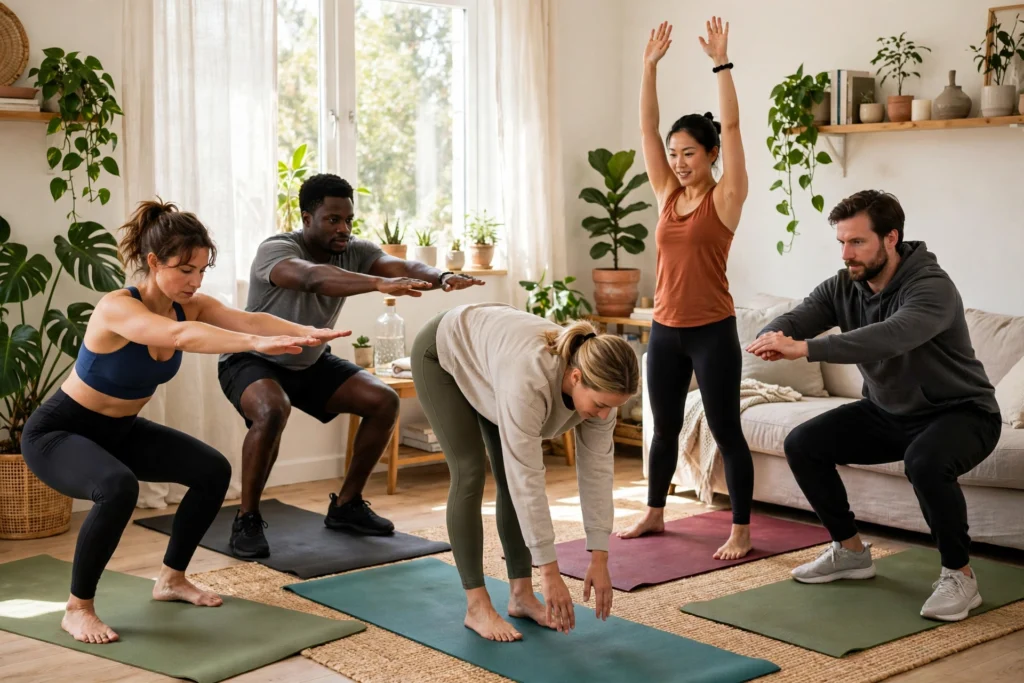
Group exercises at home are workouts done together in a living room, garden or over a video call, using body weight instead of gym machines. They work for a simple reason: if you have agreed to work out with your partner, family or friends at seven o’clock, you turn up at seven o’clock. Motivation is the hardest part of home exercise, and a group appointment solves more of it than any new piece of equipment.
The best group exercises share three qualities. First, they are scalable — easy to make harder or easier for each person. Second, they need little or no equipment and little floor space. Third, they are easy to learn by watching, so nobody needs a long explanation before the first set. Squats, lunges, glute bridges, planks, marching and step touches all pass that test. Complicated choreography and heavy weights do not, which is why they make poor group choices at home even though they can be good solo workouts.
A group session is also different from a solo session in one useful way: it mixes cardio, strength and fun in the same half hour. A bodyweight circuit raises the heart rate, a plank or squat builds strength, and a game at the end gives everyone a reason to come back next time. Our guide to cardio exercises explains the heart-health side in more detail, and this guide focuses on how to run the group version well.
How Do You Work Out as a Group When Everyone Is at a Different Fitness Level?
This is the question that decides whether a home group workout survives past week one. The answer is: everyone does the same exercise, at the same time, for the same length of time — but each person uses their own level of that exercise.
| Exercise | Easier | Standard | Harder |
|---|---|---|---|
| Squat | Sit-to-stand from a chair | Bodyweight squat | Jump squat |
| Push-up | Wall or knee push-up | Full push-up | Push-up with a high-five to a partner |
| Lunge | Small step back, hold a chair | Reverse lunge | Walking lunge |
| Plank | Knees-down plank | Forearm plank | Plank with shoulder taps |
| Marching | March in place, low knees | High knees | High knees with arm swings |
| Glute bridge | Two-foot bridge | Single-leg bridge | Bridge with a pause at the top |
Set a timer rather than counting reps together. When everyone works for 40 seconds and rests for 20 seconds, the fittest person and the least fit person finish at the same moment, and nobody is waiting or rushing. Three rounds of that pattern make a solid session, and the timer — not the strongest person — sets the pace.
Two more rules help. First, never make the session a race or a contest of repetitions; that turns a shared habit into a test, and the people who most need the habit are the first to drop out. Second, let the least confident person set the starting level. A session that feels too easy for the fittest person is still useful exercise; a session that feels impossible for one person ends the group.
The 10 Best Group Exercises at Home
1. Bodyweight circuit
The backbone of almost every good group session. Set up five or six stations — squats, push-ups, lunges, glute bridges, planks and step touches — and everyone does each move for 40 seconds before moving on. Circuits are efficient, they need no equipment, and they let a group of any size work at once. They are also the easiest format to scale: each person simply uses their own level from the table above.
2. Partner squat hold and pass
Best for pairs. Stand facing your partner about an arm’s length apart, lower into a squat together, and pass a small object — a water bottle, a cushion, a rolled-up towel — back and forth while staying low. Do 3 rounds of 45 seconds with 30 seconds of rest. It builds leg strength and balance, and passing something back and forth keeps the focus off the burn.
3. Partner push-up high-fives
Best for couples and friends. Face each other in push-up position, do a push-up each, then lift one hand to high-five your partner, alternating sides. Use knee push-ups if full push-ups are too hard; the point is the shared rhythm, not the difficulty. This is a good upper-body partner move for a group of two.
4. Circuit relay
Best for groups of three to six. Split into pairs or small teams and rotate through stations, with one person resting while the others work. Relay-style exercises turn fitness into a team activity and keep everyone engaged even in a small room, because the resting person is counting, cheering or setting up the next station rather than standing idle.
5. Group dance workout
Best for families with children and anyone who dislikes structured exercise. Put on a playlist, agree on a few easy steps everyone can follow, and dance for 15 to 20 minutes. Dancing counts as moderate cardio when it raises your breathing, it needs no instruction, and children will join a dance session far more willingly than a squat session. Keep the steps simple and let different people choose the songs.
6. Group yoga flow
Best for a calmer session or a cool-down. A short flow of gentle stretches, cat-cow, downward dog, warrior poses and seated twists works for mixed ages, and partner stretches — where you gently help each other deepen a hamstring or shoulder stretch — add a bonding element without any competition. Yoga is also the best group choice when the group includes someone recovering from a hard week or needing a lower-intensity day.
7. Family fitness bingo
Best for children, teenagers and parents together. Make a bingo card with one exercise in each square: 10 jumping jacks, a 15-second plank, 8 lunges per leg, 20 high knees, and so on. Roll a die or draw squares at random, and everyone completes the move together. Bingo turns a workout into a game, removes arguments about which exercise comes next, and lets younger children take a turn as caller.
8. Tabata team challenge
Best for groups that want a short, sharp session. Tabata is simple: 20 seconds of effort, 10 seconds of rest, repeated 8 times, for 4 minutes in total. Pick four exercises — for example burpees, high knees, squat jumps and bicycle crunches — and do one Tabata round for each. Keep it to one or two rounds for beginners, and offer a low-impact version of every move (step touches instead of jumps, marching instead of high knees) so the whole group can stay in.
9. Walk-and-workout combo
Best for groups that need fresh air or more space. Walk together for 10 minutes, stop at a park bench or open space for a short circuit of squats, lunges and planks, then walk back. The walking itself is moderate cardio, the stops add strength work, and the change of scenery makes the session feel less like a chore. This format also suits groups that include older relatives, who can walk the full route and join the easier circuit levels.
10. Living-room obstacle course
Best for larger families with space to move. Set a simple course — step over cushions, crawl under a table edge where safe, sidestep around chairs, finish with 10 squats — and take turns or run it together at a comfortable pace. Keep the course safe and the pace relaxed: the goal is movement and laughter, not speed records. Clear the floor first, and skip anything that needs jumping if neighbours downstairs are a concern.
A Simple 30-Minute Group Session Anyone Can Lead
| Block | Time | What to do |
|---|---|---|
| Warm-up | 5 minutes | March in place, arm circles, gentle leg swings, slow squats |
| Circuit round 1 | 10 minutes | Squats, push-ups, lunges, glute bridges, plank — 40 seconds each, 20 seconds rest, repeat once |
| Partner block | 5 minutes | Partner squat hold and pass, then partner push-up high-fives |
| Team game | 5 minutes | Family fitness bingo, or a dance round |
| Cool-down | 5 minutes | Slow stretches, deep breathing, group yoga flow |
A 15-minute version works the same way: warm up for 3 minutes, do one circuit round, play one game, and stretch for 2 minutes. Short sessions done regularly beat long sessions that only happen once. If the group is new, start with the 15-minute version for the first two weeks and only then move to 30 minutes.
How Many People Can Work Out Together at Home?
The number depends on the space available and the activities chosen. Two people can do partner moves for a whole session. Three to five people suit everyone-at-once circuits followed by one team game. Six or more people in one living room need stations or a relay format, so not everyone is moving in the same spot at the same time.
Mixed ages need a shorter, gentler plan: short sets, chairs available for sit-to-stand squats and seated versions, and a game to finish, kept to about 20 minutes in total. Children do best with games, dancing and bingo; older relatives do best with marching, step touches, chair-assisted squats and balance work such as heel-to-toe walking near a wall or chair for support. Friends in different houses can use the same 15-minute plan over a video call, with 40 seconds per exercise and everyone on mute except the person calling the changes.
How Long Should a Group Session Be, and How Often?
A session of 20 to 40 minutes is effective for most fitness goals, and beginner sessions of 10 to 20 minutes including warm-up and cool-down are a fine starting point. Twice a week together is a realistic answer for most households, with people doing their own activity on other days. That fits comfortably inside the general guidance from the CDC and the WHO: adults need at least 150 minutes of moderate-intensity activity a week, or 75 minutes of vigorous activity, plus muscle-strengthening activity on at least 2 days a week. Two group sessions plus a few walks or solo workouts across the week can cover that total without anyone needing a gym.
Short, focused workouts done consistently give better results than long, irregular ones. If the group can only meet once a week, make that one session count and encourage everyone to walk, cycle or follow a solo routine — our beginner workout plan gives a simple 3-day full-body routine for the days between group sessions — on the other days.
Do Group Workouts at Home Need Equipment?
No. Most of the best group exercises at home require zero equipment: your body weight is enough to build strength, improve cardio fitness and improve balance. A mat per person makes floor work more comfortable, a chair helps with easier squat and balance versions, and a timer on a phone runs the intervals. That is the full kit list for a beginner group.
Equipment becomes useful later, not at the start: resistance bands add a harder level for squats and rows, light dumbbells add load for lunges, and a skipping rope adds a cardio station. None of it is required to begin, and buying equipment before the habit exists is one of the commonest ways a home workout plan stalls. Start with body weight, and only add equipment when the group asks for a harder level.
Low-Impact and Quiet Options: Sore Knees and Neighbours Downstairs
Not every group member can jump, and not every home can take jumping. The good news is that almost every group exercise has a quiet, low-impact version: step touches instead of jumping jacks, marching in place instead of high knees, sit-to-stand squats instead of jump squats, and glute bridges and planks, which are silent by nature. Avoid burpees, jump lunges and running in place in upstairs rooms, and keep the session on mats or a rug where possible.
For sore knees, keep squats and lunges shallow, step rather than jump, and favour glute bridges, seated leg marches and upper-body work on hard days. Pain that is sharp, swelling, or that changes how someone walks is a reason to stop that exercise and, if it persists, to get it checked — this guide is general information, not personal medical advice, and anyone with a health condition, injury or pregnancy should check with a clinician before starting a new exercise routine.
Group Exercises at Home vs at the Gym
A natural follow-up question is what to do at the gym if the group wants to move beyond the living room, and how to start going to a gym in the first place. The honest answer is that the living-room version and the gym version solve different problems. At home, the group controls the music, the pace and the embarrassment level, and the cost is zero. At a gym, the group gains classes, heavier weights and more space — and a timetable to keep.
If the group does try a gym, start with a beginner class rather than the weight floor: a beginner circuit, dance or yoga class gives the same everyone-together structure as a home session, with an instructor setting the pace. Go together for the first few visits, agree in advance that nobody has to finish every set, and keep the home session going as well — most groups that move entirely to a gym lose the habit faster than groups that keep one easy home session a week as a fallback.
How Do You Make Home Group Workouts Enjoyable?
Rotate the session leader, so the same person is not always in charge. Choose music everyone likes, or let a different person pick the playlist each week. Change the game at the end regularly — bingo one week, dancing the next, a relay the week after — so the session does not become a drill. Celebrate progress that is not about weight or speed: more sessions completed, a new person joining, a move everyone can now do at a harder level.
The single most important rule is the one already stated: do not make the session a race or a contest of repetitions. Groups stay together when the weakest member feels welcome and the strongest member feels useful — for example, by demonstrating the harder level or leading the warm-up — rather than when one person wins.
FAQ
What are the best group exercises at home for beginners?
Bodyweight exercises like squats, planks, lunges, glute bridges and step touches are perfect for beginners. They require no equipment, they are easy to learn by watching, and each one has an easier version — chair squats, knee planks, small lunges — so beginners can join a mixed group from day one.
Can children join a group workout at home?
Yes, with games and shorter sessions. Dancing, family fitness bingo, obstacle courses and walk-and-workout combos suit children far better than timed circuits, and sessions for mixed ages should stay around 20 minutes with plenty of choice about which moves to do.
What if one person is much fitter than everyone else?
Use timed intervals and the level table in this guide. Everyone works for the same 40 seconds, but the fitter person uses the harder version of each move and the less fit person uses the easier version. The fitter person can also lead the warm-up or demonstrate, which keeps them engaged without leaving anyone behind.
Do we need to work out every day as a group?
No. Twice a week together, plus individual activity such as walking on other days, is enough to build a lasting habit and to work towards the weekly activity totals recommended by the CDC and WHO. Daily group sessions sound ambitious and usually collapse within a fortnight; twice a week survives.
Conclusion
The best group exercises at home are not the hardest ones. They are the simplest moves — squats, lunges, planks, bridges and step touches — done together, at each person’s own level, for 20 to 40 minutes, twice a week, with a partner move and a game to keep it enjoyable. Start with the 15-minute version, use a timer instead of rep counts, keep an easier version ready for every move, and protect the habit by never turning the session into a contest. Do that, and the group will still be meeting in three months’ time — which is the real result a home workout is for.