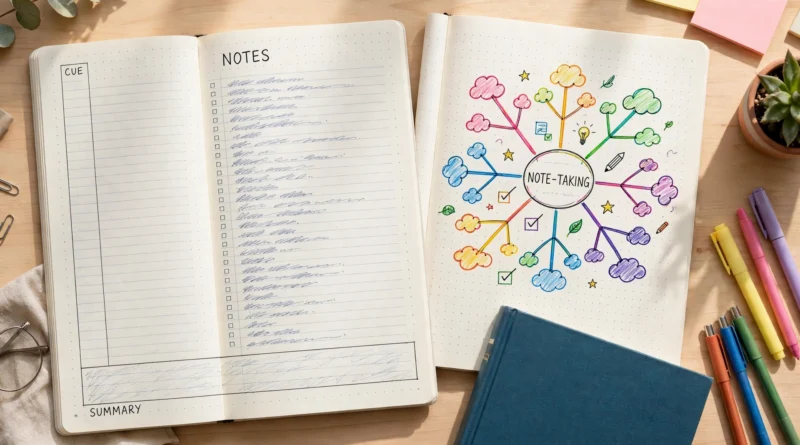
Note-Taking Methods: Cornell, Outline, Mapping, Charting and More — How to Pick the Right One
Direct Answer
Note-taking methods are repeatable layouts for capturing information so you can use it later — not just write it down. The five most commonly taught methods are Cornell, outline, mapping, charting, and sentence notes. There is no single best method: Cornell is strongest when you will be tested on detail, outline suits structured lectures and chapters, mapping suits topics full of connections, charting suits comparisons, and sentence notes suit fast, unstructured talks. Pick the method for the situation, write in your own words, and review your notes by testing yourself — that review step matters more than the layout you chose.
Key Takeaways
- A note-taking method is a structure, not a personality type — match it to the material, not to yourself.
- Cornell notes build a self-quiz into the page: cues on the left, notes on the right, a short summary at the bottom.
- Outline notes work when the lesson already has a clear shape; mapping works when everything connects.
- For textbooks, read a section first, then write from memory in your own words — copying word for word is the main trap.
- Review within 24 hours and quiz yourself from cues or headings instead of re-reading. That is what makes notes stick.

What Are Note-Taking Methods?
A note-taking method is simply a consistent way of arranging what you hear or read so that revision is possible later. Without a method, most people produce a wall of text that is hard to search, hard to quiz from, and easy to ignore until exam week. With a method, each page has a job: capture during the lesson, then support recall afterwards. Two ideas sit behind every good method. First, compression: notes should be shorter than the source, written in your own words, because turning an idea into your own phrasing forces you to understand it. Second, retrieval: notes should let you practise remembering, not just re-reading. Covering your notes and rebuilding the answer from a cue or heading does far more for memory than reading the same page three times.
What Are the 5 Main Note-Taking Methods?
The five methods taught most widely in schools and universities are Cornell, outline, mapping (mind maps and concept maps), charting, and sentence notes.
| Method | Layout | Best for | Watch out |
|---|---|---|---|
| Cornell | Cue column left, notes right, summary strip at the bottom | Lectures and chapters you will be tested on | Takes a little setup; the cue column only helps if you actually use it to quiz yourself |
| Outline | Headings with indented sub-points | Structured lectures, well-organised chapters | Falls apart when the speaker jumps around |
| Mapping | Central topic with branches and labelled links | Connected topics, essay planning, whole-unit revision | Can turn into a pretty poster that nobody revises from |
| Charting | Columns for categories, rows for items | Comparing things: theories, dates, products, characters | You need to know the categories before the lesson starts |
| Sentence | Numbered lines, one new idea per line | Fast, messy talks with no obvious structure | Messy by design — tidy it the same day or it becomes unreadable |
A few newer or niche systems — boxing (one box per topic per page), flow-based notes (arrows showing how ideas connect), rapid logging for meetings, and Zettelkasten (linked atomic notes for long research projects) — are covered briefly at the end. Most students only ever need the five above, plus one method for processing notes after class.
How Do You Use the Cornell Method?
The Cornell method was developed at Cornell University by professor Walter Pauk. It is the best default choice when you need to remember detail for a test, because the page layout includes its own revision tool. Set the page up like this: a wide column on the right (about two-thirds of the page) for notes, a narrow column on the left for cues, and a strip along the bottom for a summary. During class, write in the right-hand column only, in your own words, leaving a blank line between major points. Do not try to fill in the left column while the teacher is still talking. After class — ideally the same day — go back and add cues to the left column: a keyword or short question that each block of notes answers. Then write a two- or three-sentence summary at the bottom, again in your own words. That short delay-and-return step is part of the method, not optional decoration. To revise, cover the right-hand column, read a cue, and say the answer out loud from memory before you check it. The University of Warwick’s guide to notetaking styles describes exactly this cover-and-recall routine, and it is the reason Cornell beats a plain page of notes: you have turned your notes into a quiz without writing a second document. Cornell works best in classes that cover a lot of detailed information quickly, and for textbook chapters paired with lectures. It is less useful for brainstorming or for subjects where the connections matter more than the facts — that is mapping’s job.

How Does the Outline Method Work?
The outline method is the one most people already use without thinking about it: a main heading on the left, sub-points indented underneath, and details indented further still. Levels of importance are shown by how far right a point sits. It works brilliantly when the material already has a clear shape — a history lecture on three causes of a war, a biology chapter organised by body system, a business case with a problem, options, and a decision. It also makes review easy, because you can turn each main heading into a question and answer it from the indented points below. It struggles in two situations. First, when the speaker jumps around, your outline ends up with arrows linking everything to everything, which is a sign you should have mapped instead. Second, when the lecture moves too fast to think about organisation while listening — in that case, capture with sentence notes and convert them into an outline the same day. The conversion itself is useful revision. A practical tip: leave blank space between sections as you write. Speakers return to earlier points more often than you expect, and space lets you add the late detail under the right heading instead of squeezing it into a margin.
What Is Mapping in Note-Taking?
Mapping puts the main topic in the centre of the page and branches out to subtopics and details. A mind map keeps the branches free-form; a concept map goes one step further and labels each link — “causes”, “is a type of”, “leads to” — so the relationships themselves are part of the notes. Mapping is ideal when everything connects: an ecosystem, the themes in a novel, the causes and effects of a revolution, or a whole unit you are revising at once. It is also a strong essay-planning tool, because a finished map can be turned into an outline for a draft by reading the branches in order. Mapping is usually better as a processing step than a live-capture step. Many students take outline notes in class and turn them into a map afterwards, which doubles as revision. If you try to map live during a fast lecture, you can spend so much attention on the drawing that you stop listening. Capture first, map second. One honest warning: a map that looks good is not automatically a map you have learned from. After you draw it, test yourself the same way as with Cornell — cover the branches, start from the centre, and rebuild the map from memory.
How Does the Charting Method Work?
Charting turns notes into a table. Before the lesson, decide on the categories you will compare and set them up as column headings. During the lesson, slot each fact into the right column as you hear it. It shines whenever a lesson is basically a comparison: rock types and how each one forms, political parties and their policies, literary characters and their motives, or competing theories and their evidence. Rows keep items separate, columns keep the comparison honest — you can see at a glance which cell is empty, which is exactly the gap to fill in later. Charting needs preparation, which is its main cost. If you do not know the categories in advance, you cannot set the table up, and building it mid-lecture is slow. When the categories only become clear during the lesson, use sentence notes live and chart them afterwards.
| Method | Capture speed | Revision value | Needs preparation |
|---|---|---|---|
| Cornell | Medium | High (built-in self-quiz) | A little (page setup) |
| Outline | Fast | Medium | No |
| Mapping | Slow live, fast afterwards | High for connected topics | No |
| Charting | Medium | High for comparisons | Yes (column headings) |
| Sentence | Fastest | Low until tidied | No |
What Is the Sentence Method?
The sentence method is the simplest of all: write each new idea as its own numbered sentence, one after another, with no attempt at structure. It looks messy, and that is the point — when a talk is fast and unstructured, trying to organise live means falling behind. Use it for guest talks, fast meetings, and lectures where the speaker jumps between topics. The rule that makes it work is the same-day tidy: within 24 hours, convert the numbered sentences into an outline, Cornell cues, or a map. Without that step, sentence notes decay into a list nobody can revise from. With it, they are often the most faithful record of what was actually said, because you never stopped listening to organise. For maths and science, add one habit to whichever method you use: write worked examples step by step, with a short note on why each step happens, so you can redo the problem later without looking at the answer.
How Do You Take Notes from a Textbook?
Textbook notes fail in a predictable way: the student highlights half the chapter, copies sentences into a notebook, and remembers very little a week later. Highlighting only marks text. Rewriting the idea in your own words is the step that helps it stick. A reliable three-pass routine works for most chapters:
- Preview before you read. Skim the headings, subheadings, introduction, conclusion, and any summary boxes. Write the headings down as an outline, leaving room under each. You now know the chapter’s shape before you start.
- Read a section, then compress from memory. Read one section at a time — not the whole chapter at once. Close the book and write the key points from memory in your own words, under the right heading. Then reopen the book, check what you missed, and fill only the gaps.
- Summarise and review. Write a few sentences at the end summarising the whole chapter. Review those notes after one day, one week, and one month, each time by trying to recall before you re-read.
Which layout fits a textbook chapter? Cornell suits narrative chapters paired with lectures, outline suits well-structured technical chapters, and mapping suits concept-heavy chapters where ideas link together. A detailed textbook-notes guide from SchoolHabits walks through the same choices — paper, digital, or stylus notes, and two-column, Cornell, and outline formats — and reaches the same conclusion: start with the simpler formats, because strict systems are hard to sustain. One more textbook habit worth keeping: always note the chapter and page numbers at the top of your notes. When you need to check a detail later, that small label saves a long search.
How Do You Take Notes from a Book?
Taking notes on a book — a novel, a biography, a non-fiction book you are reading for an essay — follows the same principles with one change of emphasis: you are tracking an argument or a story, not a syllabus. Use the book’s own structure. Chapter titles and section headings become your outline headings. Under each, note the main idea in your own words, plus one short quotation or page reference only where the exact wording matters for an essay. For fiction, a simple chart works well: columns for character, what they want, what they do, and what changes. For non-fiction, Cornell’s summary strip is useful at the end of each chapter — it forces you to state what the chapter actually argued, which is exactly what an essay needs. The same rule applies as with textbooks: do not copy paragraphs. If your notes are nearly as long as the book, they are a transcript, not notes, and they will not help you write or revise.
How Do I Take Notes? A Quick-Start Checklist
If you are starting from scratch, use this sequence for your next lecture or chapter: Before: pick the method for the material (structured = outline, testable detail = Cornell, connections = mapping, comparison = charting, chaos = sentence). During: write in your own words, use abbreviations and symbols, leave blank space between points, and mark anything confusing with a star to check later. After (same day): fill in Cornell cues or convert sentence notes, write the summary, and star-check the confusing points against the textbook or a classmate. Next day: cover the notes and quiz yourself from cues or headings. Anything you cannot answer goes on a short re-study list. On paper versus digital: handwritten notes are often better for understanding, because you cannot transcribe word for word at handwriting speed and must therefore summarise. Typed notes are better when you need to search, reorganise, or share them later. A workable compromise is handwritten capture with a typed tidy-up, or typed notes with a handwritten summary. Students choosing a laptop for this work often weigh keyboard, battery, and weight together — see Best Laptops for Engineering Students.
Which Note-Taking Method Is Best?
There is no overall winner, only a best fit for each situation. Use this picker: Structured lecture or chapter, and you need a clean record: outline. Material you will be examined on in detail: Cornell. Revising a whole unit, or planning an essay: mapping. Comparing theories, products, characters, or dates: charting. Fast talk with no structure: sentence notes, tidied the same day. Meetings and daily logs: rapid logging with action items and owners. Research you will build on for months: linked atomic notes (Zettelkasten), where each note holds one idea and links to related notes. Most experienced note-takers end up combining methods: one for capture during the session, and one for processing afterwards. Outline in class and Cornell cues afterwards, or sentence notes live and a map at the end of the unit, are both common and effective combinations.
How Do I Review My Notes So They Stick?
Review is where most note-taking systems succeed or fail. Two habits carry almost all of the benefit: Self-testing beats re-reading. Cover the notes, read the cue or heading, and say the answer before checking. Cornell’s cue column and outline headings are both built for this. If you can say it without looking, you know it; if you cannot, you have found exactly what to re-study. Space the reviews. Review after one day, one week, and one month. Each review makes the next one easier, and a short spaced review beats a long cramming session the night before. Turning cue questions into flashcards automates the spacing, but the schedule matters more than the tool — spaced review on paper beats cramming with the best app.
Common Note-Taking Mistakes to Avoid
- Copying word for word from the lecture or textbook instead of compressing into your own words.
- Writing everything down, which produces long notes nobody revises, instead of selecting key ideas and examples.
- Never returning to the notes after class — unreviewed notes decay fast, whatever method produced them.
- Choosing a method for its looks (especially an elaborate map) rather than for whether you can quiz yourself from it.
- Mixing methods randomly on the same page, so no single structure can be revised from. Mix across sessions, not within one page.
FAQ
Can I mix note-taking methods?
Yes — most people do. Use one method to capture and another to process: outline live and Cornell cues afterwards, or sentence notes live and a map for revision. Just keep one structure per page so revision stays possible.
Should I handwrite or type my notes?
Handwriting usually aids understanding because it forces summarising; typing wins for search and reorganisation. Choose by purpose: handwrite for learning, type for reference, or combine both.
Do I need a special notebook or app?
No. Cornell needs only a ruled page with a margin, outline needs only indentation, and mapping needs only blank paper. Apps help with search and linking, and AI tools can help turn rough notes into organised summaries — see Best AI Tools — but no app replaces the same-day review and self-test.
What is SQ3R, and is it a note-taking method?
SQ3R (Survey, Question, Read, Recite, Review) is a reading method, not a layout. You survey the chapter, turn headings into questions, read to answer them, recite the answers from memory, and review later. It pairs well with Cornell or outline notes, and it is the deepest option for dense conceptual textbooks — slower, but with the strongest recall payoff.
How long should good notes be?
Shorter than the source, always. A useful rule: one to two pages of notes per textbook chapter, and one page per lecture hour at most. If your notes are longer, you are transcribing, not summarising.
Conclusion
Note-taking methods are tools, not rules. Start with Cornell for testable material and outline for structured material, add mapping when ideas connect and charting when things need comparing, and keep sentence notes for the fast, messy talks. Whatever layout you choose, the habits that make it work are the same: write in your own words, process the notes the same day, and review by testing yourself rather than re-reading. Do those three things, and your notes stop being something you wrote once and start being something you can actually learn from.
Once your notes are organised, the software you write them in matters too — see our guide to Microsoft Word alternatives for free options that open and save Word files.