Skin Care Products: How to Choose the Right Ones for Your Skin Type
Quick Answer: Which Skin Care Products Do You Actually Need?
You only need three skin care products to start: a gentle cleanser, a moisturizer, and a broad-spectrum sunscreen with SPF 30 or higher. Everything else — serums, toners, exfoliants, eye creams, masks — is optional and should only be added one at a time, for a specific reason, after the basics are working for you. The American Academy of Dermatology makes the same point: products do not need to be expensive to be effective, and a simple three-step approach of cleansing, moisturizing, and protecting your skin is the key.
The rest of this guide explains how to pick the right version of each product for your skin type, which ingredients genuinely help, which ones to avoid, and how to build up your routine without irritating your skin.
Key Takeaways
- Start with three products: cleanser, moisturizer, and sunscreen (SPF 30+, broad-spectrum).
- Choose formulas by skin type: gels and foaming cleansers for oily skin, creams for dry skin, fragrance-free products for sensitive skin.
- Apply products thinnest to thickest, with sunscreen last in the morning.
- Add only one new product at a time and give it four to six weeks before judging it.
- Price is not a reliable guide to quality — a basic moisturizer with the right ingredients can work as well as a luxury one.
- This article gives general skin care information only. It is not medical advice, and persistent or severe skin problems deserve a dermatologist, not a new product.
What Are Skin Care Products?
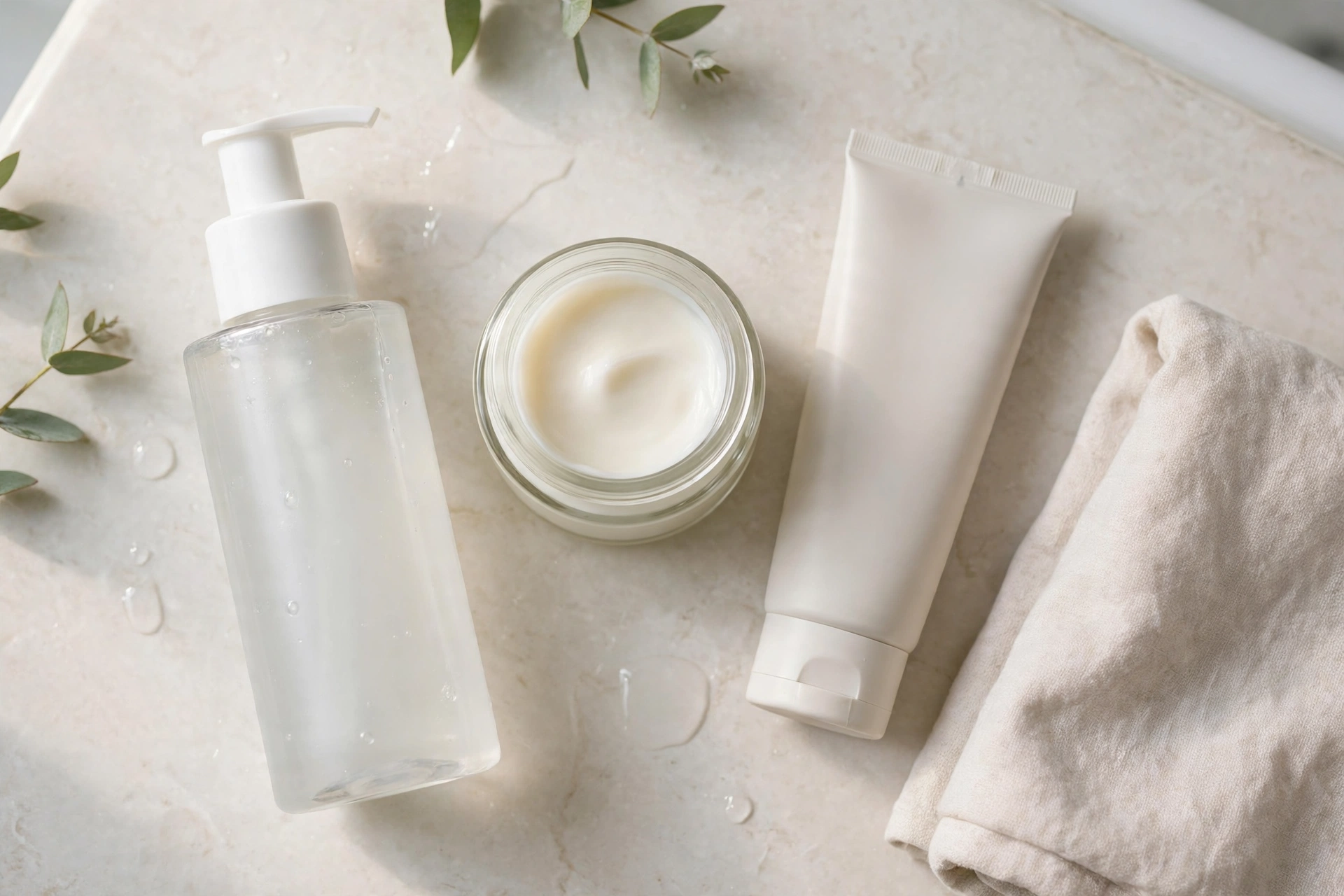
Skin care products are the cleansers, moisturizers, sunscreens, and treatments you apply to your skin to keep it clean, comfortable, and protected. They fall into a few clear jobs, and understanding the job each one does is the fastest way to stop buying products you do not need.
| Product type | What it does | Essential or optional? |
|---|---|---|
| Cleanser | Removes oil, sweat, makeup, sunscreen, and daily buildup | Essential |
| Moisturizer | Adds hydration and supports the skin barrier | Essential |
| Sunscreen | Protects against ultraviolet (UV) damage | Essential (daytime) |
| Serum | Delivers a concentrated active ingredient for one goal | Optional |
| Exfoliant | Removes dead surface skin cells | Optional |
| Toner | Adds a specific ingredient or light hydration step | Optional |
| Eye cream | A moisturizer formulated for the thinner skin around the eyes | Optional |
| Face mask | A short, intensive treatment for hydration or exfoliation | Optional |
If a product does not fit one of these jobs, or duplicates a job another product in your routine already does, you probably do not need it.
What Skin Care Products Do I Need?
For most people, the honest answer is three. Dermatologists consistently recommend the same starting lineup, and it is the lineup this site’s skin care routine guide is built around: cleanse, moisturize, protect.
1. A gentle cleanser. Wash your face twice a day — morning and night — and after sweating. A good cleanser leaves your skin feeling clean and comfortable, never tight, squeaky, or stinging. If your skin feels tight after washing, your cleanser is too harsh for you, whatever the label promises. Our guide to choosing a face wash covers cleanser types in detail.
2. A moisturizer. Apply it to slightly damp skin after cleansing, morning and night. Moisturizer traps water in your skin and supports the barrier that keeps moisture in and irritants out. Even oily skin needs one — skipping moisturizer can leave oily skin dehydrated, which often makes it produce even more oil.
3. A broad-spectrum sunscreen, SPF 30 or higher. Apply it every morning as the last step of your routine, to all skin not covered by clothing, and reapply every two hours outdoors or after swimming or sweating. Sunscreen is the single most protective step in any routine: UV damage is the main cause of premature aging, dark spots, and skin cancer, and no serum can undo years of skipped sun protection.
Once these three are working comfortably for four to six weeks, you can consider one optional product for a specific goal — for example, a niacinamide serum for oiliness and uneven tone, or a gentle exfoliant for dullness. Add one at a time, so you can tell what is actually helping. For a step-by-step starting point, see this beginner routine guide.
How to Choose Skin Care Products for Your Skin Type
Skin type is the first filter for every product choice. Here is how to tell yours, and what to look for:
| Skin type | How to recognise it | Look for | Avoid |
|---|---|---|---|
| Oily | Shiny, especially in the T-zone (forehead, nose, chin), within a few hours of washing; larger-looking pores; prone to blackheads | Gel or foaming cleansers, lightweight lotions, oil-free and non-comedogenic labels (meaning less likely to clog pores) | Heavy creams and oils that sit on the skin |
| Dry | Feels tight, rough, or flaky after washing; may look dull | Cream or lotion cleansers, richer creams with ceramides, glycerin, or hyaluronic acid | Foaming cleansers, alcohol-based toners, harsh scrubs |
| Combination | Oily T-zone with normal or dry cheeks | A gentle cleanser plus a lightweight moisturizer; you can use a richer cream only on dry areas | Treating the whole face as one type |
| Sensitive | Stings, burns, itches, or turns red easily | Fragrance-free, hypoallergenic products with short ingredient lists; soothing ingredients such as aloe or chamomile | Fragrance, alcohol, menthol, and essential oils |
| Normal | Comfortable most of the time, neither very oily nor very dry | A gentle cleanser, a balanced moisturizer, and sunscreen — you have the widest choice | Overloading a routine that already works |
Not sure about your type? Wash your face with a gentle cleanser, wait an hour without applying anything, and observe: shine all over suggests oily, tightness suggests dry, shine only in the T-zone suggests combination, and stinging or redness suggests sensitive. Skin type can also shift with seasons, climate, and age, so re-check if products that once worked start feeling wrong.
What Is Skin Texture?
Skin texture is how the surface of your skin looks and feels — smooth or rough, even or bumpy. Uneven texture usually comes from a buildup of dead skin cells, dryness, clogged pores, or past breakouts. It is a normal variation, not a flaw, and it changes over time.
How to Improve Skin Texture
Texture improves when you address its cause rather than scrubbing at it:
- Cleanse gently and consistently. Removing daily buildup stops pores from clogging, which is the most common cause of a bumpy feel.
- Moisturize daily. Hydrated skin looks and feels smoother; dry, flaky skin exaggerates every bump.
- Exfoliate gently, and only 2–3 times a week at most. Chemical exfoliants (such as salicylic acid for oily skin or glycolic acid for dry, dull skin) dissolve dead cells without scrubbing. Physical scrubs can irritate, especially on sensitive skin.
- Wear sunscreen every day. UV damage thickens and roughens skin over time, so sun protection is a texture treatment too.
- Be patient. Skin renews itself over roughly a month, so give any change at least four weeks before deciding it is not working. If texture changes suddenly, or comes with pain, swelling, or sores, see a dermatologist rather than adding products.
Best Skin Care Products: What “Best” Actually Means
Search results for “best skin care products” are full of ranked lists, but the best product for you is the one that matches your skin type, solves your specific concern, and does not irritate your skin — not the one with the most famous name. Use these tests instead of a list:
- Does it match your skin type? A “best” cream for dry skin can be exactly wrong for oily skin.
- Does it contain a proven ingredient for your goal? Niacinamide for oiliness and uneven tone, hyaluronic acid and ceramides for hydration, salicylic acid for clogged pores, vitamin C for dullness — each has real evidence behind it.
- Is the ingredient list short and readable? Long lists full of fragrance and filler usually mean the active ingredient is present in tiny amounts.
- Does your skin stay comfortable after two weeks? No stinging, no new breakouts, no tightness. Comfort is the test that matters most.
- Can you afford to keep using it? A routine only works if you actually use it every day, so a product you can repurchase beats one you cannot.
This is also why this guide does not name “the best” brand: brands reformulate, prices change, and the right pick depends on your skin. Judge products by type and ingredients, not by advertising.
Ingredients to Look For — and Ingredients to Avoid
Ingredients worth looking for:
- Hyaluronic acid and glycerin — humectants that draw water into the skin; good for almost every skin type.
- Ceramides — fats naturally found in the skin barrier; help dry and sensitive skin hold moisture.
- Niacinamide (vitamin B3) — gentle, suits most skin types, helps with oiliness, uneven tone, and barrier strength.
- Salicylic acid (BHA) — gets inside pores, so it suits oily or breakout-prone skin.
- Vitamin C — helps with dullness and uneven tone, but can irritate sensitive skin, so start slowly.
Ingredients to be cautious about:
- Fragrance (including “parfum”) — the most common cause of irritation and allergic reactions, especially for sensitive skin. “Fragrance-free” is safer than “unscented,” which can still contain masking fragrances.
- Alcohol denat (denatured alcohol) — strips natural oils and can dry and irritate skin.
- Harsh sulfates — strong cleansing agents that can strip the skin barrier.
- Essential oils — natural does not mean gentle; several are common irritants.
- Multiple strong actives at once — retinol plus a strong exfoliant plus vitamin C on the same day is a recipe for irritation. Introduce actives one at a time.
A useful label habit: ingredients are listed from highest to lowest concentration, and the first five usually make up most of the product. If the ingredient you are buying it for sits near the end of the list, it is present in a very small amount.
What Order Do You Apply Skin Care Products?
Apply products from thinnest to thickest, and always finish your morning routine with sunscreen:
- Cleanser
- Toner (if you use one)
- Serum or treatment
- Eye cream (if you use one)
- Moisturizer
- Sunscreen (morning only, last step)
Wait a minute or so between layers so each one can settle. In the evening, the same order applies without sunscreen. Our full morning-and-night routine guide walks through the timing in detail, including how sunscreen fits after moisturizer.
How to Add a New Product Without Irritating Your Skin
Most bad reactions come from adding too much, too fast. Use this checklist:
- Patch test first. Apply a small amount behind your ear or along your jawline for 48 hours and watch for redness, itching, or breakouts before using it on your whole face.
- One product at a time. Wait at least two weeks — ideally four — between new products, so you know which one caused any reaction.
- Start slowly with actives. Retinol and exfoliating acids work best 2–3 nights a week at first, building up only if your skin stays comfortable.
- Stop if it stings persistently. Mild tingling that fades in a minute is one thing; burning, peeling, or breakouts that worsen mean the product is not for you. Stop it, return to your three basics, and let your skin settle.
- Keep a simple note. A phone note of what you started and when makes it easy to spot the culprit when something goes wrong.
Do I Need Expensive Skin Care Products?
No. Dermatologists are clear on this: products do not need to be expensive to be effective. A basic cleanser, moisturizer, and sunscreen with the right ingredients can perform as well as luxury versions, because what matters is the formula, not the packaging or the price tag. Where spending more can make sense is texture, fragrance-free formulation, or a specific active at a proven concentration — but none of those requires a luxury price. If a product works for your skin and you can afford to keep buying it, that is the right product, whatever it costs.
Common Mistakes With Skin Care Products
- Using too many products at once. Ten products used sporadically lose to three products used daily, every time.
- Scrubbing hard or washing too often. Over-cleansing strips the barrier and usually makes oiliness, dryness, and breakouts worse.
- Skipping sunscreen on cloudy days or indoors. UV rays pass through clouds and glass, so daily sunscreen matters even when you cannot see the sun.
- Judging a product after three days. Skin needs weeks to respond; early breakouts from a new active are sometimes confused with a bad reaction, while true irritation keeps getting worse.
- Copying someone else’s routine. A routine built for different skin, a different climate, and different concerns is unlikely to suit you.
Frequently Asked Questions
Can one product do everything?
A moisturizer with sunscreen covers two jobs in the morning, and some cleansers include gentle exfoliants, but no single product cleanses, hydrates, treats, and protects equally well. The three basics remain the honest minimum.
Do men need different skin care products?
No — skin care products work by skin type and concern, not by gender. Men may prefer fragrance-free or lighter formulas and often have thicker, oilier skin, but the same cleanser-moisturizer-sunscreen foundation applies.
How long do skin care products take to work?
Hydration improves within days, but texture, tone, and breakouts usually need four to six weeks of consistent use, and some ingredients take eight to twelve weeks to show their full effect. If nothing has changed after twelve weeks, the product is probably not addressing your concern.
Conclusion
Choosing skin care products gets simple once you ignore the noise: start with a gentle cleanser, a moisturizer, and sunscreen; pick formulas for your actual skin type; judge products by ingredients and by how your skin feels after two weeks, not by price or advertising; and add new products one at a time. That three-product foundation, used every day, will do more for your skin than a shelf full of products used now and then. If your skin problems persist, worsen, or worry you, a dermatologist can identify what is really going on far faster than another new product can.
General information only: this article does not replace advice from a dermatologist or another qualified healthcare professional.
Sources: American Academy of Dermatology and beginner routine guide.
For a detailed beginner guide to one treatment product, see our guide to the best retinol and how to use it without irritating your skin.