Smart Ways to Save Money on Groceries: A Practical Guide That Actually Works
Direct answer
Smart ways to save money on groceries start before you reach the store: plan your meals, shop from a list built around what you already own, compare unit prices instead of sticker prices, choose store brands for staples, buy seasonal produce and frozen vegetables, and stop food going to waste. Done together, these habits cut a grocery bill without cutting the quality of what you eat — no extreme couponing, no bland meals, and no weekly spreadsheet required.
Key Takeaways
- Plan meals first, then write the list — this one habit prevents most impulse buying and most wasted food.
- Compare the unit price (cost per ounce, per pound, or per item), not the size of the pack.
- Store brands are usually the same staple for less; try them on rice, pasta, canned goods, and cleaning basics first.
- Buy in bulk only for things you will definitely use before they go off.
- Seasonal produce, frozen vegetables, and leftovers used on purpose are three of the biggest quiet savers.
How do I grocery shop on a budget?
Start with a number, not a wish. Look at what you actually spent on groceries over the last four weeks — your bank app or card statement will show it faster than any guess — and set a weekly target a little below that average, not half of it. A target you can hit for four weeks in a row beats a dramatic one you abandon by Wednesday.
Then build a simple weekly rhythm:
- Check the fridge, freezer, and pantry before you plan anything. Meals built around what you already own are free meals in disguise.
- Plan five or six dinners, not seven — leave room for leftovers, a night out, or a fridge-clearing evening.
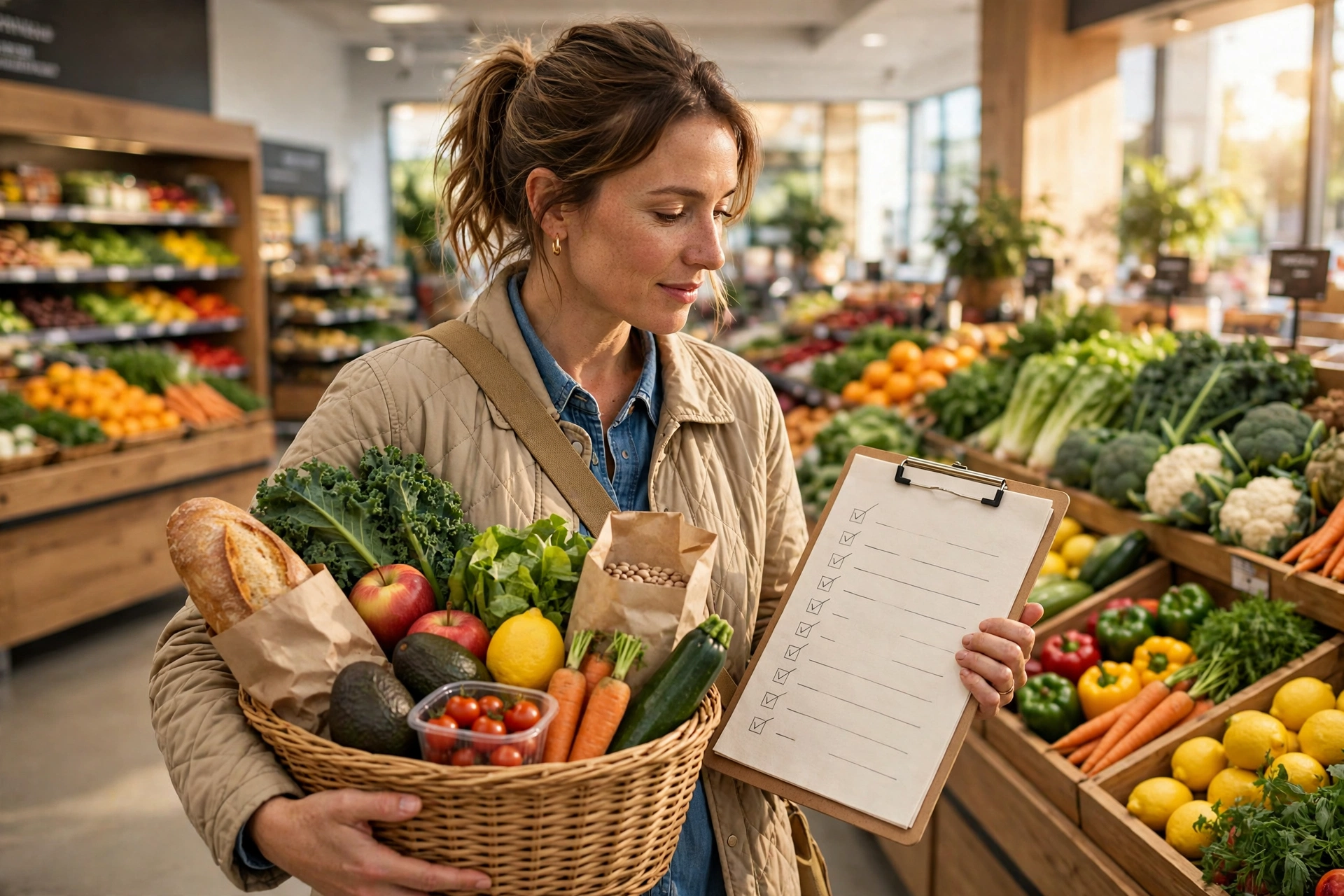
- Write the list from the plan, grouped by store section, so you walk the store once instead of circling back past the snacks.
- Shop the list. If something is not on it, it needs a reason, not just a good display.
If tracking every dollar feels heavy, a budgeting app can do the adding-up for you — our guide to the best budget apps compares options that track grocery spending automatically. And if grocery saving is part of a bigger question — how far your money will stretch overall — see how long your money will last.
How do I meal plan to save money?
Meal planning saves money in three ways at once: you buy less, you waste less, and you order less takeout on tired evenings. The trick is to plan around overlap. If Monday’s roast chicken becomes Tuesday’s chicken sandwiches and Wednesday’s soup, one purchase covers three meals and nothing lingers in the fridge until it has to be thrown away.
A workable weekly template looks like this:
- Two meals built around a cheap, flexible protein (eggs, beans, lentils, or chicken thighs).
- One batch-cooked meal you deliberately make double of, and freeze half.
- One ‘use it up’ meal — stir-fry, soup, or fried rice — designed to finish leftover vegetables and grains.
- One simple meal (pasta, eggs on toast, soup and bread) for the night you will not feel like cooking.
Keep a short list of five or six meals your household reliably likes and rotate them. A meal plan does not need to be new or exciting every week; a plan you actually follow is worth far more than an ambitious one you ignore. For a complete week of breakfast, lunch and dinner planning, see our weekly meal-ideas planning guide.
What is a unit price, and why does it matter?
The unit price is the cost per ounce, per pound, per litre, or per item — usually printed in small type on the shelf-edge label next to the big sticker price. It is the only fair way to compare two packs of different sizes, because the bigger pack is not always the better deal.
A large bag of rice can cost more per pound than the medium bag if the large one is not actually on offer. A ‘value’ multipack of snacks can cost more per item than buying the singles. Checking the unit price takes about two seconds per item once it becomes a habit, and it is the single most reliable defence against paying extra for packaging.
Should I buy store brands?
For most staples, yes — try them. Store-brand rice, pasta, canned tomatoes, oats, flour, frozen vegetables, and basic cleaning products are often made to the same standard as the branded version, and the saving on each item is small but repeats every single week, which is exactly how it adds up.
A low-risk way to switch:
- Start with ingredients that disappear into a dish (canned tomatoes, stock, beans, flour) rather than foods you eat plain.
- Switch one category per shop, so a disappointing swap never ruins a whole trolley.
- Keep the brand only where you can genuinely taste or feel the difference — for most households that is a short list, not a long one.
If a store brand disappoints, you have lost a dollar or two once, not a fortune. If it works, you save that amount every week for years.
Is buying in bulk actually cheaper?
Buying in bulk is cheaper only when you use everything you buy. A bulk pack of rice, dried beans, canned goods, or toilet paper that you will definitely finish is a genuine saving. A bulk pack of berries, salad, or bread that half goes off is not a saving at all — it is a more expensive way to throw food away.
| Safe to buy in bulk | Think twice before bulk-buying |
|---|---|
| Rice, pasta, oats, dried beans and lentils | Fresh berries, salad leaves, and soft fruit |
| Canned goods, stock, and long-life milk | Bread, unless you freeze it the same day |
| Frozen vegetables, fruit, and meat | Fresh herbs, unless you freeze or dry them |
| Paper goods and cleaning basics | Anything you bought only because the pack was big |
| Pantry staples you use weekly | Perishables for a household of one or two |
Before a bulk purchase, ask one question: how fast does my household actually finish this? If the honest answer is ‘not before it goes off,’ buy the smaller pack.
How do I stop impulse buying?
Most impulse buying happens in three places: the end of the aisle, the checkout queue, and a hungry stomach. You can beat all three with simple rules:
- Never shop hungry. Eat something before you go — this old advice survives because it works.
- Skip the middle aisles when you can. Fresh food mostly lives around the edge of the store; the centre is where the processed snacks and impulse displays live.
- Use curbside pickup or an online order if you know you are tempted in-store. Ordering from your list removes the displays entirely, and you see the running total before you pay.
- Give yourself a small ‘treat’ line in the budget. A planned treat does not blow the plan; an unplanned trolley-full does.
How do I reduce food waste?
Food waste is money in the bin, and it is often the largest hidden part of a grocery bill. Three habits fix most of it: store food properly, use leftovers on purpose, and know the difference between ‘best before’ (quality) and ‘use by’ (safety) dates on perishable food.
Practical steps that cost nothing:
- Put new items behind old ones in the fridge so the oldest gets used first.
- Freeze bread, meat, and cooked meals in portions the day you buy or cook them, not the day they start looking tired.
- Turn leftovers into a planned lunch the next day instead of leaving them to compete with a fresh dinner.
- Keep a ‘use first’ box or shelf in the fridge for anything that needs eating within a day or two.
Guidance from Fidelity’s grocery-saving guide makes the same point: planning meals and checking what you already have are among the most effective ways to avoid buying duplicates and wasting food.
How can I eat healthy on a budget?
Healthy and cheap overlap far more than grocery marketing suggests. The cheapest healthy foods are rarely the ones in the health aisle: dried beans and lentils, oats, eggs, frozen vegetables, seasonal fruit, canned fish, and whole grains cost little and keep well.
Seasonal produce is usually cheaper because it is plentiful, and frozen vegetables are picked and frozen at peak freshness — they are a practical, nutritious stand-in when fresh prices spike, and they never go off in the crisper drawer. NerdWallet’s grocery guide likewise recommends comparing unit prices across stores and stocking up smartly on non-perishables rather than buying everything in bulk.
One more budget-friendly habit: cook one extra portion on purpose. A home-cooked lunch the next day replaces a bought lunch, and that single swap can save more in a week than a dozen small coupon wins.
Are cashback grocery apps and loyalty programmes worth it?
Yes, if they are free and you were buying the item anyway. Store loyalty programmes and apps regularly offer digital coupons and member prices on everyday items, and cashback apps pay a small rebate on receipts. The rule is simple: never buy something only because an app offers cash back on it. A rebate on a product you did not need is still spending, not saving.
Stack the free wins in this order: member price first, then a digital coupon for the same item if the store allows it, then a receipt rebate afterwards. Check your store’s app before you shop, not after — coupons you clip at home are the ones you actually use.
Is a wholesale club membership worth it?
A wholesale club can save money, but only if the maths works for your household. Add up the annual membership fee, then estimate honestly how often you will shop there and what you will buy. Large households and people with storage space and a freezer usually come out ahead on pantry staples, paper goods, and frozen food. Smaller households often do not, because bulk perishables go off before they are finished and the fee eats the saving.
Before joining, try this test: for one month, note which items you buy that a wholesale club sells cheaper per unit, and multiply the saving. If the yearly saving comfortably beats the fee, join. If it is close, skip it — your regular store’s sales and loyalty prices will likely cover the gap.
Can I grow my own food to save money?
Growing a little food can save a little money — and herbs are the best place to start. Fresh herbs are expensive per bunch, spoil quickly, and grow happily on a sunny windowsill. Tomatoes and leafy greens in containers are the next step if you have the space and light. A full vegetable garden takes time, soil, and patience, and it is better counted as a hobby that sometimes pays than as a grocery strategy on its own.
A simple weekly grocery checklist
- Check fridge, freezer, and pantry before planning.
- Plan five or six meals, reusing one protein across two or three of them.
- Write the list from the plan, grouped by store section.
- Check the store app for coupons before leaving home.
- Compare unit prices on anything where two sizes compete.
- Buy seasonal produce and frozen vegetables for the week.
- Freeze anything you will not use within a few days.
- Plan one leftover lunch and one ‘use it up’ dinner.
FAQ — short leftovers
How much should I budget for groceries?
There is no single right number — it depends on household size, location, and diet. Start from your own last four weeks of spending, set a weekly target slightly below that average, and adjust monthly. A target based on your real spending is far more useful than a national average.
What is the easiest first step to save money on groceries?
Plan your meals and shop from a list. It is free, it takes ten minutes, and it cuts both impulse buying and food waste at the same time.
Are frozen vegetables as good as fresh?
For cooking, yes — frozen vegetables are frozen at peak freshness, keep for months, and cost less per serving, especially out of season. Fresh is still lovely for salads and raw eating.
Should I shop at more than one store?
Only if it is convenient. Knowing which nearby store is cheapest for produce, which for pantry staples, and which for meat can save money, but driving across town for small savings usually costs more in time and fuel than it saves.
Conclusion
Saving money on groceries is not one big trick — it is a handful of small habits that repeat every week: plan the meals, shop the list, compare unit prices, pick store brands for staples, buy seasonal and frozen, bulk-buy only what you will use, and waste less. Start with meal planning and the list this week. Once those two feel automatic, add unit-price checks and a leftover plan, and your grocery bill will start shrinking without your meals getting smaller or blander.