Ab Workouts: A Beginner’s Guide to a Stronger Core at Home
Direct Answer: Ab workouts are short strength sessions that train the muscles of your midsection — the rectus abdominis (the “six-pack” muscle), the obliques at your sides, and the deep transverse abdominis that wraps around your waist like a belt. For beginners, the best ab workout is 10–20 minutes, 2–3 times a week, built from a handful of well-done moves: a plank, a dead bug, a side plank, a controlled crunch or curl-up, and a reverse crunch or leg raise for the lower abs. You do not need a gym, and you do not need to train abs every day — like any other muscle group, they get stronger during rest between sessions.
Key Takeaways:
- Train abs 2–3 times a week on non-consecutive days; daily ab work is not needed and can stall progress.
- A complete ab workout trains four jobs: bending forward, resisting arching, resisting side-bending, and rotating — not just crunches.
- Ab training strengthens the muscles but does not selectively burn belly fat; visible abs depend mostly on overall body fat.
- Most beginners feel stronger within 3–4 weeks; visible definition takes longer and depends on body fat, not on doing more crunches.
- Good form beats more reps: slow, controlled reps with a braced core beat fast, sloppy sets every time.
What Your “Core” Actually Is
“Abs” is shorthand for a group of muscles that work together. The rectus abdominis runs down the front of your stomach and bends your trunk forward — that is the muscle crunches train. The internal and external obliques run along your sides and handle rotation and side-bending. Underneath them all sits the transverse abdominis, a deep muscle that acts like a corset, stabilising your spine whenever you lift, carry, or twist. A good ab workout trains all of them, because in real life your core rarely does just one job at a time: picking up a suitcase, reaching overhead, or steadying yourself on uneven ground all ask it to resist movement as much as to create it.
The Best Ab Workout for Beginners
You do not need twenty exercises. This routine takes 10–15 minutes, needs no equipment, and covers all four jobs of the core. Do it 2–3 times a week, for example Monday, Wednesday, and Friday, after a short warm-up of marching in place and gentle arm circles.
| Exercise | What it trains | Beginner dose |
|---|---|---|
| Forearm plank | Whole core, resists arching | 3 sets of 20–30 seconds |
| Dead bug | Deep core, resists arching while limbs move | 3 sets of 8 reps per side |
| Side plank | Obliques, resists side-bending | 3 sets of 15–20 seconds per side |
| Curl-up (controlled crunch) | Upper rectus abdominis | 3 sets of 10–12 reps |
| Reverse crunch | Lower rectus abdominis | 3 sets of 10–12 reps |
| Bicycle crunch | Obliques and rotation | 3 sets of 10 reps per side |
Rest 30–60 seconds between sets. Stop a set while your form is still clean — if your hips sag in a plank or your lower back arches in a dead bug, the set is over, even if the timer is not.
How to Do Each Move Correctly
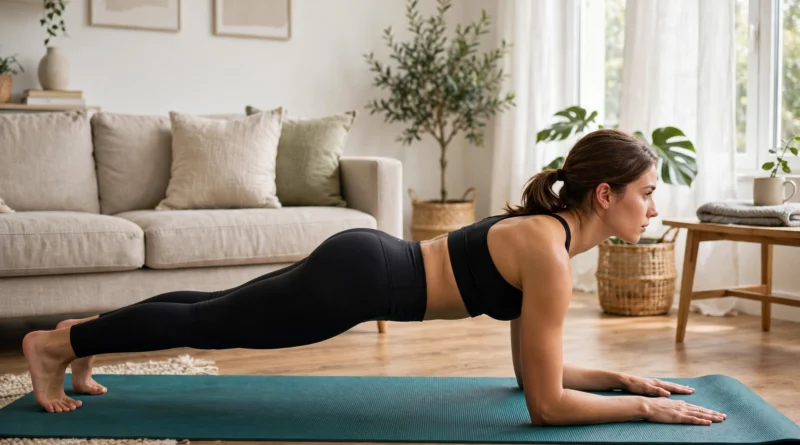
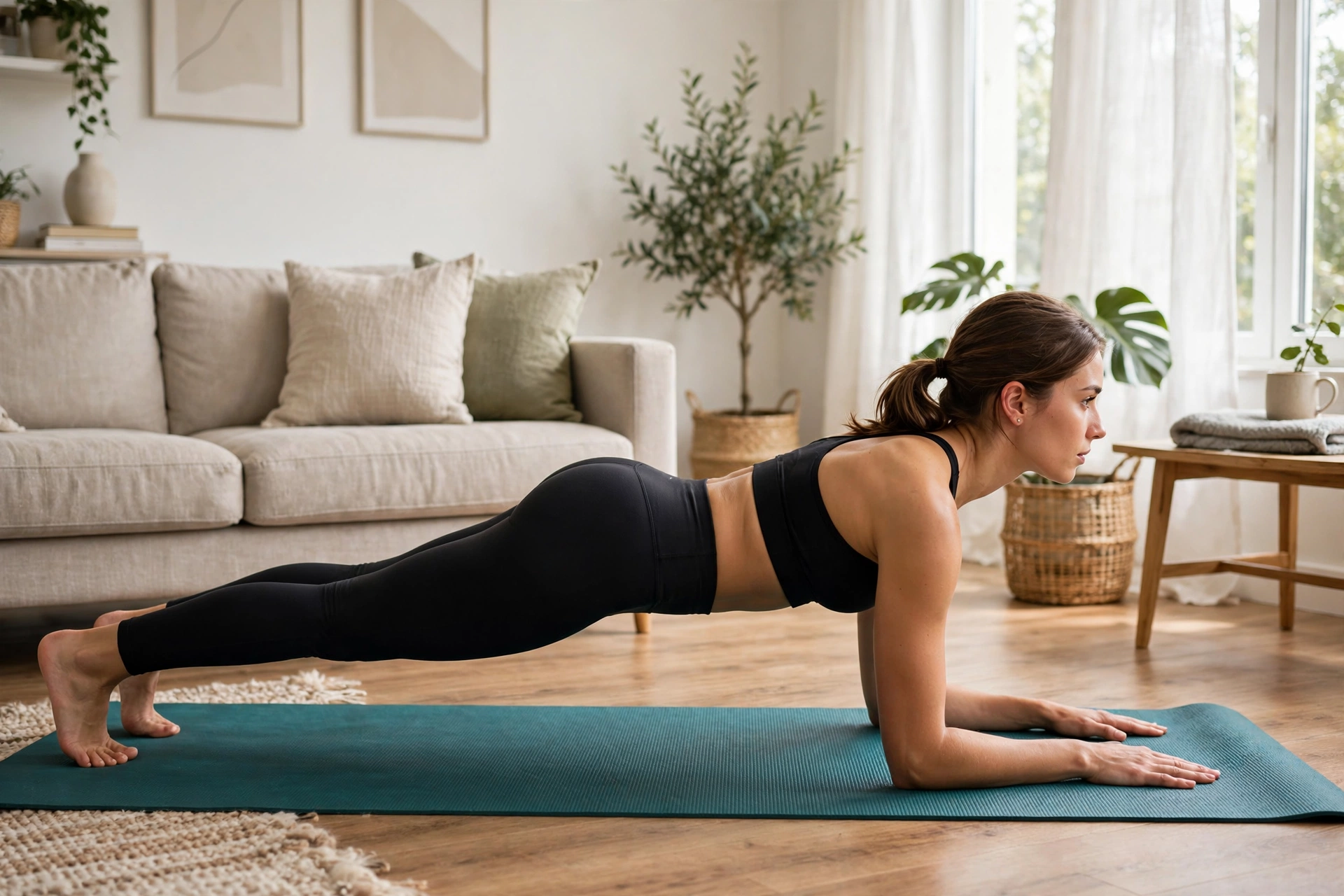
Forearm plank. Elbows under shoulders, forearms flat, body in a straight line from head to heels. Squeeze your glutes gently, breathe normally, and do not let your hips sag or pike up. If a full plank is too hard, drop to your knees — it still counts.
Dead bug. Lie on your back, arms pointing at the ceiling, knees bent at 90 degrees. Press your lower back firmly into the floor and keep it there. Slowly extend one arm overhead and the opposite leg out straight, stopping before your back lifts off the floor, then return and switch sides.
Side plank. Lie on one side, elbow under your shoulder, feet stacked. Lift your hips so your body forms a straight line from head to feet. Start with knees bent on the floor if the full version is too hard.
Curl-up. Lie on your back with knees bent. Instead of yanking your whole torso up, lift just your head and shoulders a few inches, keeping your lower back on the floor. Move slowly — two seconds up, two seconds down — and exhale as you lift.
Reverse crunch. Lie on your back, knees bent at 90 degrees. Use your lower abs to lift your hips a few inches off the floor, bringing your knees slightly toward your chest, then lower slowly. Do not swing your legs for momentum.
Bicycle crunch. Hands lightly behind your head, elbows wide. Bring one elbow toward the opposite knee while extending the other leg, then switch in a slow, controlled pedalling motion. Keep your lower back pressed down throughout.
How to Work the Bottom Abs
The “lower abs” are not a separate muscle — they are the lower portion of the same rectus abdominis. That is why they feel stubborn: you cannot isolate them completely, but you can emphasise them. Moves where your pelvis lifts or your legs move against gravity — reverse crunches, lying leg raises, and knee tucks — load the lower portion more than a standard crunch does. Two technique points matter more than the exercise choice. First, keep your lower back pressed to the floor during leg raises; if it arches, your hip flexors have taken over and your abs are no longer doing the work. Second, use a slow lowering phase: the lowering half of a leg raise is where the lower abs work hardest. If you can do 15 easy leg raises, slow them down before you add reps.
How to Flex Your Abs (and Why It Matters)
Flexing your abs — consciously tightening them — is a skill, not just a pose. Stand tall, exhale, and imagine someone is about to poke you in the stomach: the firm feeling that follows is your core bracing. Practise that brace before each rep, especially in planks and dead bugs. This “mind-muscle” habit does two things: it teaches you to keep your spine stable under load, which protects your lower back, and it makes every rep more effective, because a braced muscle works harder than a slack one. A quick drill: lie on your back, place your fingertips just inside your hip bones, and cough lightly — you will feel the deep transverse abdominis tighten. That is the feeling to recreate, gently, at the start of each set.
How Often Should You Train Abs?
Two or three times a week is the sweet spot for most people, with at least one rest day between sessions. That matches the general guidance for any muscle group: the American College of Sports Medicine recommends resistance training 2–3 days a week for beginners, and public-health guidance asks adults for muscle-strengthening activity on at least 2 days a week. Abs recover like any other muscle — the strengthening happens between sessions, not during them.
Can You Do Ab Exercises Every Day?
You can do gentle core activation daily — a short plank or a few dead bugs as part of a warm-up will not hurt you. But hard ab training every day is not recommended. If you train abs hard enough to improve, they need recovery, just like your legs or chest. If you can do the same hard ab workout every day without feeling it, the workout is too easy: make the moves harder — longer holds, slower reps, harder variations — rather than adding more days. Daily training also risks the same overuse pattern seen in any muscle: stalled progress and nagging soreness that never quite clears.
How Long Should an Ab Workout Last?
For beginners, 10–20 minutes is plenty. A focused 15-minute session of five or six moves, done well, beats a 45-minute marathon of sloppy crunches. Quality matters because ab exercises are easy to cheat: momentum, swinging legs, and arched backs all let other muscles take over. If your workout regularly runs past 20 minutes, you are probably resting too long or adding moves you do not need. As a standalone session, 10–15 minutes is right; tacked onto the end of a full-body workout, 5–10 minutes is enough.
Do Ab Workouts Burn Belly Fat?
No — not directly. This is the most persistent myth in core training. Ab exercises strengthen the muscles underneath the fat, but they do not selectively burn the fat on top of them. A controlled trial in sedentary adults found that six weeks of abdominal exercise improved abdominal endurance but did not significantly reduce abdominal fat. Visible abs come from a combination of overall fat loss — through food, sleep, and regular activity — plus the muscle underneath. That does not make ab workouts pointless: a strong core improves posture, lifting, balance, and back resilience whether or not a six-pack ever shows. It just means crunches alone will never reveal one.
Crunches or Planks: Which Is Better?
They do different jobs, so the answer is both, in the right proportions. Crunches (or the gentler curl-up) train the rectus abdominis through its bending-forward motion. Planks train the whole core to resist movement — the job your core does most of the day. If you only do crunches, you train one movement and miss stability entirely; endless crunches can also aggravate the lower back in some people, which is why several coaches now favour the curl-up’s small, controlled range over the full sit-up. A balanced beginner routine leans slightly toward stability work — planks, dead bugs, side planks — with one or two bending moves added, not twenty.
Ab Workouts at Home Without Equipment
Every move in the routine above needs nothing but floor space and, optionally, a mat. That is the point: ab workouts are among the easiest sessions to do at home, and they pair naturally with a no-equipment full-body routine. If you want to progress without buying anything, use this order: first add reps or seconds, then slow the tempo (three seconds down), then add a pause at the hardest point, then move to a harder variation — knee plank to full plank, dead bug to hollow hold, reverse crunch to straight-leg raise. Only after bodyweight variations get easy should you consider added weight, such as holding a book or water bottle during a crunch. For a full no-equipment programme to pair with this routine, see that guide.
Common Mistakes to Avoid
- Pulling on your neck during crunches. Hands rest lightly behind your head; your abs lift you, not your arms.
- Letting your lower back arch. In planks, dead bugs, and leg raises, a lifted lower back means your hip flexors took over. Shorten the range until your back stays down.
- Holding your breath. Breathe normally during holds and exhale on the effort of each rep.
- Chasing soreness. Soreness is not a scorecard. Consistent, well-formed sessions beat one punishing session you cannot repeat.
- Skipping the obliques and deep core. A routine of only crunches builds an incomplete core. Side planks and dead bugs are not optional extras.
- Training through sharp pain. Stop a move that causes sharp or joint-specific pain. This guide is general education, not personal medical advice — persistent pain, a hernia, or diastasis recti are reasons to check with a clinician before starting.
A Sample Week
- Monday: Beginner ab routine (15 minutes) after a walk or full-body session.
- Tuesday: Rest from core work — or gentle movement only.
- Wednesday: Beginner ab routine, adding 5 seconds to each plank hold.
- Thursday: Rest.
- Friday: Beginner ab routine, trying the next-harder variation of one move.
- Weekend: Optional light session — one set of each move — or a full rest.
Keep the same routine for 4–6 weeks before changing it. Progress is easier to see when the workout stays constant: more seconds, cleaner reps, less wobble.
How Long Until You See Results?
Most beginners feel stronger within 3–4 weeks — planks last longer, dead bugs feel steadier, everyday lifting feels easier. Visible definition is a different timeline: it depends mostly on body fat, and for many people takes months of consistent training plus overall fat loss, not a fixed number of weeks. Track something you can measure — plank seconds, reps with clean form, or sets completed — so progress is visible even before it shows in a mirror.
FAQ: Ab Workouts
Q: What is the best beginner ab workout? A: A plank, dead bug, side plank, curl-up, reverse crunch, and bicycle crunch, done 2–3 times a week for 10–15 minutes, cover the whole core with no equipment.
Q: Can I do ab exercises every day? A: Gentle core activation daily is fine, but hard ab training needs rest days. Two to three sessions a week is enough for most people.
Q: What are the best lower ab exercises? A: Reverse crunches, lying leg raises, and knee tucks emphasise the lower portion of the rectus abdominis — done slowly, with your lower back pressed to the floor.
Q: How do I flex my abs correctly? A: Exhale and brace as if someone is about to poke your stomach. That firm, braced feeling — not sucking in — is the right activation.
Q: How long should an ab workout last? A: About 10–20 minutes as a standalone session, or 5–10 minutes tacked onto a full-body workout.
Q: Do ab workouts burn belly fat? A: No. They strengthen the muscles underneath; visible abs require overall fat loss as well.
Q: Is it better to do crunches or planks? A: Both, in balance: crunches train bending forward, planks train stability. A beginner routine should include both, leaning slightly toward stability work.
Conclusion
Ab workouts work best when they are simple, balanced, and consistent. Pick five or six moves that train all four jobs of the core, do them 2–3 times a week with clean form, and progress slowly — longer holds, slower reps, harder variations. Do not chase daily marathons of crunches, and do not expect crunches alone to reveal a six-pack. Start this week with the beginner routine above, keep it the same for a month, and let the strength show up where it matters: in planks that last longer, lifts that feel steadier, and a core that holds up through the rest of your day.