Bodyweight Exercises for Beginners: A Simple No-Equipment Guide to Getting Stronger at Home
Direct Answer: Bodyweight exercises for beginners are strength moves that use your own weight as resistance – squats, push-ups, lunges, glute bridges, rows, and planks – done with no gym and no equipment. Start with 2-3 sessions a week on non-consecutive days, 2-3 sets of 8-12 controlled reps per move (20-45 seconds for planks), rest 60-90 seconds between sets, and make a move harder only when the last reps feel easy with clean form. For most beginners, that simple pattern is enough to get noticeably stronger within a few weeks. Key Takeaways: You do not need a gym, weights, or a long workout to start getting stronger. Six movement patterns – squat, hinge, push, pull, lunge, and core – cover the whole body. Stop each set 1-2 reps before your form breaks down; good reps beat more reps. Progress by adding reps, slowing down, or moving to a harder variation – not by jumping to advanced moves. Train 2-3 days a week, leave a rest day between harder sessions, and keep the routine the same for a few weeks so you can see progress.
What Are Bodyweight Exercises?
Bodyweight exercises are moves where your own body provides the resistance. A squat loads your legs, a push-up loads your chest, shoulders, and triceps, and a plank loads your core – all without a barbell, dumbbell, or machine. That is why they suit beginners so well: the load is automatically scaled to you, the moves can be done in a living room, park, or hotel room, and the risk of loading too much too soon is lower than with heavy weights. You need only enough floor space to lie down with your arms out, about 20-25 minutes, and clothes you can move in. If a move hurts in a sharp or joint-specific way, stop that move rather than pushing through it – this guide is general education, not personal medical advice.
Can Bodyweight Exercises Build Muscle?
Yes – especially for beginners. When you are new to training, your own weight is a real challenge for your muscles. A set of squats, push-ups, or lunges taken close to the point where good form gets hard creates the tension muscles need to adapt and grow stronger. Coaches call this progressive overload: gradually making the work a little harder over time. There is a limit to be honest about: advanced lifters chasing maximum size eventually need extra load, because some muscles – notably the back and biceps in pulling moves – are hard to load heavily without a bar or bands. For a beginner, that limit is a long way off.
How to Build Lean Muscle With Bodyweight Training
Lean muscle mostly means muscle built without a lot of extra body fat – and the training side is the same as building muscle generally: train the major muscle groups at least twice a week, work close enough to effort that the last reps are hard, and progress gradually. The CDC physical activity guidance for adults recommends muscle-strengthening activity on at least 2 days a week, working all major muscle groups, with 8-12 reps per activity and 2-3 sets for extra benefit. Bodyweight moves count: the CDC lists exercises that use your body weight for resistance, such as push-ups, alongside weights and resistance bands.
The 6 Bodyweight Moves Every Beginner Should Learn
You do not need twenty exercises. Learn one solid version of each pattern below and you have a complete beginner programme.
1. Squat – bodyweight squat
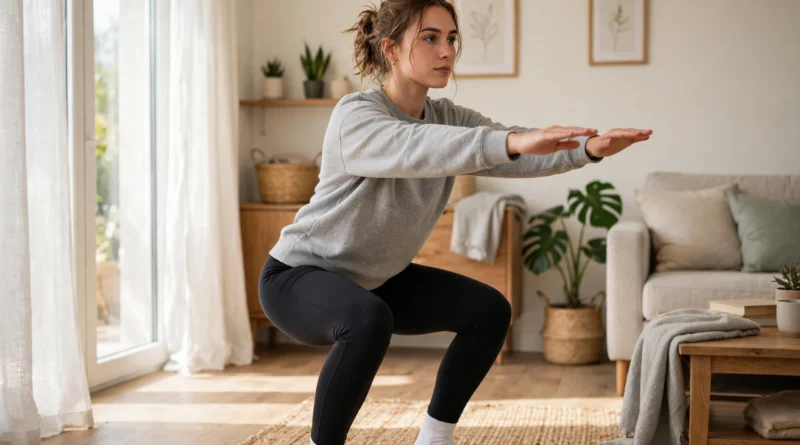
Stand feet about shoulder-width apart, toes slightly out. Push hips back and bend knees as if sitting into a chair, chest up, heels on floor. Go as low as you can with a flat back and knees tracking over toes, then drive through heels to stand. Start: 2-3 sets of 8-12 reps. Easier: squat to a chair and stand back up. Harder: pause 2 seconds at the bottom.
2. Hinge – glute bridge
Lie on back, knees bent, feet flat near hips. Press through heels, squeeze glutes, lift hips until body forms a straight line from shoulders to knees. Pause briefly, lower slowly. Start: 2-3 sets of 10-15 reps. Easier: shorter range. Harder: single-leg glute bridge, keeping hips level.
3. Push – push-up (start on an incline if needed)
Floor push-up: hands under or just outside shoulders, body straight from head to heels. Lower chest toward floor with elbows at roughly 45 degrees, press back up without hips sagging. If floor push-up is too hard, use a wall, counter, or sturdy table – steeper angle is easier and still counts. Start: 2-3 sets of 5-10 reps at a level where last reps are hard but clean. Harder: floor push-up, then pause push-up, then feet-elevated push-up.
4. Pull – the pattern beginners neglect
Pulling is hardest without equipment. Two honest beginner options: a table row (lie under a sturdy table, grip edge, pull chest toward it – only if table is heavy and stable enough not to tip) or a towel row (loop a towel around a sturdy, fixed post or door anchor rated for the load and pull). If neither is safe at home, use prone Y-T-W raises: lie face down, lift arms into Y, T, and W shapes to work upper back and shoulders. Do not hang from anything not built to hold your weight.
5. Lunge – reverse lunge
Stand tall, step one foot back, lower until both knees are roughly 90 degrees, front knee over ankle, torso upright. Push through front heel to return. Reverse lunges are kinder on balance than forward lunges for most beginners. Start: 2-3 sets of 8-10 reps per leg. Easier: hold a chair or wall for balance. Harder: walking lunges or step-up onto a low, stable step.
6. Core – plank and dead bug
Plank: forearms and toes, body straight, glutes gently squeezed, breathe normally. Start: 2-3 sets of 20-45 seconds. If full plank is too hard, drop to knees. Dead bug alternative: lie on back, arms up, knees up at 90 degrees, slowly extend one arm and opposite leg while keeping lower back pressed to floor, then switch. Start: 2-3 sets of 6-10 reps per side. 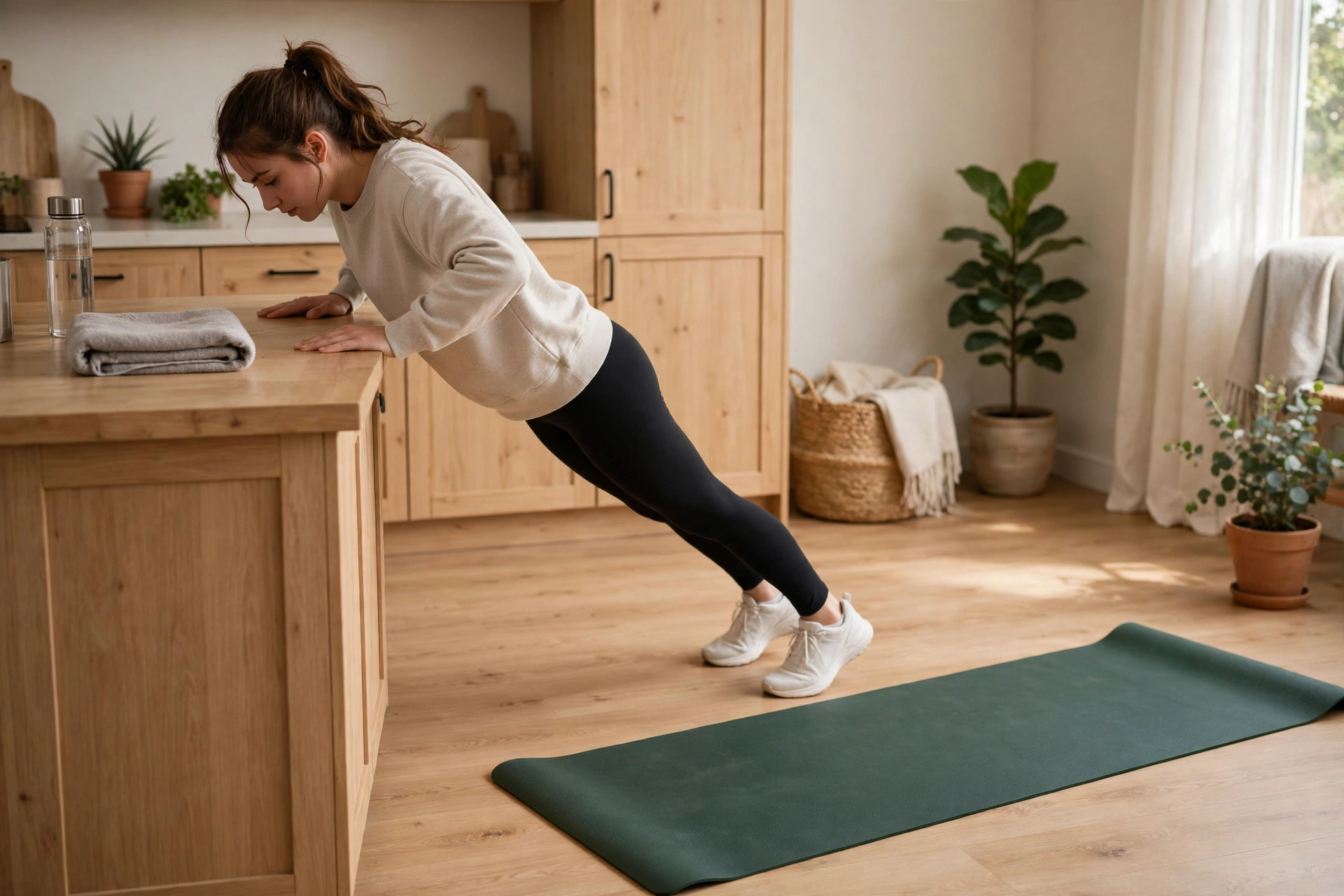
A Beginner Bodyweight Workout: Your First Routine
Do this full-body session 2-3 times a week on non-consecutive days, e.g. Monday, Wednesday, Friday. Warm up first with 3-5 minutes of marching in place, arm circles, gentle leg swings. Bodyweight squat: 2-3 sets, 8-12 reps. Incline or floor push-up: 2-3 sets, 5-10 reps. Glute bridge: 2-3 sets, 10-15 reps. Reverse lunge: 2-3 sets, 8-10 reps per leg. Table row or prone Y-T-W: 2-3 sets, 8-12 reps. Plank or dead bug: 2-3 sets, 20-45 seconds or 6-10 per side. Rest 60-90 seconds between sets. Whole session including warm-up about 20-25 minutes. Stop each set while form is still clean – leave 1-2 good reps in reserve. A shorter option for busy days: one set of each move, about 10 minutes, still counts.
How Many Days a Week Should Beginners Train?
Two to three days a week is the sweet spot. CDC guidance for adults is muscle-strengthening activity on at least 2 days a week, and three non-consecutive days gives each muscle group a rest day between harder sessions, which is when recovery happens. Training the same muscles hard on back-to-back days is the most common beginner mistake. On non-training days, gentle movement helps: brisk walk, easy cycling, or light stretching. You do not need to be sore to be making progress.
How to Progress Bodyweight Exercises Without Weights
Progressive overload without weights, in order: 1. Add reps (3×8 push-ups becomes 3×10, then 12). 2. Add sets (2 sets becomes 3). 3. Slow the tempo (lower for 3 seconds). 4. Add pauses (2 seconds at bottom). 5. Increase range of motion (deeper lunges or squats if pain-free). 6. Harder variations (incline to floor push-up, glute bridge to single-leg bridge, squat to split squat). 7. Shorten rest carefully (helps conditioning more than strength). 8. Increase frequency (2 sessions to 3). Practical rule: when you can do 20 controlled reps (or 45 seconds plank) with clean form, move to the harder variation rather than adding endless reps.
Bodyweight vs Weights: Which Is Better for Beginners?
For beginners, bodyweight wins on access, safety, habit-building: no membership, no commute, no waiting for equipment, load matches current strength. Weights win later for maximum loading, especially pulling and legs. The two are not rivals – many strong people mix both, using bodyweight for warm-ups, travel, and home sessions and weights for heavier work. If you have no gym access at all, bodyweight alone is a complete starting point, not a compromise.
Common Beginner Mistakes to Avoid
Chasing advanced moves too soon (master basic squat and push-up first). Rushing reps (slow down, control lowering). Skipping the pull pattern (include a row or Y-T-W every session). Training through sharp pain (stop that move; get persistent or joint pain checked). Changing routine every week (repeat 4-6 weeks to compare). Skipping rest days (muscles adapt between sessions).
How Long Until You See Results?
Most beginners feel stronger within 2-3 weeks – stairs easier, push-ups less impossible, balance improves – and visible changes typically take longer, often 6-12 weeks of consistent training, depending on starting point, sleep, and food. That timeline is a guide, not a promise. Track something simple – reps per move, or sets completed – so progress is visible even before it shows in a mirror.
FAQ: Bodyweight Exercises for Beginners
Q: Do I need any equipment to start? A: No. A floor, wall or counter for incline push-ups, sturdy chair or step for support are enough; a mat is optional. Q: Can bodyweight exercises build muscle without weights? A: Yes, especially for beginners, as long as you progress gradually and train each major muscle group at least twice a week. Q: How long should a beginner bodyweight workout take? A: About 20-25 minutes including warm-up, or about 10 minutes for a single-set version. Q: Is it OK to do bodyweight exercises every day? A: Light easy movement every day is fine, but hard strength sessions need a rest day between them for the same muscles. Q: What if I cannot do a single push-up? A: Start with wall push-ups, then counter, then low table, then floor – each step is real training. Q: What should I do if a move hurts? A: Stop that move, try the easier variation, check form, and if pain persists or is joint-specific, get it checked by a clinician.
Conclusion
Bodyweight exercises for beginners work because they remove every excuse between you and your first session: no gym, no equipment, no hour-long commitment. Learn six moves, do them 2-3 times a week with clean form, and make them a little harder each week. That is the whole system – and it is enough to build real strength at home. Start today with one set of each move, write down your reps, and beat those numbers next session. General education only: this guide is not personal medical or fitness advice. Stop any move that causes sharp pain and speak to a clinician if you have an injury or health condition.
See also: Beginner Workout Plan and Best Exercises for Strength at Home. CDC sources: CDC What Counts as Physical Activity and CDC Adding Physical Activity as an Adult.
| Exercise | Sets | Reps |
|---|---|---|
| Bodyweight squat | 2-3 | 8-12 |
| Incline or floor push-up | 2-3 | 5-10 |
| Glute bridge | 2-3 | 10-15 |
| Reverse lunge | 2-3 | 8-10 per leg |
| Table row or prone Y-T-W | 2-3 | 8-12 |
| Plank or dead bug | 2-3 | 20-45 seconds / 6-10 per side |
To turn the plank and dead bug in the core section into a full routine, see our ab workouts guide.
When the weather keeps you indoors, you can adapt these same moves into a rainy-day indoor workout with cardio, strength, and mobility options for a small space.