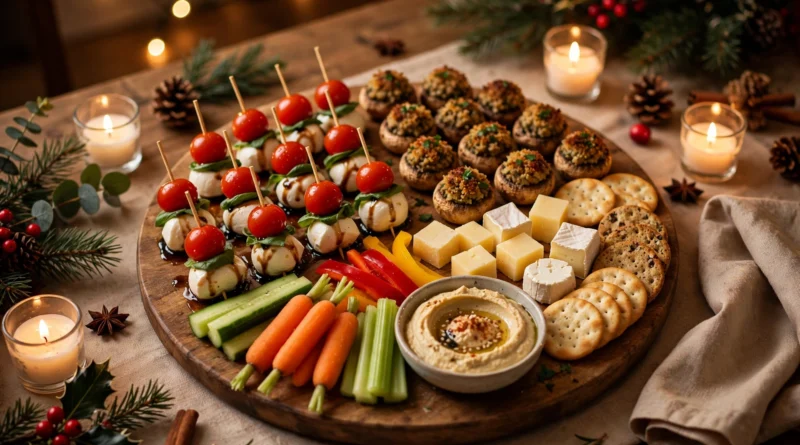
Hors d’Oeuvres: Easy Holiday Party Ideas, How Many to Serve, and Food-Safety Basics
Direct Answer
Hors d’oeuvres are small, savoury, one- or two-bite foods served before a meal — or on their own at a standing party — so guests can eat them by hand while they mingle. Unlike a seated first course, they are not part of the formal courses of the meal, and they are meant to whet the appetite rather than fill it. For a holiday party, a mix of cold, room-temperature and a few hot bites, planned by the number of guests and the length of the party, is the simplest way to get this right.
Key Takeaways
- Hors d’oeuvres are finger food, usually one or two bites, eaten standing up; an appetizer is usually a seated first course eaten with cutlery.
- Plan roughly 3 to 4 pieces per person if a meal follows within the hour, and 8 to 12 pieces per person for a cocktail-only evening.
- Build the spread from cold, room-temperature and hot items, so you are not cooking everything at the last minute.
- Keep hot foods at 140°F or warmer and cold foods at 40°F or colder, and discard perishable food left at room temperature for more than 2 hours.
- Make dips, spreads and many cold bites a day or two ahead; bake hot bites in small batches during the party.
What Is an Hors d’Oeuvre?
The word comes from French and literally means “outside the work” — outside the main body of the meal. That origin explains the whole idea: hors d’oeuvres sit outside the formal courses. They may come before dinner, during a cocktail hour, or they may be the entire food offering at a drinks party.
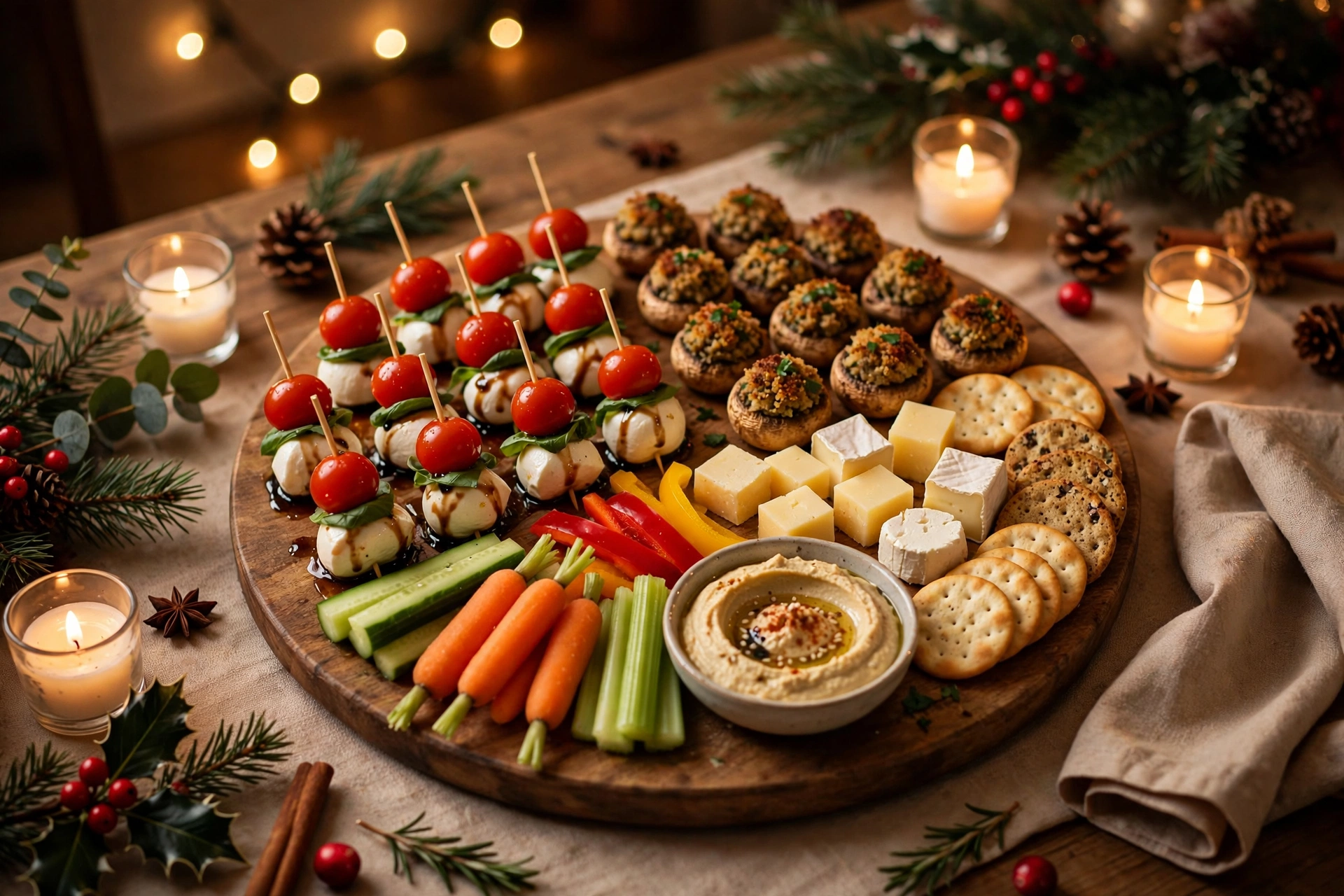
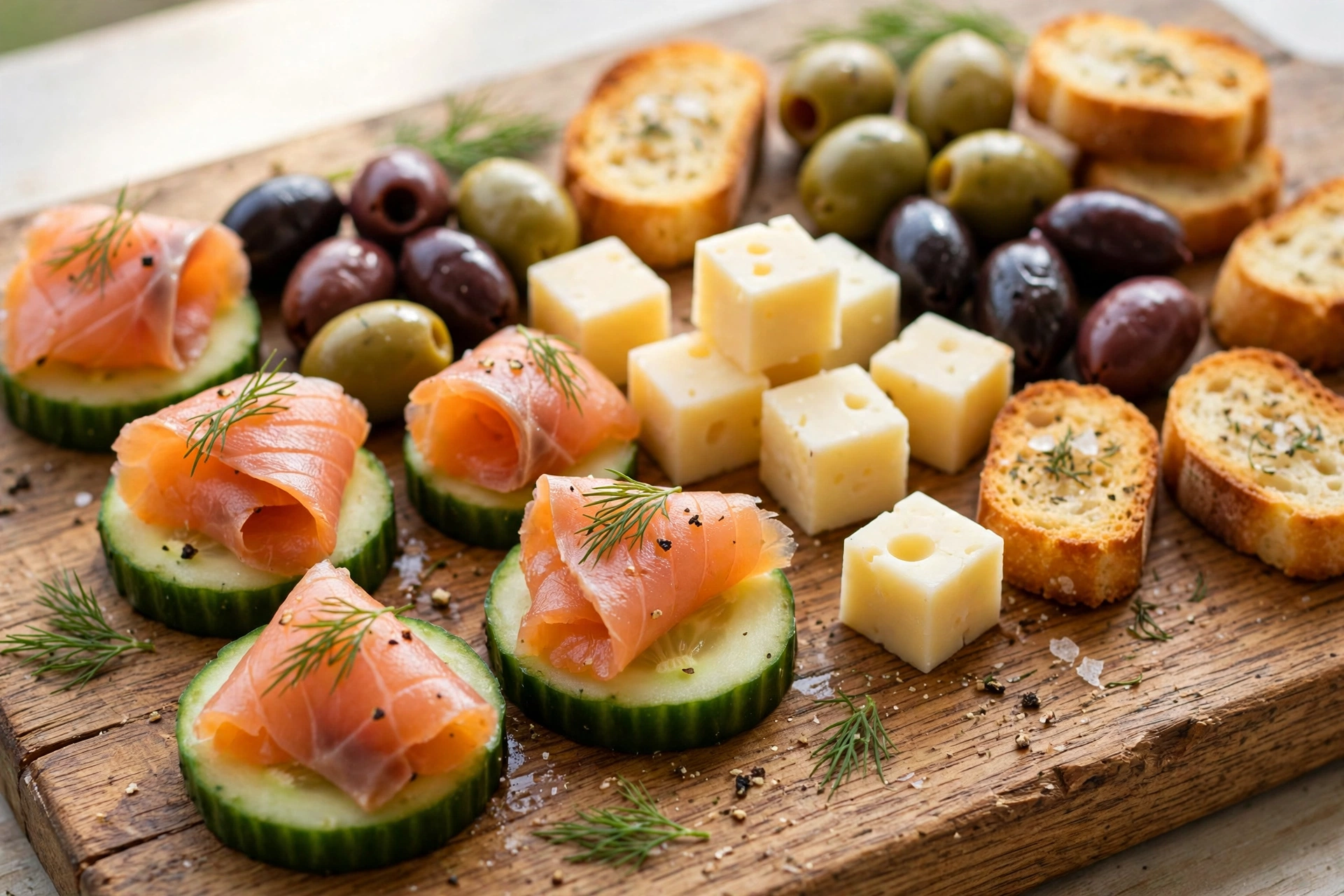
In everyday use, ” hors d’oeuvres” and “appetizers” are often used as if they mean the same thing, and dictionaries do define hors d’oeuvres as savoury foods usually served as appetizers. But hosts find the distinction useful, because it changes how the food is served. An hors d’oeuvre is designed to be picked up, eaten in a bite or two, and finished without a plate, a knife and fork, or a seat at a table. Think of a caprese skewer, a stuffed mushroom, a small crostini, or a cucumber round topped with smoked salmon. Each one is complete in itself.
That is also why hors d’oeuvres work so well at holiday parties. Guests arrive at different times, stand and talk, and hold a drink. Small food that can be eaten with one hand fits that setting far better than a plated course that needs everyone seated at once.
Hors d’Oeuvres vs Appetizers: What Is the Difference?
The difference is mostly about portion, setting and timing — not about ingredients. The same cheese, the same shrimp or the same mushroom can appear in either form; how it is served decides which word fits.
| Feature | Hors d’oeuvre | Appetizer |
|---|---|---|
| Portion | 1 to 2 bites | Usually a small course, often 3 to 4 bites or more |
| How it is eaten | By hand, usually no cutlery | Seated, usually with a fork and knife |
| Setting | Standing, mingling, cocktail hour | Seated at the table |
| Timing | Before the meal, or instead of a meal at a drinks party | The first course of the meal itself |
| Number served | Several different types passed or set out | Usually one per person |
A simple test helps: if guests are standing with a drink in one hand and eating with the other, it is an hors d’oeuvre. If they are seated, have picked up a fork, and the meal has begun, it is an appetizer. There are exceptions — a small seated starter can feel very much like an hors d’oeuvre — but for planning a party, this test is enough.
The Main Types of Hors d’Oeuvres
Cold hors d’oeuvres
Cold bites are the backbone of a relaxed party because they can be made ahead and need no oven time while guests are there. Examples include cheese and crackers, crudités (raw vegetable sticks) with dip, shrimp cocktail cups, smoked salmon on cucumber rounds or rye, caprese skewers, antipasto skewers of cherry tomatoes, olives and mozzarella, and fruit skewers. Serve cold items straight from the refrigerator, and keep them chilled on the table by nesting dishes in bowls of ice or by putting out small trays and refilling them often.
Hot hors d’oeuvres
Hot bites add warmth and a sense of occasion: stuffed mushrooms, mini quiches, cocktail meatballs, bacon-wrapped dates, puff-pastry pinwheels, baked brie bites, mini chicken taquitos and small savoury hand pies. The practical rule is to serve hot items in small batches, so each tray comes out hot rather than sitting and going soggy. A slow cooker, chafing dish or warming tray helps hold a hot item at serving temperature; without one, bake a fresh batch when the last tray empties.
Room-temperature hors d’oeuvres
Some of the easiest party food needs no temperature control at all, or only short chilling: marinated olives, tapenade on endive leaves, cheese cubes with fig jam and toasted nuts, prosciutto-wrapped melon, breadsticks, and most crackers and nuts. Room-temperature items are the safest part of the spread to put out first, because they do not depend on the oven or the refrigerator once guests arrive. Even so, anything perishable mixed in — a soft cheese spread, a meat topping — still falls under the 2-hour rule in the food-safety section below.
Easy Holiday Party Hors d’Oeuvres Ideas
You do not need twenty different bites. Six to eight items, balanced across flavours and temperatures, look generous and are far easier to manage than a long list. Aim for something creamy, something crunchy, something briny, something fresh, and one warm tray that comes out during the party.
Cold and room-temperature ideas
- Caprese skewers. Cherry tomato, basil leaf and a small mozzarella ball on a pick, drizzled with balsamic glaze just before serving so the basil stays bright.
- Smoked salmon cucumber rounds. A cucumber slice, a folded piece of smoked salmon, and a spoonful of sour cream mixed with dill, lemon and a little red onion.
- Antipasto skewers. Cherry tomatoes, olives, mozzarella balls and a piece of cured meat or cooked tortellini, finished with a light pesto drizzle.
- Cheese, crackers and fig jam. Cubes of a firm cheese, a soft cheese, crackers, fig jam and toasted nuts. This is the easiest board to scale up for a crowd.
- Crudités and dip cups. Cucumber spears, carrot sticks and snap peas with individual dip cups, so guests are not sharing one bowl.
- Tapenade on endive leaves. Black olives and sun-dried tomatoes pulsed with parsley, lemon and olive oil, spooned onto crisp endive leaves. Naturally gluten-free and dairy-free.
Hot ideas
- Stuffed mushrooms. Mushroom caps filled with cream cheese or goat cheese, herbs and breadcrumbs, baked until golden.
- Bacon-wrapped dates. Sweet, salty and one bite — assemble a day ahead and bake just before serving.
- Puff-pastry pinwheels. Rolled pastry with sun-dried tomato, spinach, cheese and garlic, sliced and baked in batches.
- Cocktail meatballs. Small meatballs in a cranberry-orange or barbecue glaze, held warm in a slow cooker and served with picks.
- Baked brie bites. Small squares of puff pastry with brie and cranberry, baked until the pastry puffs and the cheese softens.
- Mini quiches. Small pastry cases with seasonal vegetables and cheese — easy to bake in a muffin tin and serve warm.
Ideas for different diets
Put at least one gluten-free base on the table (rice crackers or vegetable sticks), one dairy-free bite (marinated olives, shrimp cups or fruit skewers), and one vegetarian warm tray (stuffed mushrooms or mini quiches) if you can. Labelling the vegetarian and gluten-free items with a small card saves guests from having to ask about every tray, and it costs nothing.
How Many Hors d’Oeuvres Per Person?
How many you need depends on one question: is a meal coming afterwards?
- A meal follows within about an hour: plan 3 to 4 pieces per person. The bites are a welcome, not a dinner.
- Cocktail-only party, no main course: plan 8 to 12 pieces per person over the evening. For a four-hour party, a common planning guide is about 8 pieces per person during the first two hours and about 4 more per person for the remaining two hours.
- Long party with a late meal: start with the smaller number and add a warm tray later, rather than putting everything out at once.
Multiply by your guest count, then divide across your 6 to 8 items. For 20 guests at a cocktail-only party, 8 to 12 pieces each means 160 to 240 pieces in total — roughly 25 to 35 pieces of each of 7 or 8 items. That sounds like a lot until it is spread across trays, and it is better than running out halfway through the evening. If guests include children, count them at about half the adult number, and add a plain option such as mini grilled-cheese triangles or fruit skewers.
Can You Make Hors d’Oeuvres Ahead of Time?
Yes — and for a holiday party, you should. Making food ahead is what keeps the host out of the kitchen when guests arrive.
- 1 to 2 days ahead: dips and spreads, cheese boards (kept covered in the refrigerator), tapenade, marinated olives, and cranberry sauce for brie bites. Many dips taste better after a day in the refrigerator, as the flavours blend.
- Up to a day ahead: assemble puff-pastry pinwheels, stuffed mushrooms and bacon-wrapped dates, cover and refrigerate, then bake on the day. Cut vegetables for crudités and store them in water in the refrigerator.
- On the day, a few hours ahead: assemble caprese and antipasto skewers, fill cucumber rounds, and arrange platters. Keep cold items refrigerated until guests arrive.
- During the party: bake hot items in small batches. A tray that comes out hot halfway through the evening feels like a second course and keeps the party moving.
One caution: assemble cold bites with wet toppings (tomato, melon, dressed leaves) as close to serving as you can, or the base will go soggy. Keep crackers, crostini and pastry separate from wet toppings until the last moment.
How Long Can Hors d’Oeuvres Sit Out? Food Safety Basics
This is the part of party planning that matters most, because the food sits out while people talk. The rule used by university extension services and food-safety agencies is simple: keep hot foods hot and cold foods cold.
- Hot foods: hold at 140°F or warmer, using a chafing dish, slow cooker or warming tray.
- Cold foods: hold at 40°F or colder, by nesting dishes in ice or by putting out small trays and replacing them often.
- The 2-hour rule: discard perishable food — meat, poultry, seafood, eggs, dairy-based dips, cooked vegetables and anything with a creamy filling — left at room temperature for more than 2 hours. If the temperature is above 90°F, that window drops to 1 hour.
- Do not taste-test old food: food that has sat too long can look and smell fine while still being unsafe. When in doubt, throw it out, and do not put food back in the refrigerator after it has passed the limit in the hope of saving it.
For a long party, the practical way to follow the rule is to put out half the food, keep the rest refrigerated or warm, and refill trays on a schedule. Note the time a tray went out, and replace it after two hours at most. For more detail, see the University of Arkansas Extension guide to appetizers and hors d’oeuvres and the University of Florida Extension explanation of the 2-hour rule, linked at the end of this article.
What to Bring to a Potluck or a Cookout
What to bring to a potluck at work
A potluck dish needs to travel well, survive a desk or a break room, and serve without reheating or complicated assembly. Hors d’oeuvres are a strong choice for exactly that reason: a tray of caprese skewers, a cheese-and-cracker board, tapenade with endive leaves, or a dip with sturdy crackers travels in one container and needs no oven at work. Choose items that are sturdy (nothing that wilts or leaks), safe at room temperature for the time they will sit out, and easy to label — especially if they are vegetarian or gluten-free. Bring serving picks or a small spoon, and bring the food in the container it will be served from if you can, so nothing needs transferring.
What to bring to a cookout
At a cookout, the grill is the main event, so hors d’oeuvres play a smaller role: something for guests to eat while the grill heats up. The same sturdy, transportable rules apply, with one extra caution — heat. In warm weather the 2-hour window drops to 1 hour above 90°F, so keep cold items in a cooler with ice until serving, put out small amounts at a time, and choose items that tolerate warmth better, such as marinated olives, cheese cubes with crackers, and vegetable sticks with a sturdy dip. Skip creamy seafood or egg-based bites for an outdoor cookout unless you can keep them properly chilled, and save the hot bites for the grill itself.
Common Mistakes to Avoid
- Putting everything out at once. Food dries out, warms up or cools down, and the table looks picked-over by mid-party. Refill in waves instead.
- Only hot food. A spread of only hot bites means constant oven work. Mix cold, room-temperature and hot items so most of the food is ready before guests arrive.
- Saucy, crumbly or drippy bites. At a standing party, guests hold a drink in one hand. Choose bites that pass a simple test: can it be eaten in one or two bites, with one hand, without dripping?
- No plain or dietary option. One vegetarian tray and one gluten-free base cover most guests without a separate menu.
- Forgetting the clock. Set a quiet reminder to swap trays and discard perishable food after two hours — the easiest food-safety step, and the one most often missed.
Planning Checklist
- Decide: meal afterwards, or cocktail-only? That sets your per-person number.
- Pick 6 to 8 items: cold, room-temperature and one or two hot.
- Add one vegetarian tray and one gluten-free base.
- Make dips, spreads and boards 1 to 2 days ahead; assemble cold bites on the day.
- Put out half the food; keep the rest hot or cold and refill on schedule.
- Note the time each tray goes out; discard perishable food after 2 hours.
- Keep crackers and crostini separate from wet toppings until serving.
Conclusion
Hors d’oeuvres are not a fussy French formality. They are a practical answer to a real hosting problem: how to feed people who are standing, talking and holding a drink, without seating everyone for a course. Keep them small, keep them varied, plan the quantity by whether a meal follows, and respect the 2-hour rule for perishable food. Do that, and a holiday spread of caprese skewers, stuffed mushrooms, a cheese board and one warm tray will feel generous without keeping you in the kitchen all evening. If you are planning the rest of the meal too, our easy comfort-food dinners and quick weeknight ideas can help you build the main course around the same relaxed approach.
FAQ
What is the difference between hors d’oeuvres and appetizers?
Hors d’oeuvres are small, one- or two-bite finger foods served standing up before or apart from a meal. Appetizers are usually a seated first course eaten with cutlery as part of the meal itself.
How many hors d’oeuvres do I need for 20 guests?
For a cocktail-only party, plan 8 to 12 pieces per person, so 160 to 240 pieces for 20 guests across 6 to 8 items. If a meal follows within the hour, 3 to 4 pieces per person — 60 to 80 pieces — is enough.
Can I make hors d’oeuvres the day before?
Yes. Dips, spreads, tapenade and cheese boards can be made 1 to 2 days ahead and refrigerated. Hot items such as pinwheels, stuffed mushrooms and bacon-wrapped dates can be assembled a day ahead and baked on the day.
How long can hors d’oeuvres be left out?
Perishable hors d’oeuvres should not sit at room temperature for more than 2 hours, or 1 hour if it is above 90°F. Keep hot foods at 140°F or warmer and cold foods at 40°F or colder, and discard anything past the limit.
What are good vegetarian hors d’oeuvres?
Caprese skewers, stuffed mushrooms, mini quiches, tapenade on endive leaves, crudités with dip, cheese boards and fruit skewers are all vegetarian and easy to scale for a crowd.
Sources and Further Reading
- University of Arkansas Extension: appetizers and hors d’oeuvres options, quantities and holding temperatures — https://www.uaex.uada.edu/counties/miller/news/fcs/holiday-foods/Appetizers-or-Hors-d-oeuvres-Options-are-Endless.aspx
- University of Florida IFAS Extension: the 2-hour food-safety rule — https://blogs.ifas.ufl.edu/browardco/2023/10/02/food-safety-the-2-hour-rule/
- More from UpdateMag: Casserole Recipes — https://updatemag.com/casserole-recipes/
- More from UpdateMag: Fast and Easy Dinner Recipes — https://updatemag.com/fast-and-easy-dinner-recipes/