Low Carb Meals: A Beginner’s Guide to Eating Well With Fewer Carbs
Direct answer: Low carb meals are meals that cut back sharply on starchy and sugary foods — bread, rice, pasta, potatoes, sweets and sugary drinks — and build the plate around protein, non-starchy vegetables and healthy fats instead. A low carb diet is generally described as under about 130 grams of carbohydrates a day, compared with roughly 225–325 grams a day on a typical 2,000-calorie diet. You do not have to give up carbs entirely: the simplest version keeps vegetables, some fruit, dairy and small portions of whole grains, and just removes the biggest sources of refined starch and sugar first.
Key Takeaways
- Low carb meals centre on protein, non-starchy vegetables and healthy fats, with starchy foods and sugar kept small or skipped.
- “Low carb” is generally under about 130 grams of carbs a day; a gentler start at 100–150 grams suits most beginners.
- You do not need special products: eggs, chicken, fish, vegetables, olive oil, nuts and cheese already make low carb meals.
- The easiest first step is cutting sugary drinks, sweets and large portions of bread, rice and pasta, before worrying about exact gram counts.
- Low carb is not the same as keto: keto is much stricter, usually under 50 grams a day.
- This guide is general educational information, not personal medical advice — talk to your clinician first if you take diabetes or blood pressure medication, are pregnant, or have kidney, liver or gallbladder problems.
What Is a Low Carb Meal?
A low carb meal is simply a meal in which carbohydrates play a much smaller role than usual. Mayo Clinic describes a low-carb diet as one that limits carbohydrates such as those found in grains, starchy vegetables and fruit, and focuses instead on foods high in protein and fat. In practice, that means the plate changes shape: vegetables take up about half the plate, protein takes about a quarter, and healthy fats — olive oil, avocado, nuts — fill the rest, while bread, rice, pasta and potatoes shrink to a small side or disappear altogether.
Carbohydrates are not one thing. They include starches (bread, rice, pasta, potatoes), sugars (sweets, sugary drinks, fruit juice) and fibre (vegetables, beans, whole grains). A low carb meal does not try to remove fibre-rich vegetables; it mainly removes the starchy and sugary foods that deliver a lot of carbohydrate in a small portion. That distinction matters, because a plate of broccoli, salmon and olive oil is low in carbs and high in fibre and nutrients, while a plate of white bread and jam is high in carbs and low in almost everything else.
It also helps to know what low carb meals are not. They are not zero-carb meals, they are not automatically high in processed meat, and they are not a licence to eat unlimited cheese, cream and bacon. The versions that work best in everyday life are built on whole foods — vegetables, fish, poultry, eggs, dairy, nuts and healthy oils — with processed meats and fried foods kept occasional, just as in any balanced way of eating.
How Many Carbs a Day Is Low Carb?
There is no single official number, and different sources draw the line in slightly different places, so treat the ranges below as a guide, not a prescription. Cleveland Clinic‘s dietitians describe a low-carbohydrate diet as less than 26% of total calories from carbohydrates, or less than 130 grams of carbs per day, with moderate carbohydrate intake at 26–44% of calories. Most beginner guides use a similar picture:
| Level | Rough daily carbs | What it looks like |
|---|---|---|
| Moderate low carb | About 100–150 grams | No sugary drinks or sweets, smaller portions of rice, pasta and potatoes; fruit, beans and some whole grains still included |
| Low carb | About 50–130 grams | Bread, pasta and rice become occasional; fruit is mostly berries in small portions; beans in small amounts |
| Very low carb (keto) | Under about 50 grams | Grains, beans, potatoes and most fruit are mostly gone; this is keto territory, not ordinary low carb |
For comparison, the usual dietary guideline range of 45–65% of calories from carbohydrate works out to roughly 225–325 grams a day on a 2,000-calorie diet. So even the gentlest low carb starting point, around 100–150 grams, is a real reduction from a typical diet — which is why it can feel different without feeling extreme.
If you are just starting, the moderate range is the sensible place to begin. Dropping from around 250 grams a day to around 120 grams is already a big change, and it leaves room for fruit, vegetables, dairy and the occasional small portion of whole grains. You can always go lower later if you want to, but starting gently makes the change much easier to stick with, and sustainability matters more than severity.
What Can I Eat on a Low Carb Diet?
The good news is that the shopping list is mostly ordinary food. Build low carb meals from these groups, and you will rarely need a special “low carb” product:
Eat plenty of:
- Non-starchy vegetables: leafy greens, broccoli, cauliflower, courgette (zucchini), peppers, mushrooms, green beans, cucumber, asparagus and aubergine
- Protein: eggs, chicken, turkey, fish, seafood, lean beef and pork, tofu and tempeh
- Healthy fats: olive oil, avocado, olives, nuts, seeds and nut butters
- Dairy in sensible portions: plain Greek yogurt, cottage cheese and cheese
- Low-sugar fruit in small portions: berries such as strawberries, raspberries and blueberries
Limit or skip:
- Bread, bagels, wraps, tortillas and breakfast cereals
- Pasta, rice, noodles and couscous
- Potatoes, corn and other starchy vegetables (in large portions)
- Sweets, cakes, biscuits, pastries and chocolate bars
- Sugary drinks, fruit juice and sweetened coffees
- Beer and sweet alcoholic drinks, which carry carbohydrate as well as alcohol
A useful rule of thumb for a low carb meal is: protein plus non-starchy vegetables plus a healthy fat. Grilled chicken with roasted broccoli and olive oil, salmon with a big salad and avocado, or an omelette with mushrooms, spinach and cheese all fit that formula, and none of them feels like diet food.
Low Carb Breakfast Ideas
Breakfast is where most people eat the most carbs without noticing — cereal, toast, pastries and fruit juice can easily add up to a full day’s low carb allowance before 9 a.m. These swaps keep breakfast satisfying without the carb load:
- Scrambled eggs with spinach and feta, plus a quarter of an avocado. Eggs are one of the best low carb foods: filling, cheap and quick.
- Plain Greek yogurt with a handful of berries and a spoonful of nuts or seeds. Choose unsweetened yogurt; flavoured yogurts often hide a lot of added sugar.
- An omelette with mushrooms, peppers and cheese, served with sliced tomato or cucumber instead of toast.
- Cottage cheese with berries and chia seeds, or smoked salmon with cucumber and cream cheese when you want something lighter.
- Chia pudding made with unsweetened milk, topped with a few sliced strawberries — prepare it the night before and it is ready in the morning.
If you love toast, you do not have to ban it forever. At the moderate level, one slice of wholegrain toast with eggs is a reasonable compromise; at stricter levels, a lettuce wrap or a slice of grilled aubergine can carry the same filling. The point is portion and frequency, not perfection.
Low Carb Lunch Ideas
Lunch low carb meals work best when they are built to travel well and keep you full until dinner. Salads only work if they contain enough protein and fat — a bowl of leaves alone will leave you hungry by 3 p.m.
- A large salad with grilled chicken or tuna, avocado and olive oil dressing, plus cucumber, peppers, olives and a small handful of chickpeas if your carb target allows.
- Tuna salad lettuce wraps, with celery, mustard and a little mayonnaise, wrapped in butter lettuce or romaine leaves.
- Leftover roast chicken or salmon over spinach, with sliced avocado, boiled egg and a vinaigrette — cooking once and eating twice is the easiest low carb habit there is.
- A Cobb-style salad: greens, boiled egg, chicken, bacon in moderation, avocado and blue cheese with vinaigrette.
- A hearty soup, such as chicken and vegetable or broccoli and cheese soup, served without bread. Our guide to soup season is linked in this section, and many soup recipes adapt easily by skipping the potato or noodle element.
When buying lunch out, look for the same formula: a protein, a pile of vegetables or salad, and a healthy fat. A burrito bowl without rice, a salad with grilled fish, or a bunless burger with a side salad all fit, while sandwiches, wraps and pasta dishes usually do not.
Low Carb Dinner Ideas
Dinner is the easiest low carb meal of the day, because most classic dinners already have a protein and vegetables — the only change is what you serve alongside them.
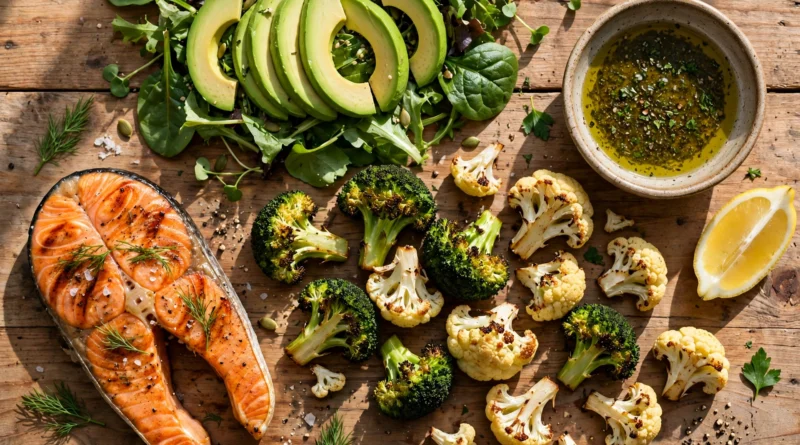
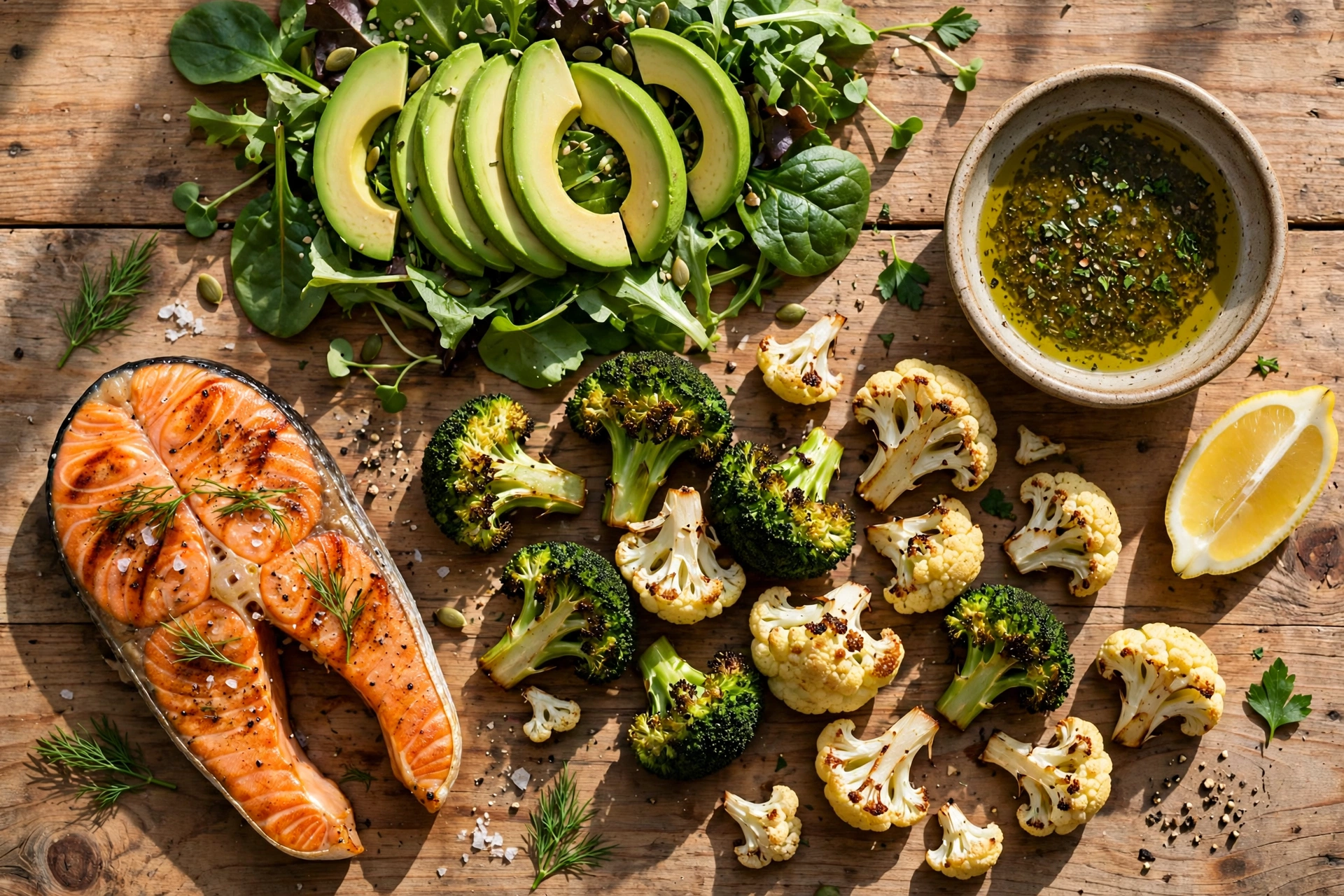
- Baked salmon with roasted broccoli and cauliflower, lemon and olive oil — the meal in our featured photo, and a good template for any fish dinner.
- Chicken or tofu stir-fry with lots of vegetables, served over cauliflower rice instead of white rice, or simply with extra vegetables and no rice at all.
- One-pan chicken thighs with roasted courgette, peppers and onions, finished with herbs and a squeeze of lemon.
- Beef or turkey taco bowls over shredded lettuce, with cheese, salsa, sour cream and guacamole instead of tortillas and rice.
- Zucchini noodles (zoodles) with pesto and prawns or chicken, which give you the pasta experience with a fraction of the carbohydrate.
- A low carb casserole, such as chicken and broccoli bake or cauliflower cheese with ham — baked dishes like these are also great for batch cooking. Our casserole recipes collection is linked in this section and includes comfort-food bakes that adapt well by swapping potato or pasta toppings for cauliflower mash or extra vegetables.
A simple sample day at the moderate level, around 100 grams of carbs, might look like this — figures are rough guides, since exact grams vary with portion size and brand:
| Meal | Example | Rough carbs |
|---|---|---|
| Breakfast | 2 eggs with spinach and feta, plus half an avocado | About 5–10 grams |
| Lunch | Large grilled chicken salad with olive oil dressing and a small apple | About 25–30 grams |
| Snack | Plain Greek yogurt with a few berries, or a handful of nuts | About 5–10 grams |
| Dinner | Salmon with roasted broccoli, cauliflower and a green salad | About 15–20 grams |
You do not need to hit a number like this exactly. It is there to show that a full, satisfying day of low carb meals still includes fruit, dairy and plenty of vegetables — it is not just meat and cheese.
Easy Low Carb Swaps
Swaps are what make low carb meals sustainable, because they let you keep the dishes you love with a smaller carb load:
| Instead of | Try |
|---|---|
| White rice | Cauliflower rice, or a smaller portion of brown rice with extra vegetables |
| Pasta | Zucchini noodles, spaghetti squash, or a hearty vegetable and meat sauce served over roasted vegetables |
| Mashed potato | Cauliflower mash with butter and a little cheese |
| Bread and wraps | Lettuce leaves, grilled aubergine slices, or a small wholegrain portion at the moderate level |
| Chips and crisps | Roasted chickpeas in small portions, nuts, cucumber and hummus, or cheese crisps |
| Sugary drinks | Water, sparkling water, unsweetened tea or coffee |
| Breakfast cereal | Eggs, Greek yogurt with berries, or chia pudding |
| Pizza base | Cauliflower base, or a topping-loaded flatbread made with a thin wholegrain base in a smaller portion |
The best swap is the one you will actually repeat. Cauliflower rice works for some people and feels like a poor substitute to others; if it does not work for you, simply eating a smaller portion of real rice with a much larger portion of vegetables is a better low carb meal than a substitute you hate.
Low Carb Snacks That Actually Fill You Up
Snacks are optional on a low carb diet, but if you need one, choose protein or fat rather than refined carbohydrate, which tends to leave you hungry again quickly:
- Hard-boiled eggs, kept ready in the fridge
- A small handful of almonds, walnuts or mixed nuts (watch portions — nuts are calorie-dense)
- Celery, cucumber or pepper strips with hummus or guacamole
- Plain Greek yogurt with a few berries
- A small piece of cheese with cucumber slices
- Olives, or a few slices of cold meat with mustard
Avoid the trap of “low carb” bars and sweets. Many are highly processed, sweetened with sugar alcohols that upset some people’s stomachs, and no more filling than an ordinary snack. Whole food snacks are almost always the better choice.
Can Vegetarians Eat Low Carb?
Yes, but it takes more planning, because the easiest vegetarian proteins — beans, lentils and chickpeas — also contain carbohydrate. At the moderate level (100–150 grams), there is room for small portions of beans and lentils alongside vegetables, eggs and dairy. At stricter levels, vegetarian low carb meals lean more heavily on:
- Eggs and dairy: omelettes, Greek yogurt, cottage cheese and cheese
- Tofu and tempeh, which are low in carbs and high in protein
- Non-starchy vegetables in large portions, with olive oil, avocado, nuts and seeds for fat and fullness
- Berries in small portions for fruit
A vegetarian low carb day might be a spinach and feta omelette for breakfast, a tofu and vegetable stir-fry for lunch, and roasted aubergine with tomato, mozzarella and basil for dinner. If you eat no animal products at all, low carb becomes much harder, because plant proteins mostly come packaged with carbohydrate — at that point, a moderate approach that keeps beans and lentils in small portions is more realistic than a strict one, and a dietitian’s advice is worth seeking.
Low Carb vs Keto: What Is the Difference?
Low carb and keto are related, but they are not the same thing. Keto, short for ketogenic, is a very-low-carbohydrate diet, usually under 50 grams of carbs a day, designed to shift the body into burning fat for fuel, a state called ketosis. Ordinary low carb meals, at 50–130 grams or a moderate 100–150 grams, do not aim for ketosis at all.
That difference matters for everyday life. Keto restricts fruit, beans, potatoes and most grains almost entirely, and it needs careful planning to avoid missing nutrients. A moderate low carb approach keeps berries, some beans, dairy and occasional whole grains, which makes it easier to eat out, cook for a family and stick with over months. Mayo Clinic’s own summary notes that the weight-loss advantage of low carb diets over other diets is small, which is another reason to choose the version you can actually sustain rather than the strictest one.
If keto interests you, treat it as a separate decision with its own rules and cautions, not as a slightly stricter version of the meals in this guide — and discuss it with a clinician first, since very-low-carbohydrate diets are not suitable for everyone.
How to Meal Prep Low Carb Meals
Meal prep is where low carb meals either succeed or fall apart, because a hungry evening with nothing ready is when bread, pasta and takeaway win. A simple weekly routine:
- Cook two proteins on Sunday. Roast chicken thighs and a tray of salmon, or a pot of beef stew and a batch of boiled eggs, give you the base for several meals.
- Prep vegetables in bulk. Wash salad leaves, chop peppers and cucumber, and roast a tray of broccoli and cauliflower to reheat through the week.
- Make one batch dish. A casserole, a soup or a stir-fry base can cover two or three dinners; refrigerate within two hours and use within 3–4 days, or freeze portions for later.
- Keep emergency low carb foods stocked. Eggs, tinned tuna, cheese, nuts, olives and frozen vegetables turn a bare fridge into a meal in ten minutes.
- Pack lunch the night before. A lunchbox with protein, vegetables and a fat — chicken salad with avocado, for example — removes the daily decision that leads to a sandwich and crisps.
Leftovers are your best friend here. Tonight’s roast chicken becomes tomorrow’s salad, and tonight’s stir-fry vegetables become tomorrow’s omelette filling. That is also why soups and casseroles feature so often in low carb cooking: they improve overnight, reheat well and feed a family without extra work.
Eating Low Carb at a Restaurant
You do not need to avoid restaurants to eat low carb meals — you just need an ordering strategy:
- Start with the protein. Grilled fish, chicken, steak or tofu is the anchor of the meal; ask for it grilled rather than breaded or battered.
- Swap the side. Ask for salad, steamed vegetables or roasted vegetables instead of chips, rice or bread, and ask for dressing on the side.
- Watch the sauces. Creamy and tomato sauces are usually fine; sweet glazes, honey dressings and breaded coatings are where hidden carbs live.
- Skip the bread basket, or take one piece and enjoy it. At the moderate level, one piece of bread with a meal is not a failure — it is a choice, and it is better than three pieces eaten without thinking.
- For drinks, choose water, sparkling water or an unsweetened drink, and keep alcohol occasional, since beer and sweet cocktails add carbohydrate on top of alcohol.
If the menu is pasta, pizza or sandwiches only, choose the option with the most vegetables and protein and the smallest starchy portion, and enjoy it. One meal does not undo a pattern, and a way of eating that cannot survive a restaurant is not a way of eating you will keep.
Common Low Carb Mistakes to Avoid
- Going too strict, too fast. Jumping straight to under 50 grams a day often leads to tiredness, headaches and giving up within a week. Start moderate and adjust gradually.
- Replacing carbs with processed meat and cheese alone. Bacon, sausage and cheese at every meal may be low in carbs, but they are not a balanced diet. Vegetables should still fill half the plate.
- Forgetting fibre and water. Cutting grains and fruit can cut fibre, so keep vegetables generous, drink water through the day, and include nuts, seeds and berries.
- Buying every “low carb” product. Special breads, pastas and sweets are often expensive, highly processed and no more filling than ordinary food. Whole foods do the job better.
- Counting grams but ignoring portions. Nuts, cheese, oils and cream are low in carbs but high in calories, so portions still matter if weight is part of your goal.
- Treating one high-carb meal as failure. A birthday cake or a holiday dinner is a normal part of life. Return to your usual low carb meals at the next meal, rather than abandoning the whole approach.
- Skipping medical advice when it matters. If you take medication for diabetes or blood pressure, are pregnant, or have kidney, liver or gallbladder problems, talk to your clinician before changing your carbohydrate intake, because medication or monitoring may need adjusting. This guide is general information, not advice for your situation.
Is Low Carb Sustainable Long Term?
For many people, a moderate low carb pattern is sustainable precisely because it is not extreme: it keeps vegetables, fruit, dairy and occasional grains, and it does not require special products or complicated rules. The versions that fail are usually the strictest ones, or the ones built on processed meats and “low carb” snacks rather than whole foods.
A good test is whether you can imagine eating this way at a family dinner, on holiday and at a restaurant without anxiety. If the answer is yes, the pattern is sustainable for you. If it only works when you cook every meal at home and never eat out, it is probably too strict, and a moderate version — or a different pattern altogether, such as simply cutting sugary drinks and large refined portions — may serve you better. The best diet is the one you can keep, and low carb meals work best when they feel like normal, enjoyable food with smaller portions of starch, not like a punishment.
Conclusion
Low carb meals are not complicated, and they do not require special products or extreme restriction. Cut the biggest sources of refined starch and sugar first, build each meal around protein, non-starchy vegetables and a healthy fat, and start at a moderate level you can actually live with. Use the swaps, meal prep and restaurant strategies in this guide to make the pattern easy on busy days, keep vegetables at the centre of the plate, and treat keto as a separate, stricter choice rather than the default. Done that way, low carb meals are simply good, filling food with fewer carbs — and that is a pattern most people can enjoy for a long time.
Further reading: our casserole recipes collection and our guide to soup season are linked above. This article is general educational information about food and nutrition, not personal medical or dietary advice.
FAQ
What is a low carb meal?
A low carb meal cuts back sharply on bread, rice, pasta, potatoes, sweets and sugary drinks, and builds the plate around protein, non-starchy vegetables and healthy fats instead.
How many carbs a day is low carb?
Low carb is generally described as under about 130 grams of carbs a day, or under 26% of calories from carbohydrate. A gentler starting point is 100–150 grams a day, compared with roughly 225–325 grams on a typical 2,000-calorie diet.
What can I eat on a low carb diet?
Eggs, chicken, fish, seafood, tofu, non-starchy vegetables, olive oil, avocado, nuts, seeds, cheese and plain yogurt, plus berries in small portions. Limit bread, pasta, rice, potatoes, sweets, sugary drinks and fruit juice.
Is low carb the same as keto?
No. Keto is a very-low-carbohydrate diet, usually under 50 grams a day, designed to produce ketosis. Ordinary low carb meals, at 50–150 grams, do not aim for ketosis and keep more fruit, dairy and whole grains.
Can I eat fruit on a low carb diet?
Yes, in small portions, especially berries, which are lower in sugar than bananas, grapes or mangoes. At stricter levels, fruit portions shrink further.
Can I ever eat bread, rice or potatoes on a low carb diet?
Yes, especially at the moderate level. Keep portions small, choose wholegrain versions where possible, and pair them with plenty of vegetables and protein, rather than making them the main part of the meal.
Do I have to count every gram of carbohydrate?
No. Most beginners do better starting with the plate formula — half vegetables, a quarter protein, plus a healthy fat — and cutting sugary drinks, sweets and large starchy portions, then counting only if progress stalls.
What are good low carb snacks?
Hard-boiled eggs, a small handful of nuts, cucumber or celery with hummus, plain Greek yogurt with berries, olives, or a small piece of cheese.
Should I talk to a doctor before going low carb?
Talk to your clinician first if you take diabetes or blood pressure medication, are pregnant, or have kidney, liver or gallbladder problems, since changing carbohydrate intake can affect medication and monitoring. This article is general information, not personal advice.