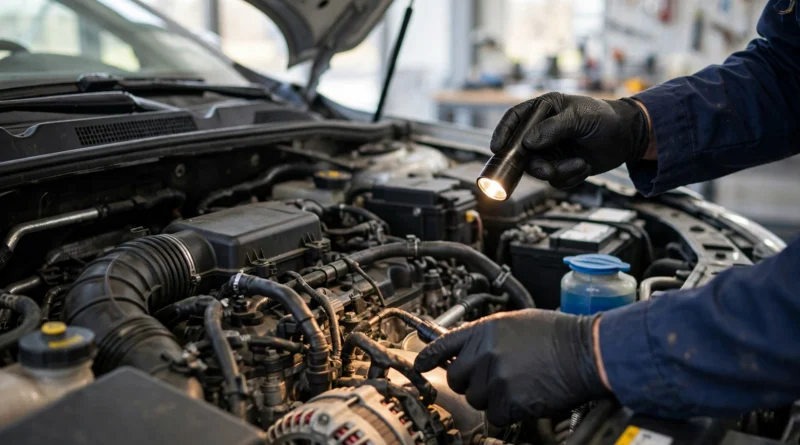
Car Engine Repair: Common Problems, Costs, and When to Fix It
Direct Answer
Car engine repair usually means fixing the one failed part that is making your engine run badly — most often a blown head gasket, a worn timing belt, an oil leak, or a misfiring ignition system. Typical costs run from a few hundred dollars for a timing belt to $1,500–$3,500 for a head gasket replacement, while a full engine replacement costs $3,500–$12,900 depending on whether the engine is used, remanufactured or new. Before you approve any big engine job, get the diagnosis in writing, ask whether related parts (timing belt, water pump, seals) should be replaced while the engine is already apart, and compare the quote with what the car is worth — because on an old car, a major engine repair can cost more than the car itself.
Key Takeaways
- The warning signs that your engine needs repair are a check engine light, overheating, white or blue exhaust smoke, knocking or ticking noises, oil or coolant leaks, and a rough idle or loss of power.
- The most common engine repairs are head gasket replacement ($1,500–$3,500), timing belt or chain replacement ($500–$1,200), and fixing oil leaks — costs vary widely by engine size and vehicle.
- A rebuild typically costs $2,500–$4,500, a remanufactured engine $3,500–$6,000 installed, and a brand-new engine $6,300–$12,900 installed.
- Labour is often more than half the bill on a major engine job, because reaching the failed part can take 10–25 hours.
- Never keep driving an overheating engine: a few more miles can turn a head gasket job into a warped cylinder head or a ruined engine.
- Regular oil checks and coolant changes are the cheapest engine repairs there are — most engine failures start as neglected maintenance.
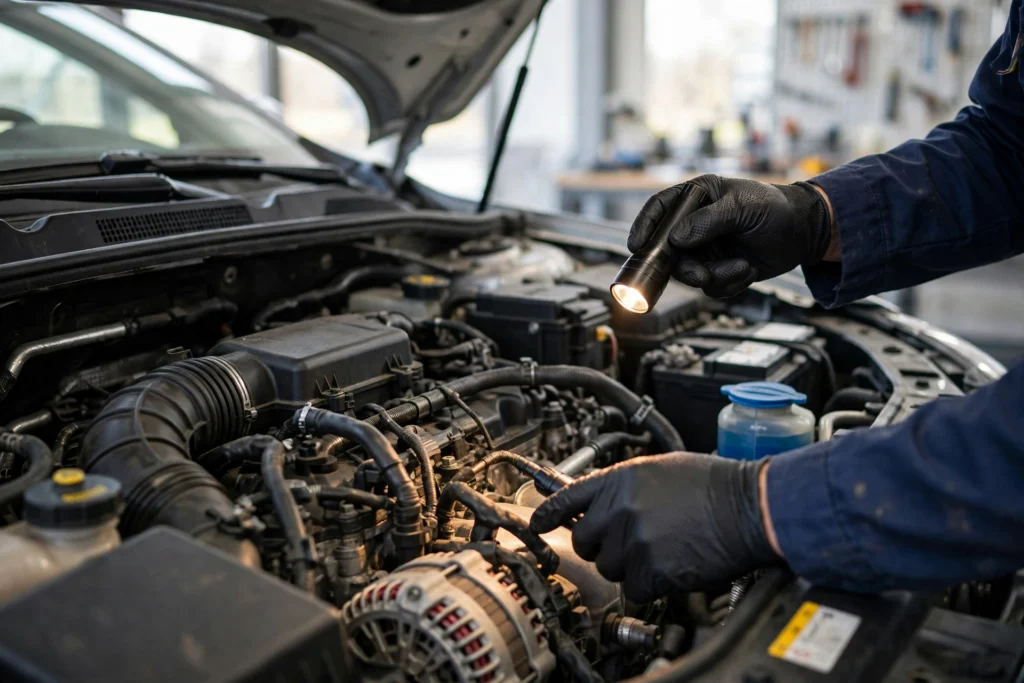
What Does Car Engine Repair Actually Involve?
Your car’s engine is a controlled explosion happening thousands of times a minute, sealed inside metal parts that have to stay oiled, cooled and precisely timed. “Car engine repair” is the catch-all term for fixing anything in that system when it stops working properly — from a single worn seal to a complete engine replacement.
A good shop always diagnoses first. Engine symptoms overlap heavily: a rough idle can be a spark plug, a vacuum leak, a failing sensor or low compression, and each one costs very different money. That is why the first step of any engine repair is a proper diagnosis — usually a scan of the engine computer for fault codes, a compression or leak-down test, and a check of oil and coolant condition — before anyone quotes you a repair.
Most engine repairs fall into four groups: sealing problems (gaskets and seals that leak oil or coolant), timing problems (the belt or chain that keeps the valves and pistons in sync), ignition and fuel problems (spark plugs, coils and injectors that cause misfires), and wear problems (bearings, piston rings and cylinder walls that wear out with age and mileage). Knowing which group your problem sits in is what tells you whether the fix is a few hundred dollars or a few thousand.
How Do I Know If My Engine Needs Repair?
Engines rarely fail without warning. The signs below are the ones mechanics see most often, and the sooner you act on them, the cheaper the repair usually is.
| Symptom | What it usually means |
|---|---|
| Check engine light on (steady or flashing) | A fault code is stored — anything from a loose fuel cap to a misfire; a flashing light means a misfire that can damage the catalytic converter |
| Temperature gauge climbing into the red | Cooling system failure, low coolant, a stuck thermostat or a failing water pump — stop driving, not “drive it home slowly” |
| White smoke from the exhaust | Coolant leaking into the combustion chamber, most often a blown head gasket |
| Blue smoke from the exhaust | Oil burning in the combustion chamber — worn valve seals or piston rings |
| Knocking, ticking or rattling noises | Low oil pressure, worn bearings, or a loose timing chain — all serious |
| Oil or coolant puddles under the car | A leaking gasket, seal or hose — check the colour: oil is brown/black, coolant is green, orange or pink |
| Rough idle, stalling or loss of power | Misfire, vacuum leak, fuel delivery problem or low compression in one or more cylinders |
| Milky, frothy residue under the oil cap | Coolant mixing with the oil — a classic head gasket symptom |
| Engine using oil between changes | Worn piston rings or valve seals, or an external leak you have not spotted |
One symptom deserves special attention: a flashing check engine light. That means the engine is misfiring badly enough to send unburned fuel into the exhaust, which can overheat and destroy the catalytic converter — turning a spark plug job into a $700–$2,500 catalytic converter replacement. If the light is flashing, slow down and get it checked the same day. Our guide to why your check engine light is on explains what the light means and what to do first when it appears.
The Most Common Engine Problems — and What Causes Them
Overheating
Overheating is both a symptom and a cause of engine damage. A failed thermostat, a broken water pump, a leaking radiator hose or simply low coolant can let the temperature climb until the cylinder head warps or the head gasket blows. The repair cost depends entirely on how long the engine ran hot: a thermostat and coolant top-up is a small job, but a warped head adds machining and can double the bill. If the gauge ever reaches the red, pull over and switch the engine off — driving on is the most expensive decision in this whole guide.
Blown head gasket
The head gasket seals the cylinder head to the engine block, keeping oil, coolant and combustion gases in their own channels. When it fails, coolant leaks into the cylinders (white smoke), oil and coolant mix (milky residue), or the engine loses compression (rough running, overheating). It is one of the most expensive common repairs because reaching the gasket means stripping the top of the engine apart — 10 to 25 hours of labour on many cars. A detailed breakdown of head gasket replacement costs, including RepairPal’s June 2026 national estimate of $2,543–$3,337, shows why quotes vary so much by engine type.
Oil leaks
Oil leaks start small — a weeping valve cover gasket, a worn crankshaft seal — and get worse with heat and age. A small leak is mostly a mess on your driveway, but a leak left alone lowers the oil level, and low oil is what kills bearings. The repair cost depends on where the leak is: a valve cover gasket is accessible and cheap, while a rear main seal sits between the engine and the transmission, so the transmission has to come out to reach it. Check your oil level regularly — our step-by-step guide to checking your oil shows how — and a leak gets found while it is still a small job.
Timing belt or chain failure
The timing belt or chain keeps the valves opening and closing in exact sync with the pistons. Belts are rubber and wear out — they are usually due every 60,000 to 100,000 miles — while chains last longer but can stretch and rattle with age. A snapped belt on many engines means the pistons hit the valves, which turns a $500–$1,200 belt job into a full cylinder head rebuild. That is why the belt’s replacement interval in your owner’s manual is not a suggestion: it is the cheapest insurance your engine has.
Misfires and rough running
A misfire — one cylinder not firing properly — is usually an ignition or fuel problem: worn spark plugs, a failed ignition coil, a clogged fuel injector, or a vacuum leak. It is also the cheapest group of engine problems to fix, and the one most often caught early by the check engine light. Ignoring a misfire is a false economy: unburned fuel damages the catalytic converter, and a rough-running engine wears its mounts and bearings faster.
Worn bearings and low oil pressure
Bearings are the thin shells of soft metal that the crankshaft spins inside, floating on a film of oil. When oil runs low, gets dirty, or loses pressure, metal touches metal — first as a ticking noise on a cold start, then as a deep knock that gets worse with revs. By the time an engine knocks loudly, the damage is usually extensive, and the choice becomes a rebuild or a replacement engine rather than a repair.
How Much Does Car Engine Repair Cost?
Costs vary by vehicle, engine size and where you live, but repair-cost guides report broadly consistent US ranges for the common jobs. Use them as a benchmark, then get a written quote for your car before authorising anything.
| Repair | Typical cost range | How long it takes |
|---|---|---|
| Timing belt or chain replacement | $500–$1,200 | 3–6 hours |
| Head gasket replacement | $1,500–$3,500 (RepairPal June 2026: $2,543–$3,337) | 10–25 hours |
| Engine rebuild | $2,500–$4,500 | Several days |
| Engine replacement, used engine | $2,500–$5,000 all-in | 15–25 hours |
| Engine replacement, remanufactured | $3,500–$6,000 all-in | 15–25 hours |
| Engine replacement, new engine | $6,300–$12,900 all-in | 15–25 hours |
Three things move the price most:
- Engine size and layout. A four-cylinder engine in an economy car is the cheapest to repair; a V6 costs more because it has two cylinder heads, and a V8, diesel or European turbo engine can cost far more — head gasket jobs on those can reach $4,000–$8,000 or more.
- Labour. Labour commonly makes up more than half the bill on a major engine job, and shop rates typically run $100–$200 an hour. A head gasket itself costs only $50–$250; the rest is the hours needed to take the engine apart and put it back together.
- What else gets replaced. A proper head gasket job usually includes a new timing belt or chain, water pump, thermostat and head bolts, because all of them are already accessible while the engine is open. That adds to the bill but avoids paying the same labour twice later.
How Much Does It Cost to Replace a Car Engine?
When the engine itself is worn out — low compression across all cylinders, a cracked block, a seized crankshaft — repairing individual parts stops making sense, and the question becomes replacement. There are three options, and the price gap between them is large.
| Engine source | Typical all-in cost | Warranty | Best for |
|---|---|---|---|
| Used / salvage engine | $2,500–$5,000 | Usually none, or 30–90 days | The cheapest way to get running again, but the engine’s history is unknown |
| Remanufactured engine | $3,500–$6,000 | Commonly 3 years / 100,000 miles from national remanufacturers | Best value for most drivers — a documented rebuild with a real warranty |
| New / crate engine | $6,300–$12,900 | Typically 3 years / 100,000 miles | Keeping the car long-term, or a rare or performance vehicle |
The engine itself is only part of the cost: a new four-cylinder engine runs about $4,000, a V8 about $7,000, and labour adds $2,000–$4,000 for the 15 to 25 hours the swap takes. A full cost breakdown of engine replacement, drawing on J.D. Power and Kelley Blue Book figures, puts the typical all-in range at $6,300–$12,900 for a new engine and $3,500–$6,000 for a rebuilt one. Always get the warranty in writing before you agree — it is the main thing that separates a good remanufactured engine from a gamble.
Is It Cheaper to Rebuild or Replace an Engine?
Rebuilding is usually cheaper. A rebuild keeps your original engine block and replaces only the worn internal parts — bearings, piston rings, gaskets and seals — typically $2,500–$4,500. A replacement with a remanufactured engine runs $3,500–$6,000 but gives you a completely renewed powerplant with a warranty.
The right choice depends on the damage:
- Rebuild when the block and cylinder head are sound and only the internals are worn. The quality depends entirely on the shop doing the work, so ask what is included and what warranty they offer.
- Replace with a remanufactured engine when you want a warranty and a known outcome, or when the block itself is damaged. It is the most expensive option per part, but the most predictable.
- Replace with a used engine when the car is old, the budget is tight, and you accept the risk. A used engine can be fine — or it can have the same wear your old one had. Check the mileage, ask for a compression test, and understand the warranty (often 30–90 days, sometimes none).
- Do neither when the repair costs more than the car is worth and the car has other problems waiting. That is a financial decision, not a mechanical one — see the next section.
Is It Worth Fixing the Engine on an Old Car?
Compare the repair quote with the car’s value and with what else the car needs. A $500–$1,200 timing belt on a car you plan to keep for another two years is almost always worth it. A $3,500 head gasket on a car worth $2,500 with rust, a worn transmission and bald tyres is a harder call.
A useful rule: if the repair costs more than half the car’s value, pause and price a replacement car before you approve it. Also add up everything else the car needs in the next year — tyres, brakes, suspension — because an engine repair does not fix those. If the car is otherwise sound, you rely on it daily, and the repair comes with a warranty, fixing it is usually cheaper than replacing the car. If you are weighing repair against replacement, our guide to the best used cars to buy can help you judge what a replacement would actually cost.
One exception: if the car is still under warranty, a certified pre-owned plan, or a recall — check the cover before paying anything yourself. Some engine faults, including certain oil-consumption and timing-chain problems, have been covered by manufacturer extensions on specific models.
Can You Drive With a Bad Engine?
It depends on what is wrong — and the wrong guess is expensive.
- A misfire or a steady check engine light: drive gently to a shop, soon. It is not an emergency, but it is not something to ignore for weeks either.
- Overheating: no. Pull over and switch off. Every minute of driving with the gauge in the red risks warping the cylinder head.
- A knocking noise or oil pressure warning light: no. Low oil pressure means metal parts are already touching. Switch off and get it towed.
- A blown head gasket: only far enough to reach a shop, and only if the engine is not overheating. Coolant in the oil destroys bearings quickly, so the longer you drive, the bigger the repair.
- White smoke with no overheating: get it checked promptly, but it is usually safe to drive a short distance to a shop.
If you are unsure, a tow costs far less than the damage from guessing wrong. Many breakdown cover plans include towing — check yours before you pay out of pocket.
How Long Does Engine Repair Take?
A timing belt takes a few hours. A head gasket typically takes two to four days in the shop, because the cylinder head usually goes to a machine shop to be checked for warping and resurfaced. A rebuild takes a week or more, and an engine replacement usually takes two to five days, depending on parts availability and how much has to be transferred from the old engine (intake, exhaust, sensors, wiring). Add time if the shop finds more damage once the engine is open — which is common with head gasket jobs, and why a written quote should state what happens if the head is cracked or the block is damaged.
How to Keep Your Engine Healthy
Most engine failures are slow and preventable. The maintenance that matters most is also the cheapest:
- Check the oil regularly, and change it on schedule. Low or dirty oil is the single most common cause of premature engine wear. A monthly dipstick check takes two minutes — see our guide to checking your oil.
- Keep the coolant fresh. Coolant does more than stop freezing: it carries anti-corrosion additives that wear out. Follow the manufacturer’s interval — commonly 2–5 years or 30,000–150,000 miles depending on the coolant formulation — and have the system flushed when the coolant is changed. Flushing the radiator and the cooling system removes the rust and scale that block passages and cause overheating.
- Replace the timing belt on time. The interval is in your owner’s manual, usually 60,000–100,000 miles. A belt that snaps can destroy the engine.
- Do not ignore small changes. A new noise, a faint smell, a temperature gauge that sits slightly higher than it used to, or oil that needs topping up between changes are all cheaper to investigate now than after the damage spreads.
- Let the engine warm up gently. Most engine wear happens in the first minutes after a cold start. Drive gently until the temperature gauge reaches its normal position, and avoid hard acceleration while the engine is cold.
FAQ
How do I know if my engine needs repair?
The clearest signs are a check engine light, overheating, white or blue exhaust smoke, knocking or ticking noises, oil or coolant leaks, and a rough idle or loss of power. A shop can confirm the cause in under an hour with a fault-code scan and a compression test — do not guess from the symptom alone, because several different faults produce the same warning signs.
What is the most expensive engine repair?
A full engine replacement with a new engine, at $6,300–$12,900 installed. A cracked engine block or severe overheating damage can push the total to $6,000–$10,000 or more even with a rebuild, because the block itself may need replacing. The most expensive single repair job is usually a head gasket on a large or European engine, at $4,000–$8,000 or more.
What causes engine failure?
The most common causes are loss of oil (leaks or burning), overheating (cooling system failure), neglected maintenance (missed oil changes, an overdue timing belt), and contamination (coolant in the oil, or dirt getting past a damaged air filter). Most engine failures are not sudden — they are the end of a problem that was ignored for months.
How often should coolant be flushed?
Follow your manufacturer’s interval, commonly every 2–5 years or 30,000–150,000 miles depending on the coolant formulation. If the coolant looks rusty or brown, or the car has started running hotter than usual, have it checked sooner — a flush is cheap, and a blocked cooling system is not.
Conclusion
Car engine repair is mostly diagnosis: find the one failed part, understand what it costs, and decide whether the repair is worth it for your car. Start with the cheap checks — the oil level, the coolant level, and what the check engine light is actually reporting — and never keep driving an overheating engine. Know the typical costs before you walk into a shop: a timing belt is $500–$1,200, a head gasket is usually $1,500–$3,500, a rebuild is $2,500–$4,500, and a replacement engine runs $3,500–$12,900 depending on whether it is used, remanufactured or new. With those numbers in hand, a written quote in front of you, and an honest look at what your car is worth, you can tell a fair price from an inflated one — and decide with confidence whether to fix the engine or move on.