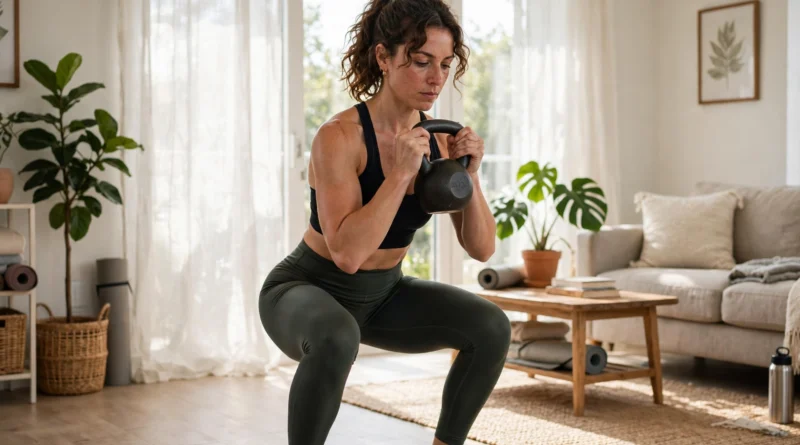
Functional Fitness Workouts: A Beginner’s Guide to Training for Everyday Strength
Direct Answer: Functional fitness workouts train your body for the movements you actually use in daily life — standing up from a chair, lifting a box off the floor, carrying shopping bags, climbing stairs and reaching overhead. Instead of isolating one muscle at a time, functional training uses compound movements that work several muscles and joints together, so you build strength, balance and coordination that transfers outside the gym. A beginner can start with bodyweight movements, two sessions a week, and no special equipment.
Key Takeaways:
- Functional fitness is training movement patterns, not just individual muscles.
- The 7 core patterns are squat, lunge, push, pull, hinge, rotation and carry.
- Two full-body sessions a week is a realistic, effective starting point for most beginners.
- You can start at home with bodyweight, then add dumbbells, bands or a kettlebell as you get stronger.
- Form comes before load: move well first, then add weight, reps or complexity.
- This is general educational information, not personal medical or training advice. If you have pain, an injury or a health condition, talk to a qualified professional before starting a new programme.
What Is Functional Fitness?
Functional fitness is a style of exercise that trains movement patterns and physical abilities that transfer to everyday activities. The idea is simple: the gym should make real life easier, not just make one muscle bigger. Traditional strength training often isolates a muscle — a bicep curl works mainly the biceps, a leg extension works mainly the quadriceps. That kind of training still has value, but it does not teach your muscles to work together the way they must when you lift a suitcase into an overhead bin or catch yourself when you trip. Functional exercises usually involve several muscles and joints working together. A squat, for example, uses your legs, glutes, core and back at the same time. A farmer’s carry — walking while holding a weight in each hand — trains grip, posture, core stability and walking balance all at once. That is why functional fitness is often described as training for life outside the gym: fewer aches doing ordinary tasks, better balance on stairs and uneven ground, and more confidence lifting, carrying and reaching.
Are Full Body Workouts Good?
Yes. Full body workouts are a good choice for most beginners and busy people, because they train all the major muscle groups in each session, typically 2 to 3 times a week. When weekly training volume is equal, research summaries comparing full body routines with body-part splits find similar gains in strength and muscle size. The practical advantage of full body training is frequency: each muscle gets stimulated 2 to 3 times a week instead of once, and missing one session does not mean an entire muscle group goes untrained for a fortnight. A full body session does not mean doing every exercise you know. A sensible session covers the main patterns — one squat, one hinge, one push, one pull and one core or carry movement — and stops there. That is usually 5 to 7 exercises, not 20. If you already follow a split routine you enjoy and it is working, you do not need to abandon it. Functional training and traditional strength training can complement each other: many lifters add functional movements, such as carries and single-leg work, to an existing programme rather than replacing it entirely.
The 7 Functional Movement Patterns
Almost every functional workout is built from seven patterns. Learning them gives you a framework for any routine, class or programme you try later.
| Movement pattern | Everyday example | Beginner exercise |
|---|---|---|
| Squat | Standing up from a chair | Bodyweight squat to a chair |
| Lunge | Climbing stairs, stepping forward | Reverse lunge |
| Push | Pushing a heavy door open | Knee or wall push-up |
| Pull | Pulling a door or drawer towards you | Resistance-band row |
| Hinge | Picking something up off the floor | Hip hinge / Romanian deadlift with light weight |
| Rotation | Turning to look behind you, putting luggage in a car boot | Standing torso rotation, Pallof press hold |
| Carry | Carrying shopping bags, walking | Farmer’s carry, loaded walk |
You do not need to train all seven in every session. A balanced week covers all of them across your two or three sessions. If one pattern feels awkward — hinges often do for beginners — practise it with no weight first and keep the range short until the movement feels natural.

Functional Training vs Traditional Strength Training
The difference is emphasis, not a rivalry. Traditional strength training often aims to build a specific muscle or lift a heavier weight in one lift. It uses machines and isolation exercises, controlled ranges of motion and clear progression in load. It is excellent for building muscle size and maximal strength. Functional training aims to improve how you move. It favours free weights, bodyweight and unstable or single-sided work, because daily life rarely happens sitting on a machine with both sides moving symmetrically. It also puts more weight on balance, coordination and core stability. In practice, the two overlap heavily. Squats, deadlifts, presses and rows appear in both approaches — and they should, because they are the most useful exercises in either. The practical question is not which camp you belong to, but whether your routine covers the movement patterns, trains both sides of the body, and includes balance and carrying work alongside pure strength.
How Many Reps Should I Do for Muscle Growth?
How many reps for muscle growth is one of the most searched functional training questions, and the honest answer is that a range works, not a single magic number. For general muscle growth, most beginners do well with 8 to 12 repetitions per set, for 2 to 3 sets per exercise, stopping 1 to 3 repetitions short of failure — close enough to be challenging, but with form intact. Higher reps (12 to 20) with lighter weight favour muscular endurance and are a gentler starting point for joints and coordination. Lower reps (5 to 8) with heavier weight favour maximal strength, but they demand solid technique first. What matters more than the exact rep count is progression over weeks: adding a repetition, a little weight, a slower tempo or a harder variation when the current version feels easy. Muscle grows when the stimulus gradually increases, not when you chase a perfect rep number in a single session. For balance and core work, time or distance often replaces reps: a 20 to 30 second plank hold, a 30 second farmer’s carry, or a single-leg stand held for 20 seconds per side.
A Beginner Functional Workout You Can Do at Home
This is a simple 2-day routine. Do it on non-consecutive days, for example Monday and Thursday, with a 5-minute warm-up of walking in place, arm circles and leg swings first.
Day 1 — Lower body and carry
- Bodyweight squat to a chair — 2 to 3 sets of 10
- Reverse lunge — 2 to 3 sets of 8 per leg
- Hip hinge (no weight, hands on hips) — 2 to 3 sets of 10
- Farmer’s carry — 3 walks of 20 to 30 seconds
- Dead bug (core) — 2 sets of 8 per side
Day 2 — Upper body and balance
- Wall or knee push-up — 2 to 3 sets of 10
- Resistance-band row — 2 to 3 sets of 12
- Step-up on a low, sturdy step — 2 to 3 sets of 8 per leg
- Standing torso rotation, slow and controlled — 2 sets of 10 per side
- Single-leg stand — 2 sets of 20 seconds per side, holding a chair if needed
Rest 60 to 90 seconds between sets. If an exercise causes sharp pain, stop and skip it — soreness the next day is normal for a beginner, sharp pain is not. Keep a short note of what you did each session so you can progress honestly instead of guessing.
Related reading on this site: our beginner workout plan gives a simple 3-day full-body routine, and our guide to the best exercises for strength at home explains how to build strength without a gym. Functional workouts sit naturally alongside both: the patterns here are the same ones those routines use, applied to everyday movement.
How Often Should I Do Functional Training?
Two sessions a week is a strong starting point, and it lines up with public health guidance. The CDC’s Physical Activity Guidelines for Americans recommend that adults do muscle-strengthening activities on at least 2 days a week, working all major muscle groups, alongside at least 150 minutes of moderate-intensity aerobic activity such as brisk walking. You can read the full guidelines on the CDC physical activity guidelines page. Three sessions a week is also fine once you recover well between them. More is not automatically better for a beginner: muscles, tendons and coordination adapt during rest, and adding a third or fourth session too soon is a common cause of burnout. A good rule is to add a session only when two sessions a week feels easy for two weeks in a row. You can also sprinkle functional movement into daily life without a formal workout: carry groceries in both hands instead of overloading one arm, take the stairs, sit down and stand up without using your hands when you safely can, and practise single-leg balance while brushing your teeth.
Do I Need Equipment for Functional Training?
No. Bodyweight is enough to start, and it is the safest way to learn the patterns. A chair for squats, a sturdy step for step-ups, and a wall for push-ups cover most beginner exercises. When bodyweight stops challenging you, simple equipment adds the most value for the least cost: resistance bands for rows and presses, one pair of dumbbells for carries and hinges, and later a kettlebell for swings and goblet squats. You do not need a gym membership, a suspension trainer or a balance board to benefit — those are options, not requirements. If you do join a gym or class, look for coaches who teach the movement first and load second, and who offer regressions (easier versions) as well as progressions. A good class should feel like practising movement, not surviving it.
Is Functional Training the Same as CrossFit?
No, although they share some exercises. CrossFit is a branded, competitive training programme built around high-intensity, constantly varied workouts, often performed against the clock or for maximum repetitions. Functional training is a broader approach: any training that improves everyday movement patterns, at any intensity, with or without competition. You can do functional training slowly, at home, with no timer and no leaderboard. Intensity is a dial you control. If timed, high-intensity workouts appeal to you, that is a separate choice — it is not a requirement of functional training.
Can Functional Training Build Muscle?
Yes, provided you progress. Muscle grows when a movement is challenging enough, performed for enough sets, and gradually made harder over time. Bodyweight squats, push-ups, rows and carries can build noticeable strength and muscle in beginners, especially in the first months, because almost any consistent resistance is a new stimulus. As you get stronger, bodyweight alone eventually stops being enough for some movements. That is the point to add dumbbells, bands or a barbell, or to switch to harder variations such as Bulgarian split squats or single-arm rows. Functional training does not mean avoiding weights — it means choosing weights that serve a movement you actually need. For a fuller introduction to functional movement principles, see the IDEA Health & Fitness Association guide to getting started with functional fitness.
Common Functional Training Mistakes
- Loading before learning. Adding weight to a squat or hinge you cannot yet do well with bodyweight is the fastest route to bad habits and injury. Earn the load with clean reps first.
- Skipping single-sided work. Daily life is rarely symmetrical. Lunges, single-arm rows and single-leg balance expose and fix imbalances that two-sided barbell work hides.
- Ignoring balance and carries. Strength without balance still leaves you unsteady on stairs or uneven ground. Carries and single-leg work are not extras; they are core patterns.
- Turning every session into a race. Speed has a place, but rushing a beginner through complex movements under fatigue is when form breaks down. Slow, controlled reps build the pattern first.
- Doing only what you are good at. If you love upper body work and avoid lunges, your programme will stay lopsided. A simple checklist of the seven patterns keeps the week balanced.
How Long Before I See Results?
Most beginners notice practical changes first: stairs feel easier, carrying feels steadier, and getting up from the floor feels less effortful, often within 3 to 4 weeks of consistent twice-weekly training. Visible muscle change and measurable strength gains typically take longer — around 8 to 12 weeks of consistent, progressive training, alongside sleep and adequate nutrition. That timeline is a general guide, not a promise. Age, starting fitness, consistency and recovery all shift it. The most reliable predictor is not the perfect programme but the one you still do in three months. Two short sessions a week, done consistently, beat an ambitious five-day plan abandoned in week two.
FAQ
Q: Is functional training good for balance?
A: Yes. Single-leg work, carries, lunges and core stability exercises directly train the balance and coordination used in daily life, and older adults in particular benefit from including balance activities alongside strength work.
Q: What if I already lift weights?
A: Add, don’t replace. Swap one or two machine exercises for functional equivalents — a goblet squat instead of a leg extension, a dumbbell row instead of a machine pull — and add a carry at the end of one session a week.
Q: Can older adults do functional training?
A: Yes, and it is often the most relevant kind of training for maintaining independence. Start with chair-assisted squats, wall push-ups, step-ups on a low step and supported balance work, and progress gradually. Anyone with a health condition should check with a professional first.
Q: Do I need to stretch after functional training?
A: A short cool-down of gentle movement and light stretching of the muscles you worked is sensible, but stretching alone does not replace the workout. Five minutes of easy walking and gentle mobility work is enough for most sessions.
Conclusion
Functional fitness workouts are not a complicated system or a new trend. They are a practical way to train: learn seven movement patterns, practise them twice a week with good form, progress gradually, and let the strength show up where it matters — in the ordinary things you do every day. Start with bodyweight, keep the routine simple, and build from there. Start this week with Day 1 above. If the squat to a chair and the farmer’s carry feel comfortable after two weeks, add a little weight or an extra set — and you will already be doing functional training properly.
For a wet-weather version of these patterns, see our best indoor exercises for rainy days, which turns squats, lunges, push-ups, and carries into a small-space circuit you can do at home.