How to Jump Start a Car Battery: A Safe Step-by-Step Guide
Direct Answer
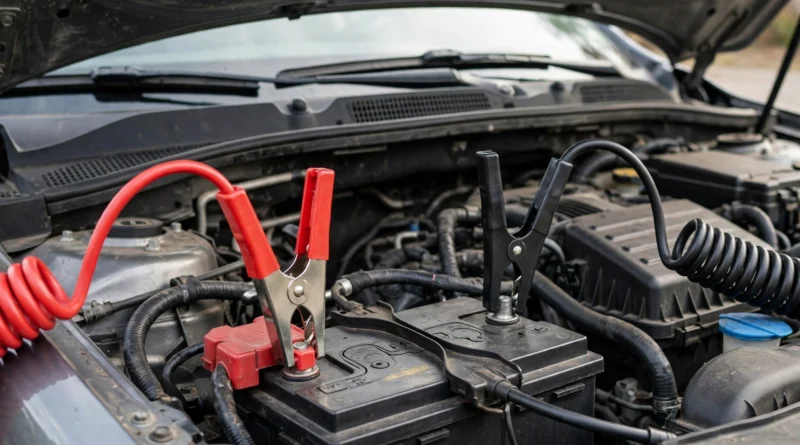
To learn how to jump start a car battery, park a working car close by, switch both cars off, and connect the cables in this order: red clamp to the dead battery’s positive (+) terminal, red clamp to the good battery’s positive terminal, black clamp to the good battery’s negative (-) terminal, and the last black clamp to unpainted metal on the dead car’s engine. Start the working car, wait a few minutes, start the dead car, then remove the cables in reverse order and drive for at least 20 to 30 minutes.
Key Takeaways
- The cable order is a safety rule, not a suggestion: red first, black last, and the final black clamp goes to bare metal, never to the dead battery’s negative terminal.
- Never jump start a battery that is cracked, leaking, swollen, or frozen solid, and never let the clamps touch each other while connected.
- A jump start is a temporary rescue, not a repair: it gets the engine running so the alternator can recharge the battery, but it does not fix a worn-out battery or a faulty charging system.
- After a successful jump, drive for at least 20 to 30 minutes rather than just idling, and longer in cold weather or if the battery is old.
- If the car will not start after two careful attempts, or dies again soon afterwards, stop repeating the jump and get the battery and charging system tested.
Before You Start: Safety Checks
A few checks before you touch any cable will keep a stressful moment safe. First, look at the dead battery. If the case is cracked, leaking fluid, bulging, or the battery smells strongly of rotten eggs, do not jump start it. A damaged battery can vent hydrogen gas, and a spark nearby can ignite it. Call for professional help instead.
Second, check that both cars use the same voltage. Almost all ordinary cars use a 12-volt system, but if either vehicle is unusual — a large truck, a hybrid with special jump points, or an older vehicle — check the owner’s manual first. Many modern cars also have remote jump posts under the bonnet because the battery itself is hidden in the boot or under a seat. Your manual will show you exactly where to connect, and using those posts is safer than hunting for the battery itself.
Third, gather what you need: a set of jumper cables (also called booster cables) long enough to reach between the two cars, and a second car with a healthy battery — or a portable jump starter, covered below. Park the working car close enough for the cables to reach, without the cars touching. Put both cars in Park (or Neutral for a manual), apply the parking brakes, switch both engines off, and turn off lights, heaters, radios, and phone chargers. Removing jewellery and keeping loose clothing away from the engine bay is also sensible: you will be working near belts and fans.
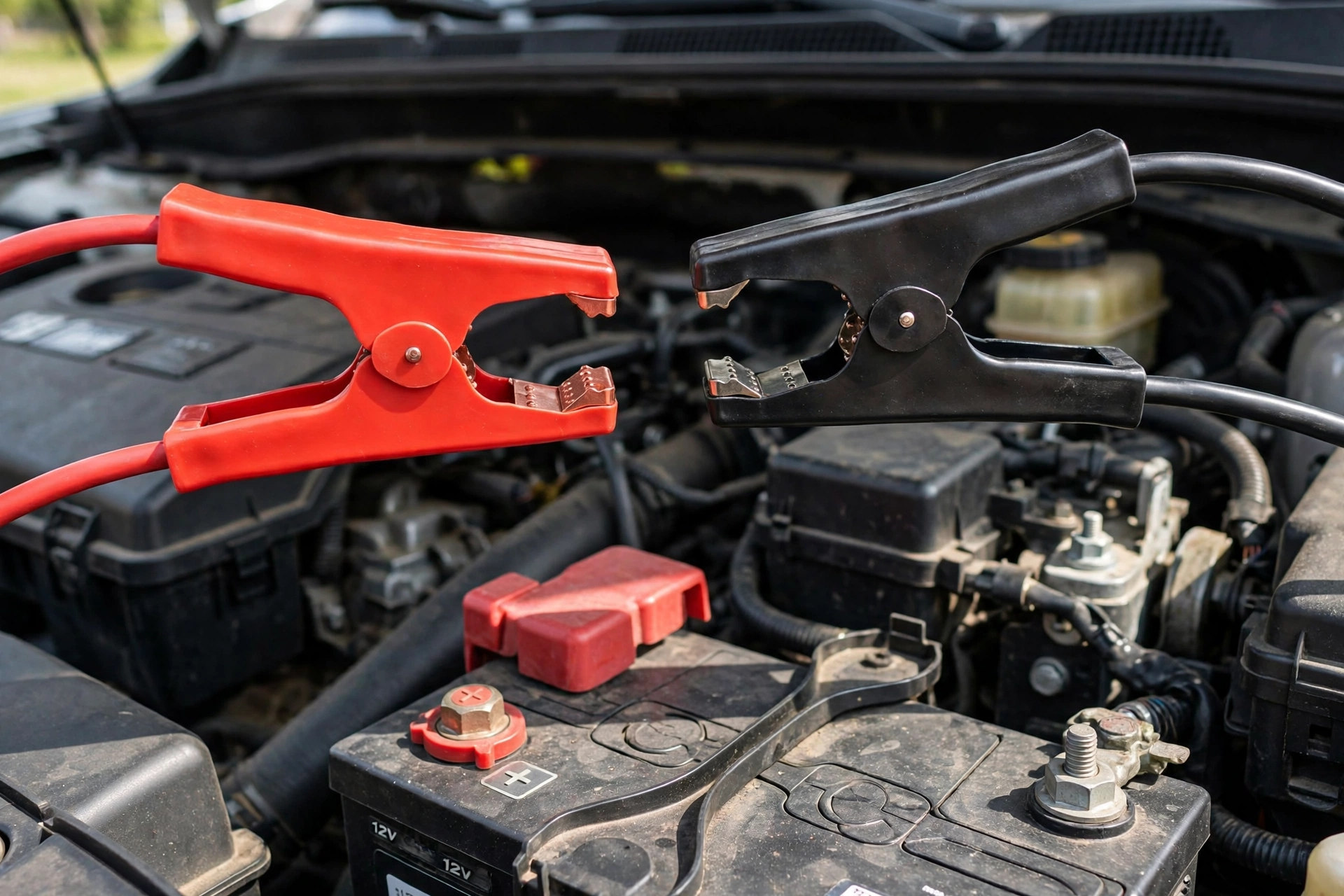
Finally, identify the terminals before you clamp anything. The positive terminal is marked with a plus sign (+) and usually has a red cover; the negative terminal is marked with a minus sign (-) and usually has a black cover. If you are unsure which is which, stop and check the manual. Connecting cables the wrong way round can damage both cars’ electronics.
How to Jump Start a Car Battery Step by Step
Follow these steps in order, and do not skip ahead. The sequence matters because the last connection is the one most likely to spark, and you want that spark to happen away from the battery.
- Park and prepare. Position the working car so the cables can reach both batteries, switch both cars off, and set the parking brakes.
- Red to the dead battery’s positive terminal. Attach one red clamp to the positive (+) terminal of the dead battery.
- Red to the good battery’s positive terminal. Attach the other red clamp to the positive (+) terminal of the working car’s battery.
- Black to the good battery’s negative terminal. Attach one black clamp to the negative (-) terminal of the working car’s battery.
- Black to bare metal on the dead car. Attach the last black clamp to an unpainted metal part of the dead car’s engine — a bolt, bracket, or a grounding point marked with a minus sign — several inches away from the battery. Do not clamp it to the dead battery’s negative terminal. This is the step most beginners get wrong, and it exists to keep any spark away from battery gases.
- Start the working car. Let it run for two to three minutes so it can feed charge towards the dead battery.
- Start the dead car. Try to start it normally. If it does not start, wait another couple of minutes and try once more. Do not crank the starter for more than about 15 seconds at a time, or you risk overheating it.
- Leave the cables connected for a few minutes once the dead car is running, so the charge stabilises.
- Remove the cables in reverse order. Black clamp off the dead car’s metal ground first, then black off the good battery’s negative terminal, then red off the good battery’s positive terminal, and finally red off the dead battery’s positive terminal. Keep the clamps from touching each other or any metal as you remove them.
- Drive the revived car. Drive for at least 20 to 30 minutes, covered in detail below, rather than switching it straight off.
A simple memory aid for the order is “red first, black last on, black first, red last off” — or, even shorter, “last on, first off.”
For another clear walkthrough of this process, see KBB’s guide to how to jump start a battery.
Which Terminal Do You Connect First When Jumping a Car?
You always connect the positive terminal first when jumping a car. The first clamp goes on the dead battery’s positive terminal, then the other red clamp goes on the good battery’s positive terminal. Only after both red clamps are in place do you attach the black clamps.
The reason is safety. Connecting the positive side first, and making the final connection to bare metal away from the battery, means that any spark at the final connection happens away from the gases a battery can give off. If you connected the negative side first and then accidentally touched a red clamp to metal, you could create a short circuit and a shower of sparks in exactly the wrong place.
For more detail on this order, see Batteries Plus on jumping a car from the positive terminal.
Which Battery Terminal Do You Disconnect First?
You disconnect in the exact reverse of the connection order. The black clamp on the dead car’s metal ground comes off first, then the black clamp on the good battery, then the red clamp on the good battery, and finally the red clamp on the dead battery. In other words, the last cable you connected is the first one you remove. This keeps sparks away from the battery and stops a loose live clamp from touching metal while the other end is still connected.
How to Use Booster Cables Correctly
Booster cables and jumper cables are the same thing: a pair of heavy cables, one red and one black, with a clamp at each end. A few habits make them much safer to use. Keep the red and black clamps apart at all times — if they touch while connected to a battery, they can short and spark. Make sure each clamp grips firmly on clean metal, not on a plastic cover or a corroded terminal; if a terminal is covered in white or greenish crust, wipe it gently with a dry cloth before clamping, but never use your bare hands on battery corrosion.
Choose cables that are long enough for real cars parked nose to nose or side by side, and thick enough for the job. Thin, cheap cables may struggle with a large engine in winter. Store them coiled and dry in the boot so they are there when you need them, and check them occasionally for cracked insulation or loose clamps. Damaged cables belong in the bin, not in your boot.
How to Jump Start a Car Without Another Car
If no second car is available, a portable jump starter — a small battery pack with its own clamps — does the same job. Connect its red clamp to the dead battery’s positive terminal and its black clamp to an unpainted metal ground on the engine, exactly as you would with cables, then switch the pack on and start the car. Remove the clamps in reverse order once the engine is running.
A portable jump starter is worth keeping charged if you often drive alone, travel in winter, or park for long periods. Check its charge every few months, because a flat jump pack is no help at all. Follow the pack’s own instructions as well as this guide: some packs have a boost button for a deeply discharged battery, and some will warn you if the clamps are reversed.
Can You Push Start a Car Without Cables?
Push starting, also called bump starting, only works on a manual car, and only if the battery still has enough life to power the ignition and fuel system. It never works on an automatic, a continuously variable transmission, or a dual-clutch car, and attempting it on those can damage the transmission. Even for a manual, it needs a slope or helpers to push, and it is a last resort rather than a plan. For most drivers, jumper cables or a portable jump starter are the safer and more reliable answer, and if the car will not start with those, the problem is probably bigger than a flat battery.
How Long Should You Drive After a Jump Start?
Drive for at least 20 to 30 minutes after a jump start, ideally at steady road speeds rather than in stop-and-go traffic. Driving charges the battery far more effectively than idling, because the alternator produces more current when the engine is under load. Simply idling in the driveway for five or ten minutes, or taking a short trip around the block, rarely puts enough charge back for the car to start again next time.
Add extra time in difficult conditions. In cold weather, the battery’s chemistry works more slowly and the starter needs more effort, so aim for 30 to 60 minutes. With an older battery, or one that was completely flat rather than just weak, a longer drive is also wise, and you should still get the battery tested within a few days. A jump start only buys time; it does not restore a battery that can no longer hold a charge.
Avoid switching the engine off soon after a jump, and avoid running unnecessary accessories — heated seats, air conditioning, phone chargers — during the recharge drive. If the car dies again the same day, or needs a jump more than once in a week, treat that as a warning, not bad luck.
Why Car Batteries Die in Cold Weather
Winter is jump-start season for a simple reason: cold slows the chemical reactions inside a lead-acid battery, so it delivers less power exactly when the engine needs more effort to turn over thick, cold oil. Short winter trips make it worse, because a car that only runs for a few minutes at a time never gets a proper recharge. Add lights, heaters, and heated screens, and the battery spends more than it earns.
That is why this guide matters most in the weeks before winter. A battery that struggled on the first cold morning will not improve on its own. If your car cranks slowly on a cold morning, get the battery tested before it fails outright. A quick test at a garage or parts store is usually free, and it is far cheaper than a breakdown on a freezing night. While you are preparing the car for winter, it is also worth checking the oil — see our guide on how to check oil in your car — since cold-weather starting and oil condition are closely linked.
What to Do If the Car Will Not Start After a Jump
First, double-check the connections. A loose clamp, a clamp on a plastic cover instead of metal, or a reversed cable are the most common reasons a jump fails. Reconnect carefully in the correct order and try once more after a few minutes of charging from the working car.
If the car still will not start, listen to what it does. A single click, or rapid clicking, usually points to a battery too weak to turn the starter. Complete silence may mean a connection problem or a failed starter. If the engine turns over normally but will not catch, the problem is probably not the battery at all — it could be fuel, spark, or another fault, and jump starting will not help.
If the car starts but dies again soon afterwards, or needs jumping repeatedly, the battery may be too old to hold a charge, or the alternator may not be charging it. Either way, get both tested promptly. Driving around on repeated jump starts risks leaving you stranded and can strain the charging system. Knowing typical repair costs in advance also helps you judge a garage quote calmly instead of under pressure.
Cable Order Cheat Sheet
| Step | Connection | Remember |
|---|---|---|
| 1 | Red clamp to dead battery positive (+) | Red first |
| 2 | Red clamp to good battery positive (+) | Red to red |
| 3 | Black clamp to good battery negative (-) | Black to the good car |
| 4 | Black clamp to bare metal on dead car | Never to the dead battery’s negative terminal |
| 5 | Start working car, wait, start dead car | Two to three minutes between starts |
| 6 | Remove cables in reverse order | Last on, first off |
Frequently Asked Questions
Can you jump start a completely dead battery?
Sometimes. If the battery is simply discharged — lights left on, car unused for weeks — a jump usually works. If the battery is damaged, frozen, or so old it cannot hold any charge, a jump may start the car once but it will die again quickly, or not start at all. A battery that will not hold a charge needs replacing, not another jump.
Does jump starting damage the donor car?
Not when done correctly. The donor car simply lends power for a few minutes. Damage happens when cables are reversed, clamps touch each other, or a damaged battery is jumped. Follow the order in this guide, keep the clamps apart, and switch the donor car’s accessories off, and the risk is minimal.
How long do you leave jumper cables connected?
Leave them connected for a few minutes after the dead car starts, so the charge stabilises, then remove them in reverse order. Do not leave cables connected for a long drive, and do not drive with the two cars still linked. The recharge happens after the cables are off, during your 20 to 30 minute drive.
Can you jump start a car in the rain?
Yes, with care. Batteries and cables can get wet, but avoid standing water, keep the clamps dry where possible, and never jump a cracked or leaking battery. If conditions feel unsafe — heavy rain, standing water around the engine bay — wait for help rather than rushing.
Conclusion
Learning how to jump start a car battery is one of the most useful roadside skills a driver can have, and it comes down to one rule: connect red first and black last, ground the final clamp to bare metal, and reverse the order to disconnect. Check the battery for damage first, drive for at least 20 to 30 minutes afterwards, and treat a repeat failure as a sign to get the battery and charging system tested. Done calmly and in the right
order, a jump start is a quick rescue — and with a set of cables or a charged jump pack in the boot before winter, it is one you will be ready for.
If a jump start does not fix the problem, use our guide to diagnosing a car that won’t start by sound and symptom to find the likely cause.
Before buying a used car, also learn how to look up a VIN number.