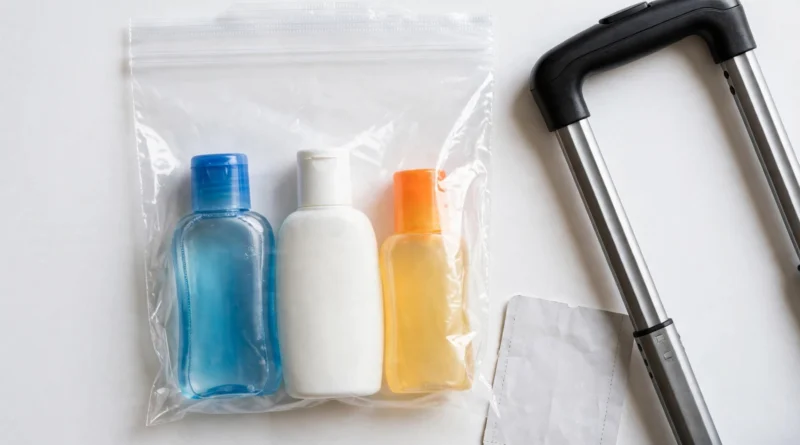
The TSA 3-1-1 Rule Explained: A Complete Guide to Carry-On Liquids
Direct answer: The TSA 3-1-1 rule — often written as the TSA 311 rule — limits liquids, gels, aerosols, creams and pastes in your carry-on to containers of 3.4 ounces (100 ml) or less, all of which must fit inside one quart-sized, clear, resealable bag, with one bag allowed per passenger. TSA measures the container size, not the amount left inside — a half-empty 6 oz bottle still fails.
Key Takeaways
- 3 = containers of 3.4 oz (100 ml) or less
- 1 = one quart-sized clear bag
- 1 = one bag per passenger
- Container size counts, not the remaining amount.
- Solids (stick deodorant, bar soap, powder makeup) are not liquids and skip the rule entirely.
- Medications, baby formula and breast milk are exempt — declare them at screening.
- The rule applies only to carry-on bags; checked bags have no liquid size limit.

What the TSA 3-1-1 Rule Means
The TSA 311 rule’s name is a memory aid: 3.4 ounces, 1 quart bag, 1 bag per traveler. It applies to every flight departing a U.S. airport, and most countries follow a nearly identical 100 ml standard.
| The number | What it means | The detail |
|---|---|---|
| 3 | 3.4 ounces (100 ml) | Maximum size per container — not per passenger, per container |
| 1 | 1 quart-sized bag | One clear, resealable bag (about 7 x 8 inches) holding all your containers |
| 1 | 1 bag per passenger | Each traveler gets exactly one bag; it must close completely |

One detail trips up more travelers than anything else: TSA judges the container, not its contents. A 6-ounce shampoo bottle that is three-quarters empty is still a 6-ounce container, and it will be confiscated. If you want to bring a favorite product, decant it into a travel-size bottle of 3.4 oz or less. At the checkpoint, the quart bag must come out of your carry-on and go through screening in its own bin (at airports with newer CT scanners you may be told to leave it in — follow the officer’s instructions). TSA PreCheck does not exempt you from the rule: PreCheck members still follow 3-1-1, they just often get to leave the bag in their luggage.
What Counts as a Liquid Under the 3-1-1 Rule?
TSA treats liquids, gels, aerosols, creams and pastes as liquids. A former TSA spokesperson’s rule of thumb: if you can spill it, spray it, spread it, pump it or pour it, it is a liquid.
Counts as a liquid (goes in the quart bag): shampoo, conditioner, body wash, lotion, sunscreen; toothpaste and mouthwash; hair gel, mousse, hairspray; perfume and cologne; liquid foundation, mascara, lip gloss; roll-on, gel and spray deodorant; peanut butter, yogurt, hummus, jam, sauces and soups.
Does not count as a liquid (pack freely): solid stick deodorant; bar soap, shampoo bars, conditioner bars; powder makeup (blush, pressed foundation, setting powder); solid lipstick; baby powder and dry shampoo powder (over 12 oz of powder needs separate screening); an empty water bottle — fill it after security.
The food items surprise people most. Peanut butter, yogurt and hummus are all treated as gels under the rule, so the 3.4 oz limit applies to them too.
How Many Ounces Can You Take on a Plane?
There is no fixed number of bottles — the limit is what fits. Every container must be 3.4 oz or smaller, and everything must fit inside the single quart bag, which must still close completely. In practice, most travelers fit roughly 6 to 9 standard travel-size bottles in a quart bag, depending on bottle shape. So when people ask about the TSA 311 rule and “how many ounces can you take on a plane,” there are two answers: per container, 3.4 oz maximum; in total, however many compliant containers you can zip into one quart bag. Tip: flat, soft-sided travel bottles pack far more efficiently than rigid round ones. Squeeze out the air as you fill them and lay them flat in the bag.
Does Deodorant Count as a Liquid for TSA?
It depends entirely on the type: Solid stick deodorant — not a liquid, bring any size, no bag needed. Gel deodorant — counts as a liquid, 3.4 oz or less, in the quart bag. Spray deodorant — counts as an aerosol, 3.4 oz or less, in the quart bag. Roll-on deodorant — counts as a liquid, 3.4 oz or less, in the quart bag. This is why frequent travelers often switch to a solid stick: it frees a slot in the quart bag and removes one decision at the checkpoint.
Other tricky items, answered
Is toothpaste a liquid? Yes — toothpaste is classed as a paste under the 3-1-1 rule. Use a travel-size tube (3.4 oz or less) in your quart bag, or switch to toothpaste tablets, which are solid.
Is mascara a liquid? Yes — mascara’s gel-based formula counts. Standard tubes are well under 3.4 oz, but they take up a slot in the bag.
Can you bring spray sunscreen on a plane? Yes, in a 3.4 oz or smaller container in the quart bag. Sunscreen sticks are a solid alternative that skip the rule.
Can you bring full-size shampoo? Not in a carry-on — only 3.4 oz or less per container. Pack full-size bottles in checked luggage instead.
What Is Not Allowed in Your Carry-On
For liquids specifically: any container larger than 3.4 oz, anything that does not fit in your single quart bag, and open containers that cannot be resealed for screening are not allowed through the checkpoint. Oversized liquids are confiscated — there is no “finish it at the bin” option for a $40 serum. Beyond liquids, the carry-on ban list includes sharp objects like knives and box cutters, sporting goods that could be used as weapons (baseball bats, for example), and flammable items. If you are unsure about a specific item, TSA runs a searchable item list on its website — check the exact item before you pack it.
Exceptions to the 3-1-1 Rule
Three categories are exempt from the TSA 311 rule’s 3.4 oz limit and do not have to fit in the quart bag:
- Medications — prescription and over-the-counter liquid medications, including the ice or gel packs needed to keep them cool. Remove them from your bag and tell the officer at the start of screening. No doctor’s note is required.
- Baby formula, breast milk and juice for babies — allowed in reasonable quantities for your itinerary. Declare them at the checkpoint; they may receive additional screening. Gel or liquid-filled teethers and canned or jarred baby food are covered too.
- Duty-free liquids — purchased after the checkpoint in sealed, tamper-evident bags with the receipt visible. Keep the bag sealed until your final destination if you have connecting flights.
What About Checked Bags?
The TSA 311 rule does not apply to checked baggage at all. You can pack full-size shampoo, large sunscreen bottles and full bottles of contact solution in your checked bag with no 100 ml restriction. Hazardous aerosols have separate airline and FAA limits, so check with your carrier for anything flammable — but ordinary toiletries in full size are fine. This is the simplest fix for over-packers: anything that will not fit in the quart bag goes in the checked bag instead of the trash bin at security. If you travel carry-on only, decanting and solid swaps are your tools — our carry-on packing guide shows how to fit the quart bag efficiently into a single suitcase.
Your Quart Bag Packing Checklist
Use this five-minute audit the night before you fly:
- Every bottle is labeled 3.4 oz / 100 ml or smaller (check the container, not the contents).
- All containers fit in ONE clear, quart-sized, resealable bag.
- The bag zips fully shut — an overstuffed bag that will not close fails.
- Solids swapped where possible (stick deodorant, bar soap, powder makeup).
- Medications and baby formula separated and ready to declare.
- Empty water bottle packed (fill it after security).
- Full-size products moved to checked luggage or left at home.
Frequently Asked Questions
Common questions about the TSA 311 rule, answered:
Q: Does TSA measure by container size or the amount of liquid inside?
A: By container size. A 6 oz bottle with only 1 oz of shampoo left is still a 6 oz container and is not allowed in a carry-on.
Q: What size bag do I need for TSA liquids?
A: A clear, resealable, quart-sized zip-top bag — roughly 7 x 8 inches. There is no required brand; any clear bag of about that size works, and it must close completely.
Q: Did the TSA liquid rule change in 2026?
A: No. Despite reports that the policy was under review, the TSA 311 rule remains the standard at every U.S. airport. Newer CT scanners at some airports mean you may not have to remove the bag from your luggage, but the 100 ml container limit is unchanged.
Q: Does the rule apply on international flights?
A: Most countries use the same 100 ml standard, including the EU and UK — though some UK airports with new scanners now allow containers up to 2 litres. Rules vary by airport, so check your departure airport before you pack. Heading to the Caribbean? Our guide to how many airports in Jamaica will help you pick the right arrival airport for your trip.
Q: Do I need to take liquids out with TSA PreCheck?
A: You still must follow the 3-1-1 rule with PreCheck. At many lanes you can leave the quart bag inside your carry-on during screening, but the size limits are identical.
Q: What happens if I bring an oversized liquid by accident?
A: It will be confiscated at the checkpoint. You cannot check it at the security lane, so decant or move it to checked luggage before you reach the airport.
Conclusion
The TSA 311 rule is simple once you internalize its logic: 3.4 oz containers, one quart bag, one bag per person — and the container size is what counts. Decant your favorites, swap a few products for solid versions, run the five-minute checklist, and you will clear security without losing a single item. Pack the bag, zip it shut, and keep it at the top of your carry-on where you can reach it.
Older travellers can find more airport and trip advice in our travel tips for senior citizens.
For sunscreen specifically, see our guide to bringing sunscreen on a plane.