Best Exercises for Strength at Home: A Beginner’s Guide to Getting Stronger Without a Gym
Direct Answer: The best exercises for strength at home are simple bodyweight moves that train every major muscle group: squats and lunges for your legs, push-ups and rows for your upper body, and planks and glute bridges for your core. Done two or three times a week, with good form and gradual progression, they can genuinely build strength without a gym, weights, or expensive equipment.
Key Takeaways
- You do not need a gym to get stronger. Your bodyweight, a sturdy chair, and optionally one resistance band are enough to start.
- Train all major muscle groups on at least two days a week, with a rest day between sessions.
- Start with 1-2 sets of each exercise, 6-15 controlled reps, and add reps, sets, or a harder variation only when the current version feels easy.
- Form comes before load: slow, controlled movement beats fast, sloppy reps every time.
- Stop if you feel sharp pain, pinching, or pain inside a joint. Muscle effort is normal; joint pain is a signal to stop.
What Are Strength Exercises?
Strength exercises are movements that make your muscles work against resistance, so they adapt and grow stronger over time. That resistance can be a dumbbell, a resistance band, a backpack full of books, or simply your own bodyweight. A squat counts. A push-up counts. Carrying a heavy bag counts too, if it challenges you. This is different from cardio exercise, which mainly trains your heart and lungs. Strength training targets muscles, bones, balance, and everyday function: lifting shopping bags, climbing stairs, getting up from a low chair, and carrying a child without strain. The two complement each other, but they are not interchangeable.
Can You Build Strength at Home Without a Gym?
Yes. For beginners especially, bodyweight exercise provides plenty of resistance. Research and public-health guidance agree on the basics: the U.S. Centers for Disease Control and Prevention (CDC) recommends muscle-strengthening activity involving all major muscle groups on at least two days a week for adults, and bodyweight moves, bands, and household items all qualify. A gym gives you heavier weights and more machines, which matter once bodyweight stops challenging you. But that point is months away for most beginners. What matters first is consistency: two or three short sessions a week, done well, beat an ambitious gym plan you quit after two weeks.
Can You Build Muscle Without Weights?
Yes, especially as a beginner. Muscle grows when a movement is hard enough that the last few reps feel challenging while your form stays good. Bodyweight moves meet that test for most people starting out: a full push-up, a deep squat, or a slow glute bridge is genuinely hard work. The trick is progression. When wall push-ups feel easy, move to countertop push-ups, then knee push-ups, then full push-ups. When bodyweight squats feel easy, slow them down, pause at the bottom, or hold a backpack. The muscle does not know whether the resistance came from a barbell or your own body — it only knows the effort.
What Equipment Do You Need for Strength Training at Home?
Almost nothing. Here is the honest list, in order of usefulness:
- Your bodyweight — enough for every exercise in this guide.
- A sturdy chair without wheels — for sit-to-stands, step-ups, and chair dips. Push it against a wall so it cannot slide.
- A clear patch of floor — roughly the size of a yoga mat.
- A resistance band (optional) — the single most useful purchase later, because it adds pulling exercises, like rows, that bodyweight alone handles poorly.
- Household weights (optional) — a backpack with books, water bottles, or gallon jugs can add load to squats, lunges, and carries.
Do not buy a home gym before you have trained for a month with what you already own. Equipment should solve a problem you actually have, not a problem you imagine.
The Best Exercises for Strength at Home
These ten moves cover your whole body. They are grouped by area so you can build a balanced session, not just train your favourite muscles.
Lower Body: Squats, Lunges, Glute Bridges, and Step-Ups
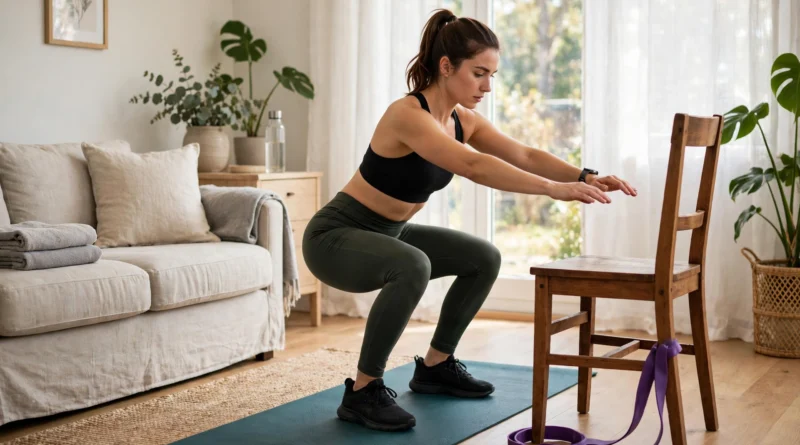
Bodyweight squat. Stand with feet about hip-width apart, chest lifted. Push your hips back as if sitting into a chair, keep your heels on the floor, and stand back up. Some forward knee movement is normal — focus on stable feet, a controlled descent, and a comfortable range. Start with 2 sets of 8-12 reps.
Sit-to-stand. The beginner version of the squat, and a genuinely useful everyday skill. Sit on a sturdy chair, feet flat, lean slightly forward, and stand without pushing off with your hands if you can. If that is hard, use your hands lightly at first and reduce the help over time.
Reverse lunge. Step one foot back, bend both knees until your back knee nearly touches the floor, then press through your front heel to stand. Reverse lunges are kinder on balance than forward lunges, which makes them a better first lunge. Do 6-10 reps per leg.
Glute bridge. Lie on your back, knees bent, feet flat. Push through your heels, squeeze your glutes at the top without arching your lower back, and lower slowly. This trains the glutes and hamstrings — the muscles that power walking, stairs, and standing up.
Step-up. Step onto a low, stable step or the bottom stair, drive through your heel, and step down with control. Alternate legs. This is strength training disguised as an everyday movement, which is exactly why it works.
Upper Body: How to Build Arm Strength and Gain Upper Body Strength
Upper-body strength is the area most people worry about at home, because pulling movements need something to pull against. The answer is a mix of pushing moves you can do anywhere, plus one band row if you have a band.
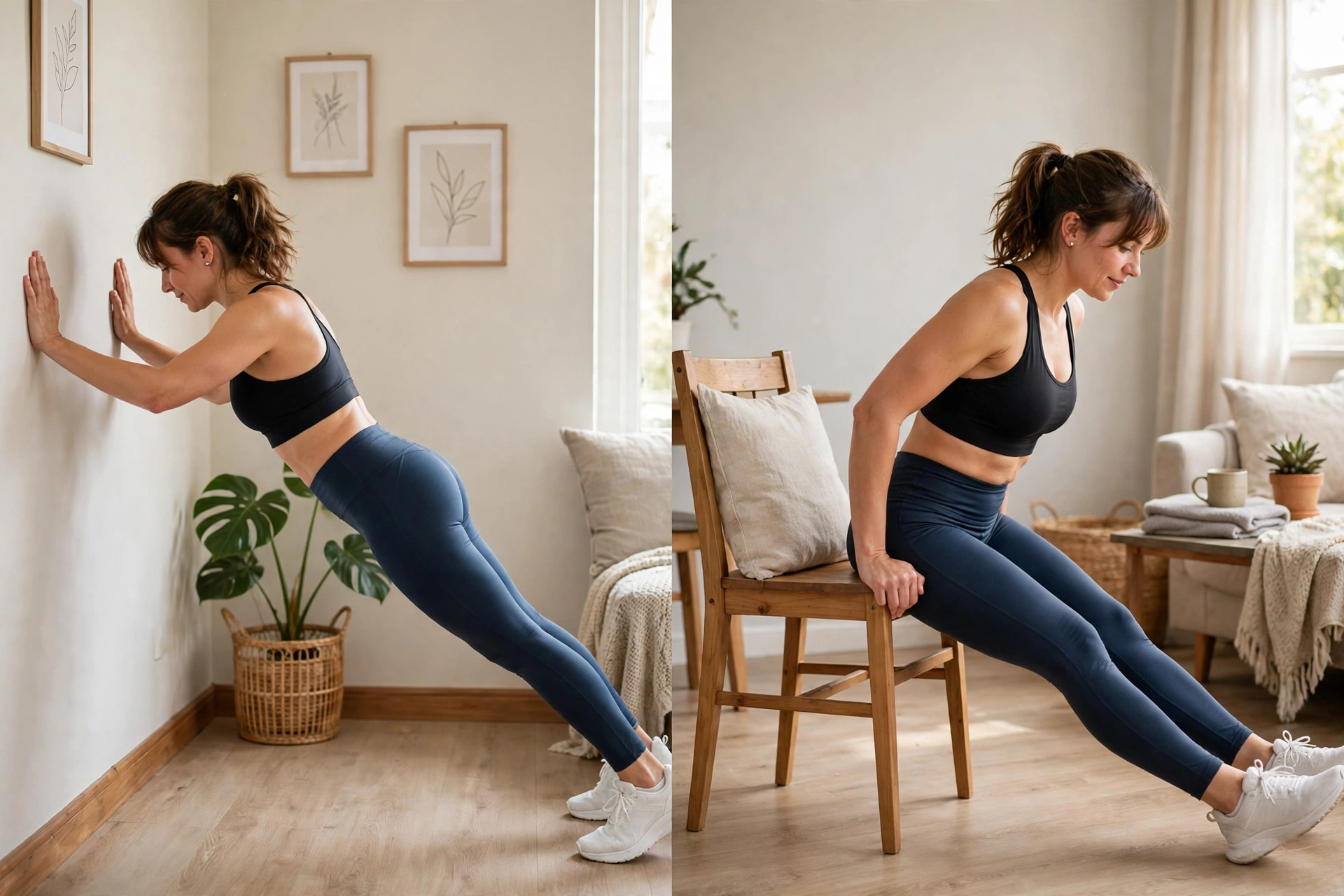
Wall push-up, then incline push-up, then knee push-up. Stand an arm’s length from a wall, hands flat at shoulder height, and bend your elbows to bring your chest toward the wall. When that feels easy, use a countertop, then the floor from your knees, then full push-ups. Each step is the same movement with more of your bodyweight behind it. Aim for 2-3 sets of 8-15 reps at whichever level challenges you.
Chair triceps dip. Sit on the edge of a sturdy chair, hands beside your hips, feet flat. Slide forward, bend your elbows to lower yourself a few inches, and press back up. Keep the range small at first — this move loads the shoulders, so control matters more than depth.
Resistance band row. Anchor a band at waist height, hold both ends, and pull your elbows back, squeezing your shoulder blades together briefly before returning slowly. Rows train the upper back and arms — the posture muscles that sitting all day neglects. If you have no band, a backpack row works: hinge at the hips, hold a loaded backpack, and row it toward your chest.
Plank shoulder tap. Hold a plank — body in one straight line from head to heels — and tap one shoulder with the opposite hand, alternating slowly without letting your hips sway. This builds shoulder, arm, and core stability at the same time. Start with 10-20 taps total.
Core: Planks and Dead Bugs
Forearm plank. Forearms on the floor, legs extended, body straight. Hold for a few breaths, rest, and repeat. A short plank with good form beats a long plank with sagging hips.
Dead bug. Lie on your back, arms toward the ceiling, knees bent at 90 degrees. Slowly lower one arm and the opposite leg toward the floor, keeping your lower back gently toward the floor, then return. Move slowly — this is a control exercise, not a speed exercise.
A Simple Weekly Plan: How Many Days, Sets, and Reps?
Here is a beginner plan that follows the CDC’s two-days-a-week minimum and leaves room to grow. Two days a week (for example, Tuesday and Friday), with at least one rest day between sessions:
- Squat or sit-to-stand: 2 sets of 8-12
- Glute bridge: 2 sets of 10-15
- Wall or incline push-up: 2 sets of 8-15
- Band or backpack row: 2 sets of 10-12
- Reverse lunge: 2 sets of 6-10 per leg
- Plank: 2 holds of 15-30 seconds
Rest 30-60 seconds between sets. The whole session takes about 20-30 minutes. After two to three weeks, add a third day or a third set — not both at once. If you want a ready-made 3-day routine to pair with this guide, our beginner workout plan lays out a full-body schedule you can follow week by week.
How Do You Know When to Make an Exercise Harder?
Progress when you can finish all your sets with good form and the last two reps still feel comfortable. That is the signal, not the calendar. Ways to progress, in order:
- More reps — from 8 to 12 to 15 at the same variation.
- More sets — from 2 to 3 sets.
- Slower reps — take 3 seconds to lower, pause, then lift.
- A harder variation — wall push-up to incline to knee to full; sit-to-stand to full squat; bodyweight to backpack-loaded.
- More resistance — a stronger band, a heavier backpack.
Change one thing at a time. If you change everything at once, you will not know what worked — or what hurt.
Do You Need to Train to Failure?
No. For beginners, stopping with one or two good reps still in reserve builds strength well and keeps form safe. Training to complete failure — where you physically cannot do another rep — does not consistently improve results for the average healthy adult, and it sharply increases the chance of sloppy form. Aim for hard but controlled on your last reps, not collapse.
Home vs Gym: Which Is Better for Beginners?
Home wins on consistency: no commute, no membership, no waiting for equipment, no self-consciousness. Gyms win on heavy loading and variety later, when bodyweight stops challenging you. Most people do best starting at home for two to three months, building the habit and the base strength, and only then deciding whether a gym adds something they actually need. There is no wrong choice here — the best programme is the one you will still be doing in three months.
Making Room: A Small Space Works Fine
You need roughly a mat-sized patch of clear floor and a wall. If your living space feels cramped, clearing one dedicated corner — and keeping it clear — removes the biggest daily excuse. Our room-by-room guide to organizing small spaces has practical ideas for freeing that corner without a full decluttering project.
Starting Later in Life or After a Long Break
The same exercises apply, with easier starting points: sit-to-stands instead of squats, wall push-ups instead of floor push-ups, shorter plank holds, and a slower progression. Gentle, regular movement maintains strength and mobility, and it pairs well with comfortable, safe travel and daily activity as you get older. If you have an injury, a condition that affects exercise, or pain that has bothered you for weeks, talk to a doctor or physical therapist before starting — general guides like this one cannot replace personal advice.
Common Mistakes to Avoid
- Skipping pulling moves. Push-ups alone create imbalance. Include rows, even band rows, from the start.
- Rushing reps. Fast, bouncy reps use momentum, not muscle. Slow down.
- Training the same muscles every day. Muscles need a rest day between sessions to recover and adapt.
- Chasing soreness. Soreness is not a score. Progress is doing more good reps than last week, not feeling wrecked.
- Holding your breath. Breathe out on the effort, breathe in as you return. If you catch yourself holding your breath, the load is probably too heavy.
FAQ
What are the best exercises for strength at home for beginners? Squats, glute bridges, lunges, push-up variations, rows, step-ups, and planks. Together they train legs, hips, upper body, and core with no gym needed.
How many days a week should I strength train at home? At least two days a week, training all major muscle groups, with a rest day between sessions. Three days is a good next step after a few weeks.
How many sets and reps should beginners do? Start with 1-2 sets of 6-15 controlled reps per exercise, depending on the move. Add sets, reps, or a harder variation only when the current version feels easy with good form.
Can I get stronger at home without any equipment? Yes. Bodyweight exercises build real strength for beginners, and household items like a backpack or water bottles can add resistance when you need it. A resistance band is the most useful first purchase.
What is the best exercise for arms without equipment? Push-ups are the best all-round choice because they work chest, shoulders, triceps, and core together. Add chair dips and plank shoulder taps for triceps and stability, and band rows for the upper back.
How long until I see results from home strength training? Most beginners feel stronger within a few weeks — stairs feel easier, carrying feels lighter — and visible changes typically follow over 8-12 weeks of consistent training. Consistency matters more than any single session.
Conclusion
The best exercises for strength at home are not exotic and not expensive: squats, lunges, glute bridges, push-ups, rows, step-ups, and planks, done two or three times a week with good form and steady progression. Start where you are — wall push-ups and sit-to-stands count — and progress one small step at a time. Strength built this way shows up everywhere: in stairs, shopping bags, posture, and confidence. Pick two days this week, clear a mat-sized space, and begin.
For the barbell versions of these moves, see our guide to compound lifts.
For a no-equipment-only routine, see our guide to bodyweight exercises for beginners.
To apply these moves to everyday life, see our functional fitness workouts guide, which organises similar exercises into squat, hinge, push, pull, rotation and carry patterns.
Combine these strength moves with regular cardio exercises to cover both halves of the weekly activity guideline.