Car Won’t Start? How to Diagnose It by Sound and Symptom — and What to Do Next
Direct Answer
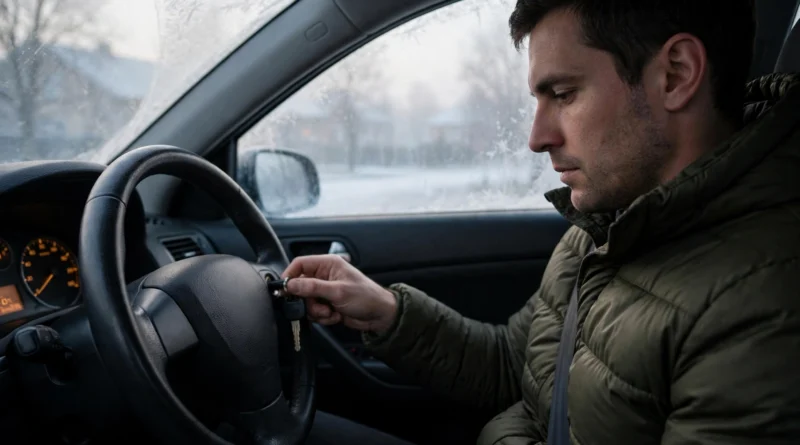
When your car won’t start, start with what happens when you turn the key or press the start button. Silence or no dashboard lights usually points to battery power or a loose connection; rapid clicking usually means a weak battery; a single loud click with no crank often means the starter; and an engine that cranks normally but never fires usually means a fuel, spark, or sensor problem. Match your symptom first, then work through the checks below in order — you will avoid replacing parts by guesswork, and you will know quickly when the job needs a mechanic.
Key Takeaways
- Diagnose by symptom, not by part: the sound and the dashboard tell you more than any guess about what failed.
- The fastest no-tool checks — Park or Neutral, key fob battery, accessories off, fuel gauge — solve a surprising number of no-starts in under a minute.
- A weak battery is the most common cause, but lights working does not prove the battery is healthy: starting needs far more current than lights do.
- A jump start is a rescue, not a diagnosis: if the car dies again or keeps going flat, the battery, alternator, or a parasitic drain still needs testing.
- Stop and call for help if you smell fuel, see smoke, hear grinding, or feel unsure around battery cables or moving engine parts.
First: Stay Safe and Do the 60-Second Checks
Before you diagnose anything, make the situation safe. Put the car in Park (or Neutral for a manual), apply the parking brake, and switch off lights, heaters, radios, and phone chargers so every bit of remaining battery power goes to starting. If you are near traffic, switch on the hazard lights. Never work under the bonnet with loose clothing or jewellery near belts and fans, and never lean over a battery that is cracked, leaking, swollen, or smells strongly of rotten eggs — call for professional help instead.
Now run the 60-second checks that cost nothing and need no tools:
- Gear position. An automatic will normally only start in Park or Neutral. If the lever is not fully in Park, push it firmly into Park and try again; if your owner’s manual allows it, try Neutral as well. A worn safety switch can also block starting in one position but not the other.
- Key or fob. With a push-button car, a dead key fob battery can mean nothing happens at all. Try the spare fob, or hold the fob against the start button — many cars have a backup spot for exactly this — and check your manual for the emergency start procedure.
- Accessories and lights. Dim or dead dashboard lights point to a power problem. Bright lights do not rule one out, as explained below.
- Fuel gauge. Check the fuel level, and remember a faulty gauge can read wrong. If you have just filled up and the car now refuses to start, contaminated fuel is worth suspecting, but do not keep cranking — that can drain the battery and flood the engine.
- Recent history. Did the car crank slowly yesterday? Did the lights dim at idle? Did you leave something on overnight? A no-start rarely arrives with no warning at all, and yesterday’s clue usually names today’s cause.
Why Won’t My Car Start? Match Your Symptom First
This table is the heart of the diagnosis. Find your row, then read only the section it points to.
| What happens when you try | Most likely area | First thing to do |
|---|---|---|
| Silence, no lights, nothing at all | Battery power or a main connection | Check terminals, try a jump start if safe |
| Rapid clicking, lights dim or flicker | Weak battery or poor terminal contact | Clean and tighten terminals, then jump start |
| Single loud click, then silence | Starter solenoid or starter motor | Check battery first, then get the starter tested |
| Slow, groaning crank that fades | Weak battery, especially in cold weather | Jump start, then test the battery and charging system |
| Cranks normally but never fires | Fuel, spark, fuse, relay, or sensor | Listen for the fuel pump, check fuses |
| Starts, then dies straight away | Alternator, fuel supply, or security system | Do not keep restarting; get it checked |
| Nothing in Drive, but starts in Neutral | Park/Neutral safety switch | Use the working position and book a repair |
Why Does My Car Click but Not Start?
Rapid, machine-gun-like clicking is the classic weak-battery sound. The starter solenoid is trying to engage but does not have enough current to turn the engine, so it clicks repeatedly while the dashboard lights dim or flicker. The cause is usually a discharged battery, a battery at the end of its life, or a poor connection at the terminals.
A single solid click is different. One loud clunk and then silence, with the lights staying bright, points more often at the starter motor or its solenoid — the part that physically turns the engine over. A bad starter usually does not dim the lights, because the battery itself may be perfectly healthy. Tapping a starter motor can occasionally free a stuck solenoid for one last start, but treat that as an emergency trick on the way to a repair, not a fix.
Battery and Terminals: The Most Common Cause
A dead or weak 12-volt battery is the single most common reason a car won’t start. Batteries lose charge when a car sits unused, when accessories are left on, or simply when the battery reaches the end of its service life — most conventional car batteries last roughly three to five years, depending on climate, driving habits, and electrical load.
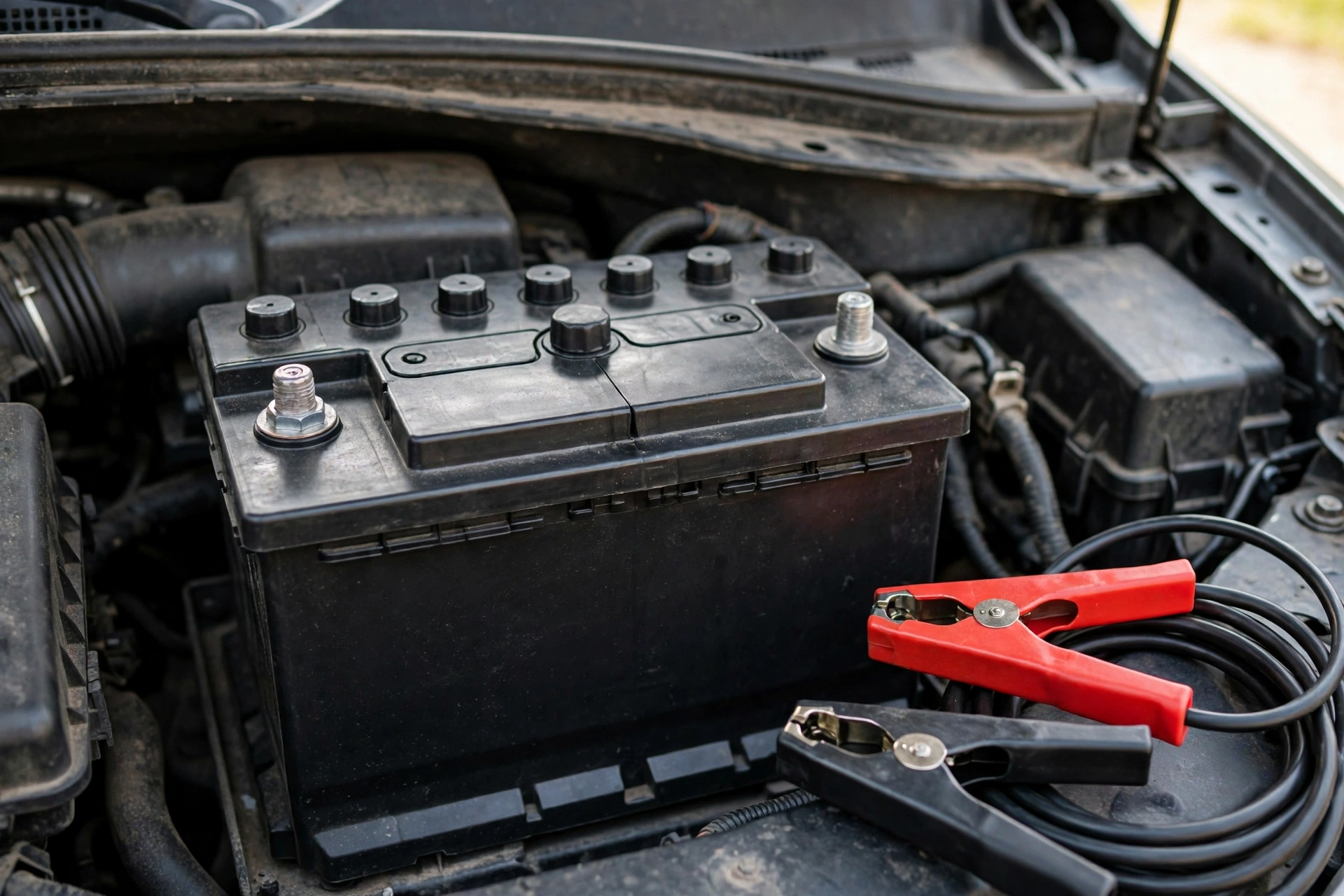
Start with your eyes. Look for white or blue-green crust on the terminals: that corrosion acts as insulation and can block the huge current the starter needs, even when the battery itself still holds a charge. Check that both terminal clamps are snug and cannot be twisted by hand. A loose clamp creates resistance, and resistance is enough to turn a healthy battery into a no-start.
If you have a multimeter, test the battery at rest with the engine off. A fully charged, healthy 12-volt battery should read around 12.6 volts or higher. A reading below about 12.4 volts suggests a discharged state, and anything below 12.0 volts is a deep discharge that will usually prevent starting. No multimeter? Many auto-parts stores test batteries free of charge, and a shop can test the alternator and charging system at the same time.
If the battery is discharged but otherwise in good condition, a jump start may get you moving. Connect the cables in the correct order — red to the dead battery’s positive terminal, red to the good battery’s positive terminal, black to the good battery’s negative terminal, and the last black clamp to clean, unpainted metal on the dead car’s engine, away from the battery itself — and follow your owner’s manual, since some newer cars have dedicated jump terminals. Our jump-start guide covers the order, the safety rules, and how long to drive afterwards. But remember: a jump start that works does not mean the problem is solved. Have the battery tested, especially if it is several years old or this has happened before.
Can a Car Not Start Even If the Lights Work?
Yes, and this is the misunderstanding that sends many drivers down the wrong path. Headlights, the radio, and the dashboard need only a small current. The starter motor needs hundreds of amps to overcome the engine’s compression and inertia. A battery can therefore have enough power for lights but not enough to crank the engine. So do not rule out the battery just because the lights come on — and do not replace the starter just because the lights are bright. Test the battery first; it is cheaper and more often the culprit.
Car Cranks but Won’t Start: Fuel, Spark, and Sensors
If the engine spins at its normal speed but never catches, the battery and starter are doing their job, and the problem moves to what an engine needs to run: fuel, spark, and compression, delivered at the right time.
- Fuel. Turn the key to the ‘on’ position without starting and listen near the rear of the car for a faint two-second whir or buzz — that is the fuel pump pressurising the system. No sound can mean a failed pump, a blown fuse, or a bad relay. Also check the obvious: an empty tank, or a gauge that reads wrong.
- Spark and ignition. Worn spark plugs, a failed ignition coil, or a faulty crankshaft sensor can all leave an engine cranking without firing. These are not beginner DIY jobs on most modern cars, but knowing the category helps you describe the fault accurately to a mechanic instead of authorising a battery you do not need.
- Fuses and relays. A single blown fuse or failed relay can cut power to the fuel pump or ignition. Your owner’s manual shows the fuse box layout; a visibly broken fuse is a cheap fix, but if it blows again, something downstream is drawing too much current and needs diagnosis.
- Security system. Some cars refuse to start if the immobiliser does not recognise the key. If the security light flashes or stays on while cranking, try the spare key before anything else.
Why Won’t My Car Start in Cold Weather?
Cold weather is the season when weak batteries finally give up, and it is why this problem peaks in winter. Cold reduces the cranking power a battery can deliver, while the engine itself becomes harder to turn because its oil is thicker — and if you have not checked your oil lately, that thicker oil adds drag at exactly the wrong moment. That is why a battery that limped through autumn fails on the first freezing morning.
Heat deserves some blame too, even though it shows up later: high temperatures accelerate the chemical deterioration inside a battery, so a battery weakened by summer heat often fails in winter cold. The practical lesson is simple: test an ageing battery before winter, not after it strands you. Short trips make things worse, because five or ten minutes of driving may not replace the charge used by starting, especially with heaters, lights, and heated seats running. If your car needed a jump, a twenty-minute drive does not necessarily mean the battery is fully recharged — get it tested.
Is It the Battery, the Starter, or the Alternator?
These three get confused constantly, so here is the quick separation:
- Battery: slow crank, rapid clicking, dim lights, problems after the car sat unused, or a battery more than three to five years old. Jump starting helps, at least temporarily.
- Starter: single click or grinding noise, lights stay bright, jump starting does not help, and the problem is the same whether the battery is fresh or not.
- Alternator: the car starts with a jump but dies again soon afterwards, the battery keeps going flat even though it tests healthy, or the battery warning light comes on while driving. The alternator recharges the battery while the engine runs; when it fails, the car runs on battery power alone until that runs out. This needs a shop test, not another jump.
If the battery repeatedly goes flat despite testing healthy, something may also be drawing power while the car is parked — a light left on, a faulty module, or an aftermarket accessory. A mechanic can measure that parasitic drain; guessing at it wastes batteries.
Car Won’t Start After a Jump Start: What Next?
If a careful jump start does not help, stop after two attempts. Repeated cranking drains both batteries and can overheat the starter. Work through this order instead: re-check that the clamps are tight and on the right terminals, try the spare key, confirm the car is fully in Park or Neutral, and listen for the fuel pump hum. If the engine cranks normally but never fires, you are in fuel or spark territory. If there is a single click and nothing else, suspect the starter. If nothing happens at all even with a known-good donor battery, suspect a main connection, a main fuse, or the starter circuit — all shop jobs. And if the car starts with a jump but dies within minutes, suspect the alternator and do not drive far: you may not be able to restart.
When to Stop Trying and Call a Mechanic
Call for help rather than keep trying if any of these apply: you smell fuel, you see smoke, you hear grinding or metal-on-metal noises, the battery is damaged or leaking, the engine overheated before it stopped, or you simply feel unsure around battery cables or moving parts. A tow to a shop is cheaper than a damaged starter, a flooded engine, or a ruined battery. When you call, report the symptom in the table’s language — ‘rapid clicking, lights dim’ or ‘cranks normally but won’t fire’ — because that sentence alone tells the technician where to look first.
How to Prevent a No-Start
Most no-starts are preventable with a few habits. Have the battery tested once a year after it turns three, and replace it before winter if it is weak rather than after it fails. Keep the terminals clean and tight, and check them whenever you check your oil — a monthly look under the bonnet catches corrosion early. Turn off lights, heaters, and accessories before switching off, and avoid repeated very short trips in winter when you can combine errands into one longer drive. Finally, keep a set of jumper cables or a portable jump starter in the car, and know where your owner’s manual puts the jump points before you need them in the dark.
FAQ: Car Won’t Start
Why wont my car start all of a sudden?
The most common sudden cause is a battery that was already weak and finally dropped below the current the starter needs — often overnight, often in cold weather. Loose or corroded terminals and a car left in Drive rather than Park are the other sudden, simple causes. Check those before assuming a major failure.
Why does my car make no sound at all when I turn the key?
Total silence with no dashboard lights usually means a complete loss of electrical power: a dead battery, a disconnected or badly corroded terminal, or a blown main fuse. Check the terminals first, then try a jump start if it is safe to do so.
How long do car batteries last?
Most conventional car batteries last roughly three to five years. Climate, driving habits, battery type, and electrical load all shift that range, and heat damage in summer often shows up as a winter failure.
Will a jump start fix my car?
A jump start rescues a discharged battery, but it does not repair a worn-out battery, a failed alternator, or a bad starter. If the car needed a jump, get the battery and charging system tested before you trust it again.
Can I push start my car?
Only a manual-transmission car can potentially be push started, and only if the battery still has enough power for ignition and fuel delivery. Never try to push start an automatic — it will not work and can damage the transmission. Check your owner’s manual first.
Further reading: a step-by-step car won’t start diagnostic and common causes, fixes, and a jump-start guide.
If your car keeps failing to start and you are weighing whether to repair it or replace it, our guide to the best used cars to buy shows how to check a replacement car’s title, history, recalls, and inspection before you pay.
Once the car is running again, it is worth checking routine maintenance too: see our guide to how often you should change your oil for the mileage and months intervals for synthetic, blend and conventional oil.
If the car starts but runs rough or a warning light stays on, see our guide to why your check engine light is on and what to do next.