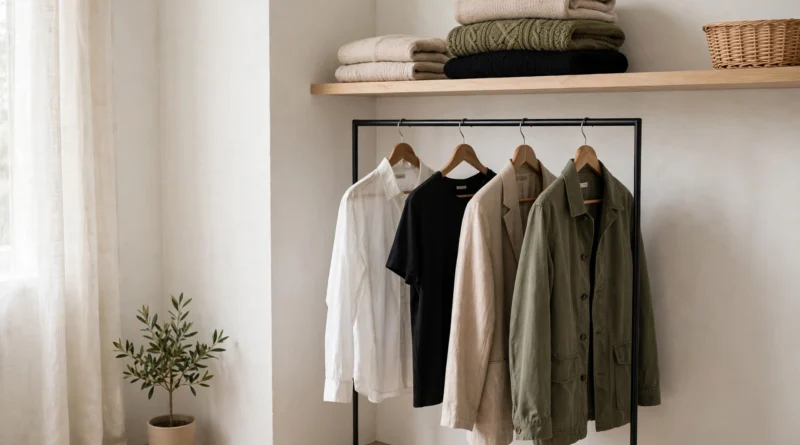
Minimalist Clothing: How to Build a Capsule Wardrobe That Actually Works
Direct Answer
Minimalist clothing means owning fewer, better-chosen pieces that all work together, so getting dressed is fast and almost everything you own actually gets worn. The simplest way to do it is to build a capsule wardrobe: start with the clothes you already own, keep only pieces that fit well and pair with at least two other items, choose a small colour palette, and buy only to fill specific gaps. You do not need to throw everything away, buy expensive basics, or count to an exact number of items.
Key Takeaways
- Minimalist clothing is a system, not a number: versatility and fit matter more than owning very little.
- Start from your own closet, not a shop: most people already own the core of a working capsule wardrobe.
- Keep a piece only if it fits, suits your real week, and pairs with at least two other kept pieces.
- Choose two neutrals plus one or two accents, so tops, bottoms and layers mix freely.
- Buy only to fill a named gap, and rotate seasonally instead of rebuilding from scratch.
What Is Minimalist Clothing?
Minimalist clothing is clothing chosen on purpose rather than collected by habit. Instead of a wardrobe full of one-off pieces that only work with one outfit, a minimalist wardrobe is built around versatile essentials in a limited palette: plain tops, well-fitting trousers or jeans, a jacket that goes with most of it, and shoes you can walk in all day.
It is not about wearing only black, owning almost nothing, or looking the same every day. Colour, pattern and personality still belong in minimalist clothing — they just need to earn their place by pairing with several other pieces. A bright top that works with your jeans, your trousers and under your jacket is a minimalist piece. A bright top that only works with one skirt you rarely wear is not, however much you like it in the shop.
The real benefit is practical. Fewer decisions in the morning, less laundry confusion, less money spent on duplicates, and a closet where you can actually see what you own. That is why minimalist clothing pairs so naturally with the rest of a tidy home: once your clothes have a system, keeping the closet itself tidy becomes much easier, as covered in our guide to how to organize small spaces.
What Is a Capsule Wardrobe?
A capsule wardrobe is a small, curated set of versatile clothing items chosen so that nearly every piece can be combined with several others. Most guides describe a capsule as roughly 25 to 50 pieces per season, including shoes and outerwear, but there is no official rule — the number is a guide, not a test you pass or fail.
The idea is simple: instead of asking “do I like this item?”, ask “how many outfits does this item make with what I already own?” A white shirt that works with jeans, trousers and a skirt, under a blazer and a cardigan, is doing far more work than three tops that each work with only one bottom.
A capsule wardrobe is usually built for a season — spring, summer, autumn or winter — and then rotated. Out-of-season pieces are stored away, which keeps the visible wardrobe small even if your total collection across the year is larger. That seasonal rhythm is also what stops a capsule from feeling restrictive: you are not giving clothes up forever, you are choosing this season’s working set.
Capsule Wardrobe vs Minimalist Wardrobe: What Is the Difference?
People often use these two terms as if they mean the same thing, but they describe different things. A capsule wardrobe is defined by versatility and curation: pieces chosen to work together as a system. A minimalist wardrobe is defined by low quantity: simply owning fewer clothes.
They often overlap, but they are not identical. You can own a 60-piece wardrobe that works as a capsule, because every item pairs with several others in a coherent palette. You can also own a 15-piece wardrobe that is not a capsule at all, because the pieces do not pair well together and several outfits are impossible.
So do not judge your wardrobe by its size alone. Judge it by a better question: can you make many different outfits from it without thinking hard, and does every piece get worn regularly? If the answer is yes, you already have the heart of minimalist clothing, whatever the exact count.
How Do I Start a Capsule Wardrobe From Scratch?
Start with what you already own, not with shopping. This is the step most people skip, and it is why so many capsule attempts end with a pile of new basics that still do not go together. Set aside a few hours and work through these steps in order. For a detailed walkthrough, see this step-by-step guide to building a capsule wardrobe.
- Define your real week. Write down what a normal week actually looks like: how many work days, what the dress code is, how often you exercise, go out, or travel. Your capsule should serve that week, not an imaginary one.
- Pull everything out and sort honestly. Sort into keep, maybe, and let go. A keeper must pass three tests: it fits well right now, you have worn it in the past year, and it pairs with at least two other keepers. Anything that fails all three is a candidate to donate, sell or store elsewhere.
- Find your palette. Look at your keepers and notice which colours repeat. Most working capsules use two neutrals — such as black, white, grey, beige, navy or olive — plus one or two accent colours for tops and knitwear. You do not need to buy a whole new palette; start from the neutrals you already wear most.
- List the gaps, then buy only those. A gap is specific: “a dark pair of trousers that works with my white shirt and my blazer”, not “more tops”. Shopping from a gap list stops duplicate buying and keeps minimalist clothing affordable at any price point.
- Try it for two weeks before changing anything. Wear only the capsule, notice which pieces you reach for and which you avoid, and adjust after that trial — not after one awkward morning.
How Many Clothes Should I Have in a Capsule Wardrobe?
There is no single correct number, and anyone who gives you one exact figure is selling a formula, not a system. Common guides suggest 25 to 50 pieces per season, while smaller starter capsules use as few as 12 to 15 pieces. Both can work, because the right number depends on your climate, your job, how often you do laundry, and how much variety you personally want.
A useful way to think about it is by coverage, not counting. Your capsule should cover: work, casual days, one smarter outfit, exercise or outdoor wear if you need it, and the weather for that season. If every part of your week is covered and every piece pairs with others, the number is right for you.
How many clothes should a woman have in her wardrobe?
The same coverage test applies, and there is no separate rule for women. A women’s clothing capsule is simply a capsule built around the pieces a particular woman actually wears — dresses or skirts may replace some trousers, or sit alongside them, but the system is identical: fit, palette, pairing, and gaps.
If you are starting out, a 30-piece seasonal capsule is a sensible middle ground: enough variety that you do not feel you are wearing a uniform, small enough that every piece is visible and gets worn. If laundry is weekly and your week is mostly casual, you may need fewer. If your work requires formal dress several days a week, you may need more — and that is fine. Minimalist clothing adapts to your life; your life does not have to shrink to fit a number.
And no, a capsule wardrobe does not have to be small in the sense of bare or uncomfortable. As long as every piece is loved, fits, and mixes with others, a larger capsule still counts. The goal is no dead-end pieces, not an empty rail.
A Starter Capsule: The Pieces That Do the Most Work
Use this table as a checklist, not a shopping list. Tick off what you already own first, and only shop for the missing rows.
| Category | Starter pieces | Why they earn their place |
|---|---|---|
| Tops | White shirt, plain tee in a neutral, one accent knit | Each pairs with every bottom below |
| Bottoms | Dark jeans, tailored trousers, one skirt or second trouser | Cover casual, work and smarter days |
| Layers | Blazer or tailored jacket, cardigan or light jacket, one coat | Turn the same outfit up or down |
| Shoes | Everyday shoes you can walk in, one smarter pair | Shoes decide whether an outfit is wearable all day |
| Accessories | One bag, one scarf or belt | Add variety without adding bulk |
Notice what is missing: trend pieces, duplicates of the same item in three colours, and anything that needs a special occasion to justify itself. Those are the items that quietly fill a closet without ever making an outfit easier.
Where Can I Buy a Capsule Wardrobe?
You cannot really buy a capsule wardrobe ready-made, and you should be wary of any shop that claims to sell you one in a single box. A capsule has to fit your body, your week and your climate, so a fixed set chosen by someone else will almost always include pieces you do not need and miss pieces you do.
The practical answer is: build it from your own closet first, then buy individual gap pieces from wherever you normally shop for basics that fit you well. That could be a high-street shop, an online retailer with easy returns, or second-hand shops for classic pieces. What matters is fit, fabric you are happy to wear repeatedly, and a return policy that lets you check the piece against your existing capsule at home.
Buy one gap at a time, try it with at least three existing outfits before removing the tags, and keep the receipt until you are sure. That one habit alone will save more money than any capsule-wardrobe bundle.
What Is a Capsule Collection?
A capsule collection is a related but different idea from a capsule wardrobe. In fashion, a capsule collection is a small, limited collection released by a brand or designer — often a seasonal edit, a collaboration, or a set of pieces designed around one theme. It is a product range, not a personal wardrobe system.
The confusion is understandable, because the words overlap. Just remember: a capsule wardrobe is what you build for yourself from clothes you own; a capsule collection is what a brand sells. You can buy individual pieces from a capsule collection if they fill a gap in your wardrobe, but buying a whole collection does not automatically give you a capsule wardrobe.
How Do I Build a Capsule Wardrobe on a Budget?
Minimalist clothing does not require expensive basics. Fit and colour coherence matter far more than price tags, and a capsule built from what you already own costs nothing to start.
If you do need to buy, set a gap list and a limit per gap, and shop second-hand first for classic pieces such as blazers, coats and jeans, where quality second-hand often beats cheap new. Avoid the trap of replacing everything at once: the most expensive capsule is the one you build in a single weekend and then abandon because half of it does not suit you.
Also, use what you already have in your home. Storing out-of-season pieces properly — folded, clean, and out of the way — makes a small closet feel much larger, which is why capsule wardrobes work so well alongside good small-space storage, as in our guide to the best storage solutions for small apartments.
How Do I Rotate a Capsule Wardrobe by Season?
At the end of a season, take out the pieces you did not wear and ask why. Were they the wrong weight, the wrong colour for your palette, or simply not your style? Those answers shape next season’s capsule far better than any list.
Then store the out-of-season set, bring in the next season’s pieces, and check the gaps again. You will usually find that only two or three items need replacing each season, not a whole wardrobe. Over a year, that is how minimalist clothing stays minimal: small, deliberate top-ups instead of constant large shops.
For work and weekends, the same capsule can usually serve both if you choose layers carefully. A blazer over a tee and jeans is a weekend outfit; the same blazer over a shirt and tailored trousers is a work outfit. The pieces do not change — the combination does. That is the whole trick, and once you see it, getting dressed stops being a daily puzzle.
Conclusion
Minimalist clothing works when you stop counting items and start building a system. Keep what fits and pairs well, choose a palette you can mix freely, buy only to fill named gaps, and rotate by season. Start today with the closet you already have: pull out one drawer, apply the three keeper tests, and see how much of your capsule is already waiting there. To take the same approach beyond your wardrobe, see how to become a minimalist. The same simplify-to-what-works idea applies beyond the closet too, including a skin care regimen.
FAQ
How many pieces should a capsule wardrobe have? Most guides suggest 25 to 50 pieces per season, but the right number is the one that covers your real week with every piece pairing with others. Start with coverage, not a count.
Does a capsule wardrobe have to be small? No. It has to be curated: every piece should be worn regularly and pair with several others. A larger capsule with no dead-end pieces still counts as a capsule.
Can I keep colours and prints in a minimalist wardrobe? Yes, if they pair with your neutrals. One or two accent colours, and prints that work with your plain pieces, add variety without breaking the system.
How do I start a capsule wardrobe with no money? Start from your own closet: sort, keep the versatile pieces, store the rest, and wear only the capsule for two weeks. Only buy later, and only to fill a specific gap.
Apply the same fewer-but-better idea to your home with our guide to minimalist furniture.
For interiors, the bold opposite is maximalist wallpaper.